More than 500,000 British households have stopped paying the BBC licence fee in the past year – as its chairman admitted major ‘broadcasting errors’ are eroding public trust.
The falling number of people paying the £180-a-year levy, which rose by £5.50 in April, has been identified as the BBC’s biggest funding risk in its annual report released today.
There are now 23.3 million TV licences in force across the UK – down by 540,000 over the past 12 months – with the decline accelerating, according to figures published by the broadcaster.
The annual fall is almost double that recorded a year earlier, when around 300,000 licences were lost. The report warned of a ‘steeper projected decline’ in the years ahead.
While 94 per cent of adults use BBC services per month, fewer than 80 per cent of households pay the licence fee.
With the BBC’s licence fee income down by around £1.2billion since 2017, chairman Samir Shah has admitted that major broadcasting errors, including those at Glastonbury and the BAFTA Film Awards, ‘affect confidence in our journalism, trust in the BBC as a public institution and perceptions of how effectively we are held to account’.
President Trump is suing the BBC for at least $10billion in damages after Panorama edited a speech to make it look like he encouraged supporters to storm the Capitol.
It came weeks after a Labour plot to extend the licence fee to households who only watch streaming services such as Netflix, Amazon Prime, Disney+ and Apple TV was branded ‘outrageous’ by critics as the BBC’s current Royal Charter is due to expire at the end of 2027.

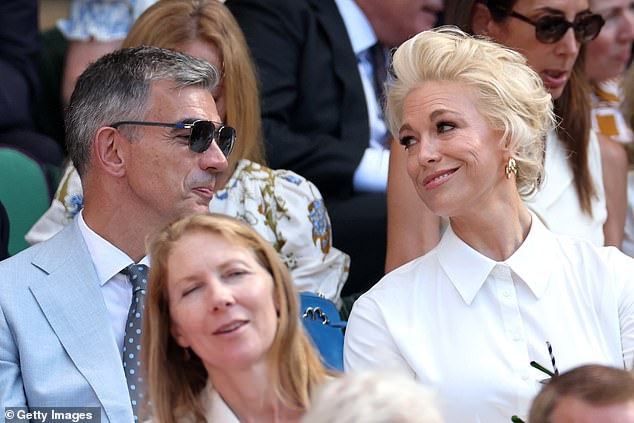
BBC Director General Matt Brittin, pictured in the Royal Box at Wimbledon with actress Hannah Waddingham, has said that the drop in people paying the licence fee is a ‘moment of real jeopardy’ for the corporation
New director-general Matt Brittin has described the broadcaster as facing a ‘moment of real jeopardy’. Suggesting reform is needed, he said the current licence fee model ‘ties us to the past’.
He added: ‘The BBC has proved throughout its history how quickly it can reinvent itself to serve the needs of audiences. We need, collectively, to call on that sense of urgency now.’
The sharp decline comes as Culture Secretary Lisa Nandy signalled her support for extending the licence fee to people who only use streaming services.
The BBC’s income has fallen by around a quarter over the past decade. The licence fee currently generates roughly two-thirds of the corporation’s £5.9billion annual income.
The annual report said: ‘Licences declined by almost 540k across the year, with 23.3 million in force at year end, with the decrease predominantly driven by a decline in households requiring a TV licence due to not consuming licensable content.
‘Total households declaring ‘no licence needed’ increased by 62,000 in 2025/26 to a total of 3.7 million households.’
The previous annual report showed there were 23.8 million licences in force.
As well as there being a drop of more than half a million year on year, the number has fallen by more than 2.5 million since the start of the decade, when it stood at 25.9 million.
Speaking to the press after the release of the report, BBC chief financial officer Bérangère Michel said: ‘We’ve got some data behind that, and we’ve done some estimates behind that, and we can see that the large majority of the reason for the decline is people… not consuming licensable content.
‘That is a trend that I don’t see changing back. In fact, I see it accelerating, and that is one of the reasons why we would like a reform of the funding.’
The annual report says the BBC’s financial outlook ‘deteriorated’ in the second half of 2025.
It adds: ‘A steeper in projection decline of licence fees sales combined with cost inflation and a challenging commercial trading environment has exacerbated the gap between income and costs.’
The annual report outlines the challenges the organisation is facing and states the BBC will not be able to sustain its public service mission in the future, without reform of its funding model.
Last month, the BBC announced plans for savings across the news, nations and content divisions, which is set to deliver £160million of £500million in savings needed by 2028/29.
In response to the figures, Public Accounts Committee chairman Sir Geoffrey Clifton-Brown said: ‘The BBC continues to face a steady decline in licence fee sales, with 587,000 fewer licences this year, offset by higher charges for those who do pay.
‘It is still struggling to attract younger audiences, who increasingly favour subscription services and video-sharing platforms over traditional broadcast content.
‘The committee has previously criticised the BBC’s licence fee enforcement and called for a clear evasion target, a recommendation the BBC declined to adopt. This issue remains acute, with an estimated £525 million lost this year to evasion.
‘Alongside this, the BBC has set ambitious savings targets: £700 million by 2028 and a 10 per cent reduction in licence fee-funded activity by 2029.
‘Delivering these efficiencies will be critical to securing long-term financial sustainability as the current charter period draws to a close in December 2027.’
BBC chairman Samir Shah said the report ‘sets out in detail the considerable pressures now faced by the BBC – not least the question of future funding’.
He added that the current funding model also meant the BBC ‘cannot maintain its public service mission’.
‘The new charter must ensure that the BBC can continue to be a universal public service media organisation of scale,’ he said.
‘We have to remember that the BBC is, and always has been, so much more than simply a broadcaster. It is a fundamental public good.
‘It delivers unique benefits to audiences and to the whole of the UK – for our society, our economy, and our democracy.’
You do not currently need a TV licence to binge watch shows such as Stranger Things on services like Netflix, The Boys on Amazon Prime or Slow Horses on Apple TV.
It is only if homes stream live TV such as Champions League football or boxing via a streaming subscription they are required to pay the licence fee, which went up to £180 in April.
Speaking to the Culture, Media and Sport Committee, Lisa Nandy said: ‘[The streamers] would be reluctant to see additional charges on their consumers, but I think they would be more reluctant to see additional charges on their businesses.
‘We don’t want to deter investment to the UK. Some of the biggest streaming companies are here investing in very big numbers right across the country partly because of British creativity, partly because of the BBC but also because everyone is on the hunt for locally rooted stories with universal appeal and the UK is brilliant at that.’
During the evidence session yesterday, Ms Nandy reiterated that no decision has been made on how the BBC will be funded in future, but she has ruled out a levy on streamers, a tax on households and a flat tax on households.
‘Once the BBC is gone, we will regret it and so this charter is the most important of its kind because we’ve ducked the question about how to put it on a sustainable footing for too long,’ she added.
‘We’re trying to achieve a situation in which the BBC is sustainable, that it can continue to not just survive but thrive, and that those of us who are using it are paying for it.’

Currently people do not need a TV licence to watch ‘on-demand’ shows such as Stranger Things on services like Netflix – but Labour may change this

Amazon Prime hits such as The Boys would also require a £180-a-year licence fee payment, despite not being live TV
Critics say it would be a ‘desperate’ move by Keir Starmer’s Government to make Britons pay the £180-a-year licence fee, even if they only watch on-demand TV via a rival streamer.

Lisa Nandy has backed expanding the BBC licence fee to include those who only use streaming services such as Netflix and Disney+
John O’Connell, chief executive of the TaxPayers’ Alliance, told the Daily Mail: ‘Forcing streaming service subscribers to pay the licence fee would be an outrageous expansion of an already deeply unpopular tax.’
An expansion of the licence fee to cover subscribers to services such as Netflix is the preferred option for Labour, industry sources involved in the talks over its future from December 2027 say.
‘It’s pretty desperate to argue that everyone should be made to pay for the BBC whether they watch it or not,’ a streaming source with knowledge of negotiations said recently.
‘The BBC needs to think more radically and creatively about how to generate income in ways that don’t undermine universal access.’
The Government is said to be wary of funding the BBC with advertising or a new subscription model because it would hurt ITV and Channel 4.
Instead, a blanket approach, where the licence fee is expanded to cover all streaming platforms, could be imposed when the current BBC charter ends in December 2027, according to a report in The Times.
An industry source has said that ministers favour this ‘expansive approach’ to the licence fee over an advertising model.