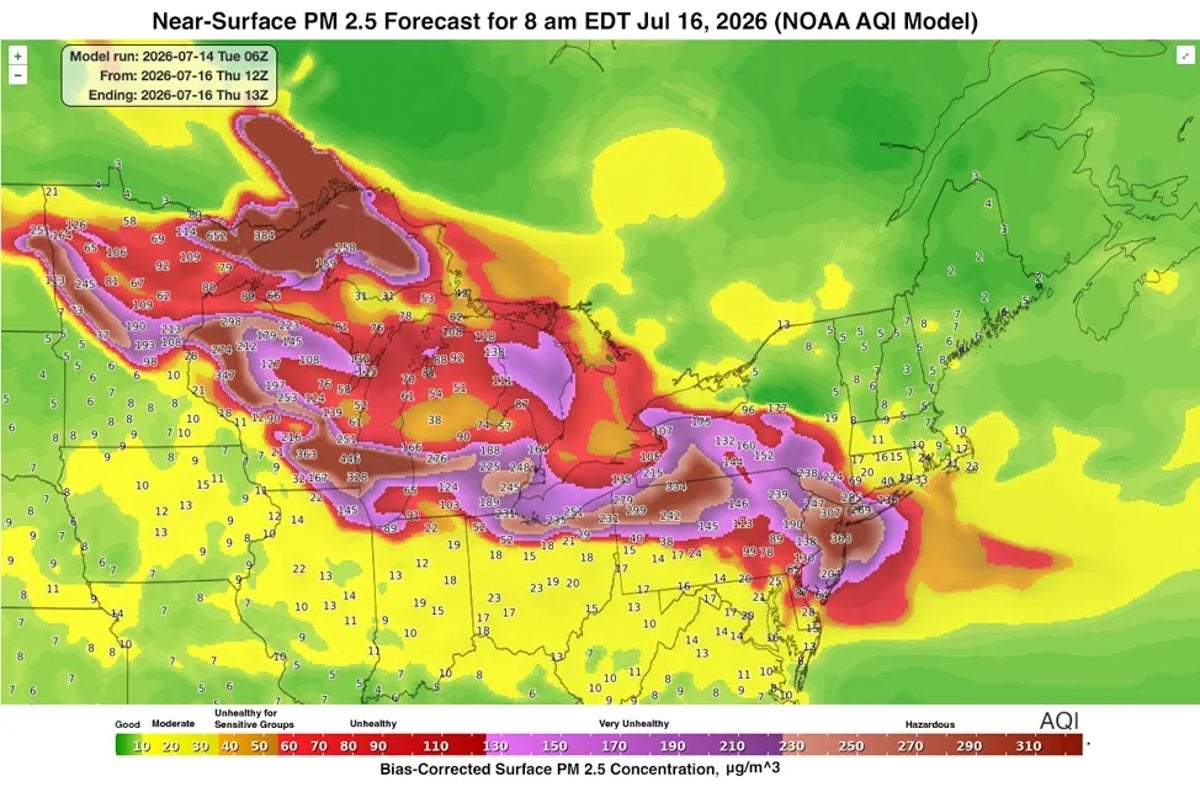
Wildfires in Minnesota are spewing dangerous smoke into the air that could soon pose a major air pollution threat to millions living in major U.S. cities such as Detroit, Milwaukee, Cleveland, Philadelphia and New York City.
Currently, the smoke is relatively high up in the atmosphere. But a National Oceanic and Atmospheric Administration forecast suggests that could soon change: The area of high pressure that is causing yet another heat dome over the central U.S. is resulting in a clockwise flow of air that will push that smoke down to ground level and toward the southeast over the next couple of days. People in its path could experience unhealthy to hazardous levels of PM2.5 pollution—small, dangerous particles in smoke that can be breathed deeply into the lungs. For context, in the color-coded Air Quality Index, red indicates “unhealthy,” while brown indicates “hazardous.”
Read more: How to Use the Air Quality Index
On supporting science journalism
If you’re enjoying this article, consider supporting our award-winning journalism by subscribing. By purchasing a subscription you are helping to ensure the future of impactful stories about the discoveries and ideas shaping our world today.
Exactly how high the pollution levels will be and how long poor conditions may last is still somewhat uncertain: “Forecasting wildfire smoke is HARD, and model forecasts are often way off—either high or low,” wrote meteorologist Jeff Masters in a Bluesky post. “The models are in their infancy, and have to get the meteorology, fire behavior and atmospheric chemistry right.”
Smoke could also make for hazy orange skies because the particles tend to scatter blue light but allow orange and red wavelengths to pass through.
The fires in Minnesota are unusual for this time of year, which is generally a wet period—fire season typically comes in spring or fall. But drought and exceptionally hot weather have left vegetation parched, which has made it primed to burn with any spark. Some such sparks came from lightning that passed through the Boundary Waters Canoe Area Wilderness and Superior National Forest last week. Steady winds have fanned the flames. Parts of those parks have been closed to visitors, and Minnesota’s governor Tim Walz has declared an emergency to allow the National Guard and other resources to assist with the fires.
The smoke from the fires could pose an air pollution problem periodically over the next 10 days, Masters notes. The best way to protect yourself from smoke is to limit time spent outdoors, wear an N95 mask when you do have to be outside and when air pollution is high, keep doors and windows closed and well sealed and run air purifiers inside.
It’s Time to Stand Up for Science
If you enjoyed this article, I’d like to ask for your support. Scientific American has served as an advocate for science and industry for 180 years, and right now may be the most critical moment in that two-century history.
I’ve been a Scientific American subscriber since I was 12 years old, and it helped shape the way I look at the world. SciAm always educates and delights me, and inspires a sense of awe for our vast, beautiful universe. I hope it does that for you, too.
If you subscribe to Scientific American, you help ensure that our coverage is centered on meaningful research and discovery; that we have the resources to report on the decisions that threaten labs across the U.S.; and that we support both budding and working scientists at a time when the value of science itself too often goes unrecognized.
In return, you get essential news, captivating podcasts, brilliant infographics, can’t-miss newsletters, must-watch videos, challenging games, and the science world’s best writing and reporting. You can even gift someone a subscription.
There has never been a more important time for us to stand up and show why science matters. I hope you’ll support us in that mission.