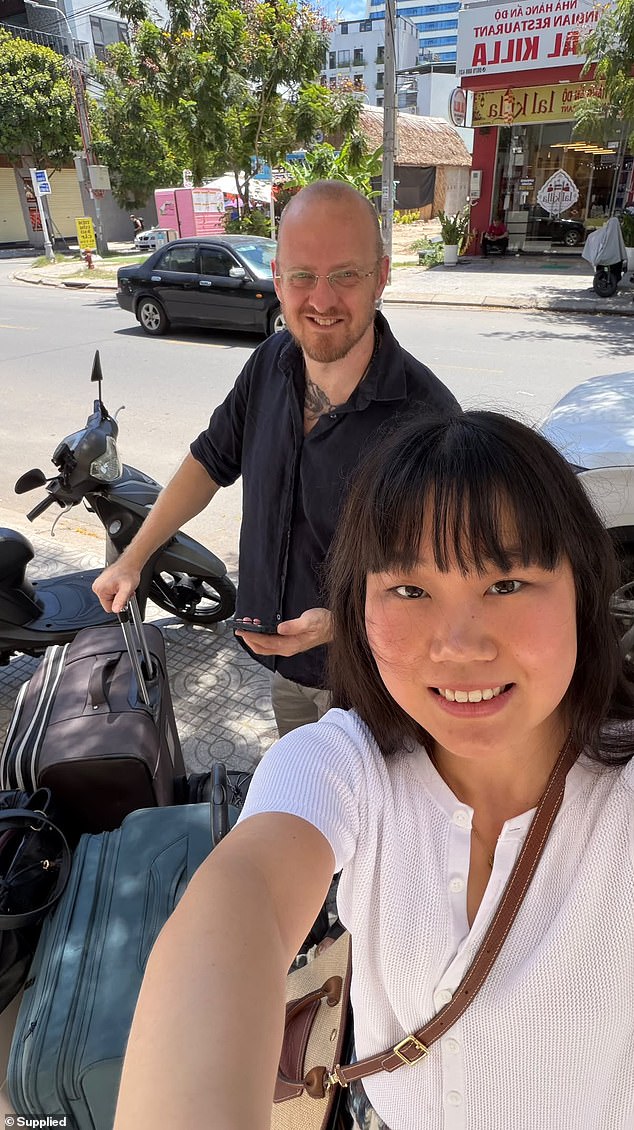
An entrepreneur couple have claimed they have been forced to give up on their ‘Australian dream’ and build their start-up overseas because it is too expensive.
Nancy Cao, who co-founded technology company Musefunnel with Canadian-born Kether Saturnius in 2025, told Daily Mail the cost-of-living crisis was the biggest reason the pair decided to move to Southeast Asia.
‘Everyone keeps saying that we’re lucky to live in Australia, but right now, if you’re trying to build a business, it’s starting to feel a bit like a nightmare, which is why we’re actually packing up our bags and leaving Sydney to go build our startup,’ she said.
‘We are becoming location independent rather than relocating permanently to one country, but we’re exploring Southeast Asia as a region and are currently based in Vietnam for the next three months.
‘The cost of living is a fraction of what it is in Sydney, which means we can keep our costs low, stay focused, and build without the constant financial pressure that comes with operating from one of the world’s most expensive cities.’
The daughter of Chinese immigrants said the move made it easier for the couple to focus entirely on the company.
‘When you’re building something from scratch, creativity and clear thinking matter,’ Ms Cao said.
‘If you’re constantly worried about rent, bills and the cost of simply existing, your attention is pulled away from the business.

An entrepreneur couple have claimed they have been forced to give up on their ‘Australian dream’ and build their start-up overseas because it is too expensive

Nancy Cao, who co-founded technology company Musefunnel with Canadian-born Kether Saturnius in 2025, told Daily Mail the cost-of-living crisis was the biggest reason the pair decided to move to Southeast Asia
‘Lowering our personal and business costs gives us more time, more focus, and more room to make better decisions.’
Ms Cao said discussions with venture capital investors ultimately proved to be the final nail in the coffin, leading them to give up on the ‘Australian dream’.
‘The tipping point came while speaking with investors in Sydney,’ she said.
‘We tried to convince investors to give us some money, but most of the ones we spoke to weren’t offering enough to support even one person on a full-time salary.
‘We decided it was more rational to self-fund, reduce our cost base, and build from Southeast Asia while we validate the business.’
Ms Cao said Australia did have its advantages.
‘It’s stable, highly educated, and has strong institutions, but it is not an easy place to build a cost efficient technology business from the ground up,’ she said.
‘The cost of running a business is high, the market is relatively small, and early-stage funding can be conservative.’

Although the cost of living played a major role in their decision to relocate, Ms Cao said discussions with venture capital investors ultimately proved to be the final nail in the coffin
While running Musefunnel from Sydney has its benefits, Ms Cao said advances in AI meant that wasn’t necessary anymore, making a move abroad more cost effective to run the business.
‘AI has made it possible for a very small team to do work that previously required a much larger product and engineering team,’ she said.
‘What may have once required a million dollar build can now be done with a far leaner budget if the founding team has the right technical and commercial capabilities.
‘For us, that means we don’t need to be in Sydney to hire a large team and between the two of us, we can cover the technical and commercial sides well enough to get much further before taking on external capital.’
If the pair were to start their company in Australia, Ms Cao said the country would have to become a more founder-friendly place to build from, especially at the earliest stages.
‘That means making it cheaper to run a business, encouraging investors to take more risks and recognising that not every technology company needs large amounts of funding from day one,’ she said.
‘Until Australia becomes more competitive on cost and more ambitious in how it backs early-stage founders, it will be hard to justify building from there when we can grow faster and keep costs down.’