


Last March, the Royal Mail posted a short advert on Facebook and Instagram, reminding viewers to send a card for Mother’s Day.
Touching or cheesy, depending on one’s taste, the 20-second film portrayed a young mum chastising her daughter for having an untidy bedroom – only to realise that she’d been scolded in precisely the same way when she was a girl.
Few of its 14,000 viewers would have found anything unusual about it. However, close observers might have noticed something strange about the woman who played the mother.
For one thing, she looked far too young and glamorous for the role. Though filmmakers strove to make her appear dowdy, dressing her in jeans, a jumper, and heavy-rimmed glasses, they couldn’t disguise her high-cheek-boned beauty.
Though she spoke only three words – barking at her daughter to ‘tidy your room’ – she also had a distinctive East European accent.
In short, she would have been more convincing as the femme fatale in a James Bond honeytrap scene than a suburban British housewife remembering to post a letter. Today I can reveal the poignant, and in many ways astonishing story behind this incongruous casting.
Barely 18 months ago, the alluring blonde in the ad, 28-year-old Marie Jedlickova, was living in Cumbria with her fiancé, Max Talich. Her lifestyle was wholesome and uncomplicated: she worked for a marketing company and hiked in the Lake District hills.
However, after reaching the final of the Miss Czech Republic contest in 2023, she had been introduced to her country’s fourth-richest man – the Royal Mail’s controversial new owner, Daniel Kretinsky, whose fortune is estimated at more than £8billion.
Kretinsky, 51, evidently has a penchant for much younger women: his previous girlfriend was a Czech showjumper in her 20s, the daughter of his late business partner.
He was bedazzled by Marie. So, when he invited some of the beauty pageant contestants to a private Maldives island, in which he holds a 25 per cent stake, she was among them.

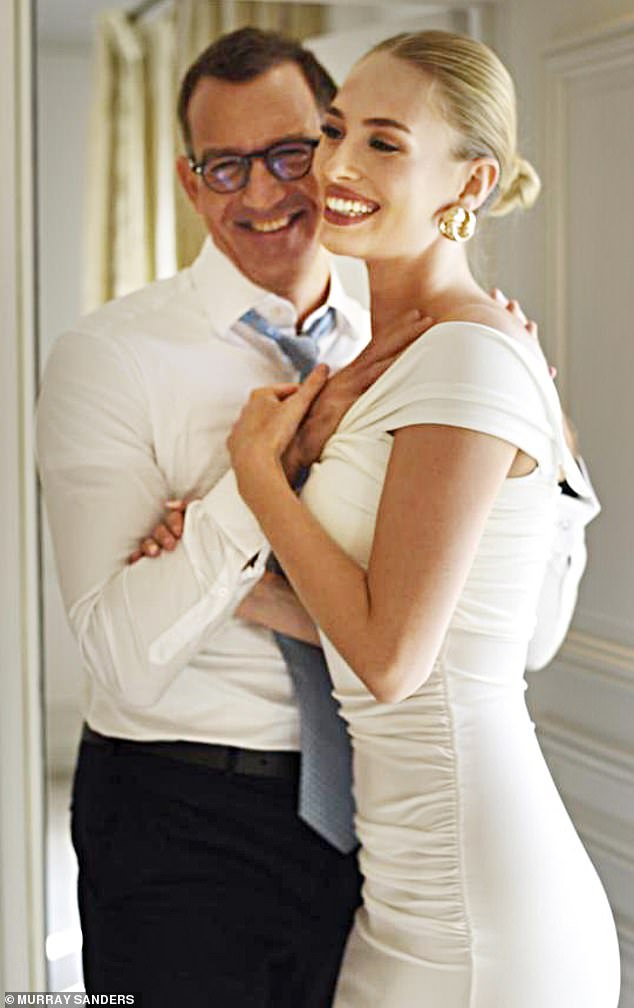
Daniel Kretinsky, 51, with Marie Jedlickova, 28… he evidently has a penchant for much younger women and he was bedazzled by Marie, writes Daniel Jones

Marie Jedlickova in the social media Royal Mail advert for Mother’s Day

Last year Marie ended her engagement with Max Talich – ‘brutally’, he claims
Then, last year, having ended her engagement with 26-year-old Max – ‘brutally’ and without warning, so he claims – she flew home to Prague and became the Royal Mail boss’s lover.
All of which is likely to explain why Marie, who had no known acting experience, landed a part in the company’s Mother’s Day commercial.
She also appeared in another video plugging its Christmas postal service – which, according to Citizens Advice, failed to deliver 16million cards and letters on time. A source close to Kretinsky says his new girlfriend received no fees for these acting jobs and is not on the Royal Mail’s payroll.
Nonetheless, the tycoon has already faced angry criticism for his running of the 500-year-old postal service, whose parent company he bought in 2024 in a £3.6billion takeover.
Earlier this year, Labour’s Liam Byrne, chairman of the Commons business and trade committee, described it as ‘a national institution in meltdown’.
The revelation that Kretinsky (dubbed the Czech Sphinx for his inscrutable demeanour) saw fit to use his girlfriend to burnish the Royal Mail’s battered image will doubtless raise more questions over his stewardship.
It certainly rankles with the mother of Marie’s jilted fiancé. ‘She doesn’t come across as very professional in the videos. I do wish she wouldn’t [appear in them],’ Amelia Talich, who took Marie into her home for seven years and came to regard her as a daughter-in-law, told me frostily this week.
Her son says he only learned Marie and Kretinsky were an item a few weeks ago, shortly before the tycoon – looking the epitome of the cat who got the cream – permitted paparazzi working for one of his Czech magazines to photograph him escorting her to a glitzy party.
‘My first reaction was to laugh,’ Max, 26, who has a master’s degree from Exeter University, told me. ‘It was surreal to find out that the girl I first met in school was going out with one of the richest men in the world.’
I’ll return to his story later. First, though, let’s set about unmasking the Sphinx to discover why, in Britain at least, this undeniably brilliant businessman has come under such scrutiny and been subject to criticism.
Kretinsky’s lifestyle oozes oligarchal affluence. According to Amelia Talich, his Valentine’s Day present to Marie was a French chateau. He has also given her a rare, 44-carat diamond necklace, she claims, and ‘buys her a new outfit every time they visit Dior’.
Then there is his splendiferous Impressionist art collection; a superyacht in Greece; and an extravagance of mansions in Paris, Prague and London, where he splashed out £65million for a 15-bedroom mansion in the Bishop’s Avenue in Hampstead, the city’s most expensive street.
As with many arriviste Eastern Europeans, however, the roots of his fortune germinated amid the chaotic economic free-for-all that came after the collapse of Communism.
Kretinsky was born in 1975, in Brno, second city of the old Czechoslovakia. His father Mojmir is a retired computer science professor and his mother, Michaela, was a constitutional court judge.
But his parents divorced when he was a young boy, and from the age of seven he was raised by Michaela and her second husband, eminent art photographer Vladimir Zidlicky.
In his cluttered studio, this week, Mr Zidlicky, now 81, described his stepson as an ‘awesome kid’ with boundless energy and curiosity, and such loyalty to his friends that he still socialises with them today, despite the vast disparity in wealth.
Files in the Czech security services archive show that Mr Zidlicky was being closely watched by the ruthless secret police, the StB, which feared he was about to defect to West Germany. However, he says that, as an artist, he and his family were largely left alone.

Daniel Kretinsky’s stepfather Vladimir Zidlicky, a famous Czech artist

Kretinsky’s palatial home on the banks of the Vltava river in Prague

Marie walked out on an ‘outdoorsy’ life with fiance Max
Kretinsky excelled at school and his penchant for writing suggested a future in journalism. But in his teens he developed an interest in business, and his stepfather lent him small sums of money to make investments, which invariably bore fruit.
These early ventures came in the immediate aftermath of the 1989 Velvet Revolution: a time when Czechs with sharp elbows and an eye for an opportunity were cashing in on the switch to capitalism. Citizens could buy coupons giving them the chance to acquire stakes in the old state-run enterprises. When Kretinsky was just 17, he and a school friend created a way of valuing these newly privatised companies and advised families on their potential.
After he turned 18, his stepfather entrusted him with money to gamble on the new Prague stock exchange, allowing him to keep 10 per cent of any profits. The bounding Czech was on his way.
Much has been written about his turbocharged rise to riches after joining an investment company and coming under the wing of
privatisation baron Petr Kellner, with whom he formed EPH, the giant company that now controls many of his interests.
Kellner died in a helicopter crash in Alaska five years ago. By then, Kretinsky was in a relationship with his daughter, leading Czech showjumper Ana Kellnerova, which began when he was in his 40s and she was in her early 20s.
His eclectic portfolio ranges from energy and retail to media and football: he will soon take control of West Ham United and owns his homeland’s most famous team, Sparta Prague.
Since this empire includes a string of fossil-fuelled power plants across Britain and Europe, he is under constant attack from green campaigners. However, it is his dealings with Russia that most worry Westminster.
Kretinsky holds a 49 per cent stake in the Slovak-based company Eustream, the main conduit for Russian gas piped into Europe.
While Kretinsky maintains that he has never met Vladimir Putin, in 2016 he reportedly attended a Moscow summit for talks with a close ally of the president who also heads Gazprom, the state-run as company.

Max, 26, who has a master’s degree from Exeter University said ‘It was surreal to find out that the girl I first met in school was going out with one of the richest men in the world’
The British Government was so fearful his ownership of the Royal Mail could jeopardise national security they took the rare step of ‘calling in’ the proposed takeover for rigorous investigation. It was only sanctioned with the proviso the Government holds a ‘golden share’, giving them the right to veto key operational changes.
Kretinsky has a penchant for snapping up failing and seemingly outdated businesses such as the postal service. According to his stepfather, the satisfaction he gains from reviving and improving them is his prime motivator.
Millions who rely on the Royal Mail might find those words ironic, for in the two years since he took it over its performance has grown ever more shambolic. In the past year, almost a quarter of all first-class letters – 126million of them – failed to arrive on time. Second-class deliveries, which are no longer made on Saturdays, have a similar lateness rate.
Disgruntled members of the company’s 130,000-strong workforce accuse Kretinsky of prioritising its highly profitable parcel service over letters. Meanwhile, the price of stamps is soaring exponentially. Confronted with this dismal picture before the business and trade committee last March, the Sphinx retained his customary composure but bemoaned the task he faces.
Promising to invest £500million on improvements over the next five years, he said he was ‘deeply sorry’ but added: ‘This is a hard job…a job that nobody else in Europe is doing. If you send a letter from Brighton to the Scottish Highlands, you need to get it there for £1.80 the next day.’
Among those who saw Kretinsky being grilled in the Commons was Max Talich’s mother, Amelia, who watched the broadcast at their home in Wigton, Cumbria. Generously, she says she was impressed by his apparent sincerity.
Indeed, as a regular Royal Mail user, when the programme ended she messaged Marie with some immediate improvements her new boyfriend could make, such as simplifying the parcel labelling system to match that of rivals such as InPost Locker. She has since heard he is acting on them.
Max, for his part, also harbours no ill-will towards the man who usurped him. Instead, he aims his anger at the director of the Miss Czech Republic pageant, Tatana Makarenko, who, he says, introduced Marie to Kretinsky – an assertion confirmed by an insider in the billionaire’s camp. For the girl he began dating when she was 18, who was unconscious of her image, unmaterialistic, and shared his outdoorsy interests, appeared to him to have changed beyond recognition after entering the competition and coming under Makarenko’s influence.
Max met Marie at high school in Prague. His British mother married the famous Czech violinist Jan Talich – whom she met at the Guildhall School of Music & Drama – and he was raised in the Czech capital. Marie then lived with her grandmother, but soon after the romance with Max began, Amelia suggested she should move in with them.
The couple later settled in Britain, where Max studied biochemistry and Marie gained a marketing degree at Nottingham Trent University.
He proposed, down on one knee, on the shores of Bassenthwaite Lake. But their relationship later became strained because, Max says, he hankered after an uncomplicated country lifestyle while Marie was ‘more into social media and all that stuff’. Yet he still felt sure they would overcome their differences and be married in 2023, when she made the fateful decision to enter the beauty contest.
It was the moment everything changed, Max says grimly. ‘She got more into glamour [and] wanted that lifestyle more and more.
‘Quite often the girls are kind of show-ponies at parties, and Marie did that. Looking back, I shouldn’t have been alright about it.’
Believing this to be a passing phase, however, he didn’t protest. In fact, when she was named among the beauty pageant winners he expressed his pride on Facebook.
Nor did he object, last year, when Marie excitedly broke the news Daniel Kretinsky had offered her a second trip to Velaa Private Island, his uber-exclusive resort in the Maldives, this time to celebrate her 27th birthday. Three days after this jaunt she returned to Wigton and told Max she was breaking off the engagement. She then flew back to Prague, never to return. ‘I’m not going to sugarcoat it – I was heartbroken,’ he says.
A Kretinsky source insists the Royal Mail chief acted perfectly properly, waiting until Marie was unattached before making his move. However, the timing of her bombshell announcement leads Max to suspect otherwise.
Though he later met Marie in Prague, and says they discussed the possibility of a reconciliation, she kept her romance with Kretinsky secret.
It was only a few weeks ago, via his mother, that his ex-fianceé unveiled the ‘mind-boggling’ truth. Today Max and Amelia remain very fond of Marie, and worry what might become of her, should the post magnate tire of her.
‘I find the relationship surprising because he is very intelligent and her focus is really social media and fashion,’ says Amelia, clearly striving not to sound unkind. ‘Let’s say I find it an unlikely pairing. I do wonder what they talk about.’
Max is also at pains to avoid upsetting Marie but remarks: ‘She says she really loves him and he’s really kind. Maybe they do genuinely love each other.
‘But to be honest, if he was a regular guy with a regular income, I don’t think she would have chosen a 51-year-old guy.’
It seems a reasonable point.
Yet as he showers his first-class girlfriend with ever more lavish gifts, the man who has turned acquisition into an art form probably doesn’t very much care.
- Additional reporting by Tim Stewart