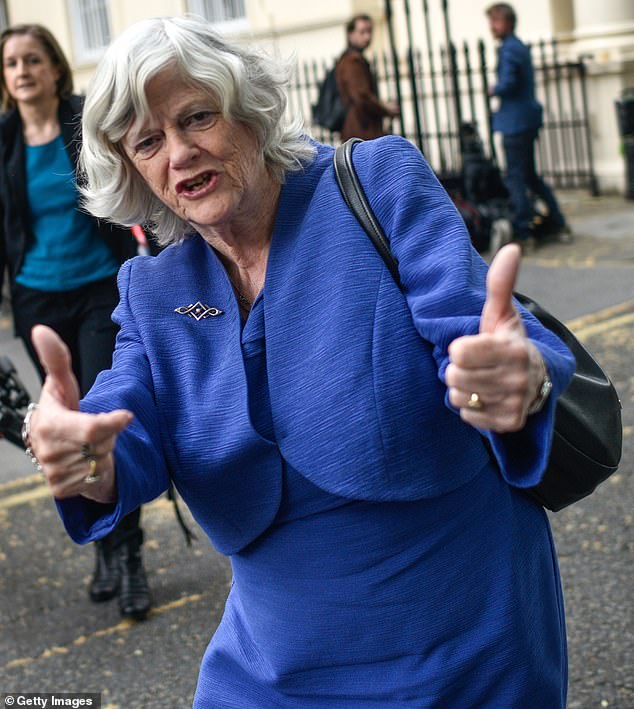
Yesterday afternoon, as I heard the TV news anchor reporting that ‘police had launched a murder inquiry’, I could hardly believe that they were talking about my treasured friend Ann Widdecombe.
I had been horrified to learn early on Thursday that ‘the Saintly Widders’, as I’ve always affectionately called her, had been found dead ‘in a pool of blood’ in the kitchen of her beloved home in the beautiful area of Haytor, Dartmoor.
At first, I assumed that Widders, who’d been a little shaky on her pins after a fall in December, had perhaps slipped and hit her head.
But then came the terrible confirmation in a police statement that my 78-year-old friend, who had stubbornly refused to accept any help at home, had been savagely killed – followed by a swift arrest.
A burglary gone wrong? Or might, I wondered, have the always-outspoken Widders been targeted for political reasons?
She had proudly received a Papal Knighthood for ‘services to charity and public life’, thanks to her implacable opposition to abortion – a position that had brought her repeated abuse and death threats.
For now, police appear to have ruled out a political motivation to her killing – but it remains a chilling thought.
I had spoken to Widders myself only on Tuesday, seemingly the day before she died. As always, she was fizzing with ideas and berating me – as she invariably did – for not having written in these pages about an issue relating to child maintenance payments, which she planned on championing at Reform’s party conference in September.

Ann had proudly received a Papal Knighthood for ‘services to charity and public life’, thanks to her implacable opposition to abortion – a position that had brought her repeated abuse and death threats

She planned on championing an issue relating to child maintenance payments at Reform’s party conference in September

I had spoken to Widders myself only on Tuesday, seemingly the day before she died, writes Andrew Pierce, pictured far right
Her uncompromising, no-nonsense nature was why I loved her, and why I will miss all 5ft one-and-a-half inches of her (‘Don’t forget the half!’ she used to quip) more than I can say.
Our finest moment together came one morning in June 2010, when she rang me unexpectedly. ‘Guess where I am?’ those splintering tones boomed in my ear. ‘I’m walking along Downing Street to see David Cameron.’
Minutes later, she sailed out of No 10 having been offered the role of Ambassador to the Holy See by Cameron, who had become Prime Minister a few weeks earlier.
Widders had stood down at the previous election, having been MP for Maidstone and the Weald since 1987. A convert to Catholicism in 1993, and fluent in Latin, she was the perfect casting to be Our Woman in Rome.
And best of all, we had cooked up the whole thing eight months earlier, over a bottle of Sancerre – and, in her case, two large brandies – at Kym’s, her favourite Chinese restaurant in Westminster.
As she tucked into her crispy duck with hoisin sauce and pancakes, Widders told me she’d heard the ambassador’s post would become available in 2011, several months after the upcoming election. ‘I could do the job, but Cameron doesn’t like me and would never agree to it,’ she said.
I said I’d do what I could, and soon established that the Tories hadn’t given the job a second thought. So I wrote an impeccably sourced story declaring that Widders was a favourite for the appointment, with a telling quote from a Cameron ally, saying: ‘Widdecombe is made for this job. It would also mean she would be well out of the way, which would suit everyone.’
In other words, the Cameroon Tories needed an old-school battleaxe like Widdecombe safely off British soil so they could get on with their plans to abandon the party’s core values and curry favour with their ultra-wet Lib Dem bedfellows.

Ann had been MP for Maidstone and the Weald since 1987 and stepped down at the 2010 general election

An ardent Catholic and fluent in Latin, she was the perfect casting to be Our Woman in Rome
As the brandies flowed during our victory meal – again, of course, at Kym’s – Widders’s cackle grew louder as she basked in the fact Cameron had fallen for our ruse to give her the job she’d coveted.
While I was delighted for my friend, I remember feeling a touch of sympathy for the cardinals of St Peter’s. Widders was not just a force of nature: she was incorrigibly undiplomatic. Woe betide any pinko cleric who dared stand in her path. In the end, despite our successful scheming, Widders never took the role – because she immediately received another offer she couldn’t refuse.
That summer, BBC’s Strictly Come Dancing came knocking for the sixth time. She knew the risks of putting herself out there, and was well aware her talents lay in fields other than the paso doble, but decided to participate in the 2010 series.
None of us anticipated what a triumph her performance would be. With her stout British blend of dogged determination and self-deprecating humour, Widders became an instant audience favourite, performing ungainly lifts and spins with her partner Anton Du Beke.
Over the weeks, she laughed delightedly as the judges affectionately called her a ‘dancing hippo’, a ‘Dalek in drag’ and likened her skills to that of a ‘lame canary’ – and she always gave as good as she got.
I was in the audience when judge Craig Revel Horwood scoffed: ‘You spend too much time sitting on your backside.’
‘And what do you do all day?’ Widders instantly retorted.
To be fair, I remember telling my dear old friend that she was perhaps ‘a little more vacuum cleaner than prima ballerina’, but let me tell you, she loved every moment of that show. Her Strictly time, she said, was ‘magnificent’ and ‘life-enhancing’ after a quarter of a century in the Commons bear pit.
Late every Saturday night she’d call me excitedly – and in flagrant breach of the show’s rules – to tell me whether or not she’d got through to the next round. In the end she made it to the tenth week – just two short of the grand finale.
Her unexpected triumph led to a deluge of offers for more TV, pantomime and even an appearance at the Royal Opera House – thankfully in a non-singing, non-dancing cameo in the comic opera La Fille du regiment.
Yet while her broadcasting career flourished – including an appearance on Celebrity Big Brother in 2018 – David Cameron never forgave her for, as he saw it, humiliating him by choosing Strictly over the Vatican. Cameron, a notoriously thin-skinned Old Etonian, was also aghast at her stated opposition, rooted in her lifelong religious faith, to legalising gay marriage, which he did in 2011.
Cameron denied her the peerage many members of the Tory Party believed she richly deserved. The snub, she wouldn’t mind me saying now, bruised her to the end.
She was 78 when she died, apparently around lunchtime on Wednesday, at her beloved home. Nicknamed ‘Widdecombe’s Rest’, it was shared only with her devoted cat Aloysius, the only male to step inside her bedroom. She told me often how much she loved that home, with its swimming pool complete with plastic slide, and the access it gave her to long marches across the moors.
Ann was born in Bath, Somerset, in 1947. Her father James was a senior civil servant in the Admiralty, and, with her older brother Malcolm, the family spent four years in Singapore, returning to England when Widders was nine.
After attending a convent school and reading Latin at Birmingham, she completed a second degree in Politics, Philosophy and Economics at Lady Margaret Hall, Oxford. There she struck up her life’s only romance – a ‘very serious’ three-year relationship with fellow student Colin Maltby.
‘I think for a while we both thought [marriage] might happen,’ she once said. ‘But it didn’t and it was right that it didn’t. It would have been a mistake, but one doesn’t necessarily see that at the time.’
She later added: ‘When the relationship with Colin was over, my underlying assumption was somebody else was going to come along; that I was going to get married. I’m not sure that I ever consciously abandoned that.’
In her 40s, however, she said she started to feel it was ‘quite nice being on my own’, and by her 50s she knew she preferred it.
In 2013, she used a nautical phrase perhaps learned from her father, telling the BBC: ‘If Mr Right came in, I’d repel all boarders, I really would . . . I’m not saying I didn’t occasionally look at a man and think, you know, you’re rather fun. But, no, I never fell in love again.’ She admitted that, although she was happy remaining a spinster, she would have preferred to have had children.
It was at Oxford that Widders found her talent for debating: she was a terrifying orator, quick on her feet and utterly across her brief. On becoming Minister of State in the Home Office in 1995, she insisted that civil servants call her ‘Ann’. When the fusty mandarins insisted they had to address her as ‘Minister,’ she snapped: ‘God calls me Ann. If it’s good enough for God, it’s good enough for you.’ The subject wasn’t raised again.
Widders and I became friends way back in 1997, when I supported her bid for the Tory leadership against Michael Howard.

With her stout British blend of dogged determination and self-deprecating humour, Ann became an instant audience favourite with her partner Anton Du Beke

Ann appeared on Celebrity Big Brother in 2018 and she was the runner-up, losing to Shane Jenek
Widders and Howard had no time for each other: she had come close to resigning as prisons minister in 1995 when she alleged that Howard, as Home Secretary, had misled Parliament over the dismissal of the prisons director general Derek Lewis – leading to Howard’s infamous Newsnight interview with Jeremy Paxman, where he refused 12 times to answer the same question.
Widders, of course, coined the most deadly political phrase of the era by saying there was ‘something of the night’ about Howard, instantly torpedoing his career. It took its toll. Often, when I called her during that saga, she was with her priest seeking spiritual solace.
Being a Right-winger in the public eye was never easy, even for someone with a skin as thick as hers. When the Left-wing Daily Mirror newspaper cruelly branded her ‘Doris Karloff’ – feminising the name of the actor Boris Karloff, known for playing Frankenstein’s monster – she tried to take it in her stride, answering the phone: ‘Karloff speaking.’ The truth, I can now say, was that it hurt her deeply. After that episode, her trademark pudding-bowl haircut went from jet-black to warmer blonde and she shed a couple of stone in weight.
Always the eccentric, on Desert Island Discs in 1999 she chose a track of animal sounds, including birdsong and the bellows of a hippo. She said it reminded her of a trip to the African bush ten years earlier, when she relished her absence from civilisation as she lay in her tent listening to wildlife.
In some ways, ours was an unlikely friendship. She strongly objected to the equalisation of the age of consent for gay people back in 2000; I campaigned for it. She opposed civil partnerships; I’m happily in one. While she met my partner on several occasions, and was always perfectly gracious, she would never have dreamt of discussing my personal life. Though we spoke almost every day, I didn’t invite her to the party celebrating our union – I knew she wouldn’t have come.
Her moral certitude was unshakeable. A ferocious opponent of fox-hunting on grounds of cruelty, and of all forms of assisted dying, she was an enthusiastic advocate for the death penalty. (After what has now happened, I find myself agreeing with her.)
Every Lent she gave up coffee, tea and alcohol – but would happily tuck into a large pudding at Kym’s because she was ‘never giving up sugar’. As soon as the Easter Saturday Vigil ended, marking the end of Lent, she would rush home and pour herself two large whiskies on the rocks.
In 2008 she was immensely proud to be the first woman granted full membership of the Carlton Club, the beating heart of the Tory establishment – and regularly reminded me that Mrs Thatcher was made only an ‘honorary’ member in 1975 when she became Conservative leader. Widders lost her membership when she defected to Nigel Farage’s Brexit Party in 2021, staying true to the movement when it morphed into Reform.
She was, I’ll admit, hard work at times, but she was one of my greatest and most loyal friends.
I’ll finish with this. The only time I saw Widders on the verge of tears was when her close friend, the Tory MP Sir David Amess, was savagely murdered in his Southend constituency surgery by a deranged Muslim fundamentalist in 2021. Behind the scenes, she was hugely supportive of the Amess family – firm Catholics like her – and was a loving godmother to David’s daughter Alexandra.
The Saintly Widders and I talked often about David’s killing and its devastating impact on his family. I never thought that, one day, I’d be mourning her own brutal murder.