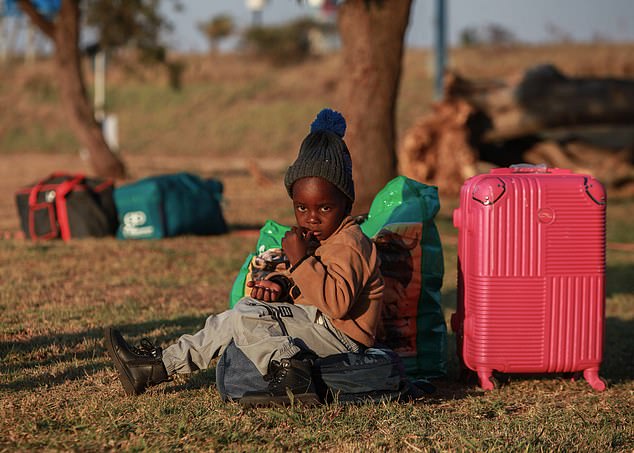
A five-year-old boy sits forlornly on scrub ground next to a petrol station near the South African town of Polokwane as he starts his journey to a country he does not know.
He is dwarfed by a large pink suitcase, carried by his uncle Steve Hove, which his mother, Angela, had packed for him before saying goodbye.
The child is called Brightman and he is stateless. When he was born at a clinic nearby, Angela, a Zimbabwean, did not register him with the authorities.
Instead, she carried him home secretly, making little Brightman one of millions of illegal migrants living undercover in South Africa: a diaspora now fleeing for their lives as civil unrest sweeps the Rainbow Nation over uncontrolled borders and mass immigration.
In horrific scenes never witnessed in the post-apartheid era, black foreigners are being chased from their homes, beaten up and having their lives threatened.
Neighbour has turned on neighbour in a wave of xenophobia against the ‘illegals’, who are blamed for fuelling an unemployment crisis in a country where one in three adults is out of work.
‘The uprising against my family began in January. It got worse in my township, where I lived for seven years, when the locals stole my possessions and began screaming at me to go,’ said Brightman’s uncle Steve, a 22-year-old construction worker, as he waited with his nephew for a lift to the Zimbabwean border, marked by the Limpopo River, a two-hour drive away.
‘The South Africans don’t like black foreigners any more,’ he added with a sad smile.

Brightman, five, is one of the stateless illegal immigrants living under cover in South Africa with his Zimbabwean father Steve Hove,22

A group of undocumented Malawian migrants gather in front of Malawi’s consulate to prepare for their return home last month following a resurgence of xenophobic attacks and anti-migrant protests in Johannesburg
‘I will never return to South Africa.’
Some migrants, like Steve, are making their own way back home.
Thousands of others are being transported there in a mass evacuation. This week alone, some 23,000 people, mostly Zimbabweans and Malawians, were carried by bus from major cities to an emergency government repatriation camp on farmland near the Zimbabwean border prior to their deportation.
The ugly uprisings rocking this country were sparked last month when the March And March movement – a new pressure group demanding stricter border control and the mass deportation of foreign workers – issued an ultimatum demanding that all undocumented migrants leave South Africa by the end of last month.
More than 120 demonstrations took place that day, with protesters sweeping through cities chanting ‘Mabahambe!’ (‘They must go!’), provoking panic among the country’s millions of migrants hailing from across the continent, including Nigeria, Ghana, Mozambique, Malawi and, notably, Zimbabwe.
Protesters looted foreigners’ homes and businesses, resulting in 600 arrests.
Young South African men waving sticks and mallets threw stones at the windows of shops and private homes rumoured to be harbouring illegals in the country’s biggest city, Johannesburg.
‘South Africans have been replaced by foreigners, increasing unemployment,’ said March And March founder Jacinta Ngobese-Zuma, a rabble-rousing ex-radio presenter who has pledged to hold demonstrations across the country every Thursday until every illegal has been thrown out.

Protestors during an anti-immigrant march in Alexandra, near Johannesburg, on Thursday
‘We want mass deportations. During the next six months, the government must get rid of all the people who have not left already,’ she added. True to her word, there were more protests this week.
It will not be an easy task: an estimated five million undocumented migrants live in South Africa, 12 per cent of the adult population.
Politicians stand accused of having failed over decades to shut porous borders, particularly with neighbouring poverty-stricken Zimbabwe, from where thousands arrive each year, successfully getting work while South Africans are jobless.
The March And March offensive has infuriated South Africa’s Left-wingers, who have the same passion for open borders as their European counterparts.
Leader of the fledgling but influential political party Economic Freedom Fighters (EFF) is the controversial Marxist firebrand Julius Malema – famous for regularly calling on his followers to ‘kill the [white South African] Boer’.
He has slammed the March And March protesters, saying: ‘You say Zimbabweans take your jobs. You march, close shops, beat up other Africans. I will never push out of school an African child who looks like me.
‘I will never refuse a pregnant woman of African descent to give birth in the clinics of South Africa.’
Only this week, Malema condemned ‘Afrophobia’, the hatred felt by South Africans towards other Africans.

Protestors take part in a ‘March and March (until we win)’ rally in Mtwalume, south of Durban, on Thursday
His call is for a borderless continent allowing the free movement of all Africans, plus a controversial plan for a pan-African parliament, currency and army.
Distressing though the deportations are, there are signs that South Africans are getting jobs again as the Biblical-scale exodus escalates.
Businesses, shops, farms, mining companies and homeowners are being forced to hire them as the number of cash-in-hand black market workers falls. Employers also face government raids and stiff fines if they are caught paying, or hiding, foreign workers.
Sinisterly, people are being encouraged to report their neighbours if they believe they are breaking the rules.
An anonymous tip-off phone line to police is asking for information on the ‘exact details’ of the location of foreigners, ostensibly to ‘avoid vigilantism’ breaking out and South Africans ‘taking matters into their own hands’.
In a deprived township called Mapetla East on the outskirts of Johannesburg, I visited the Sorty Tuck Shop, which for the past four years has been run and staffed by illegal workers from impoverished Mozambique.
It was taken over by South African 26-year-old Themba Mokhobo on Wednesday after his family struck a deal with the ‘foreigners’ before they were driven out.

Themba Mokhobo ouitside the Sorty Tuck Shop, which he now runs after ‘foreigners’, illegal workers from Mozambique, were driven out
One of his first customers was Lesego, 22. Wearing a colourful headscarf, and buying beans, she said: ‘We are pleased a South African is running our local shop again.’
For days, migrants waiting to be picked up by bus for the emergency deportation camp on the Zimbabwean border have been gathering in dreadfully unsanitary conditions at impromptu meeting points in cities, including one on the grass outside the tall white walls of Johannesburg’s Malawian Embassy.
When I visited the embassy on Monday, I met mothers and their young children sleeping on the ground in the winter cold. It was a pitiful sight.
Standing among the mayhem was Lizzie Banda, a young Malawian with a baby daughter, Effort, peeping out from a blanket.
Lizzie had worked in Johannesburg for seven years as a cleaner for a middle-class Zulu family living in a smart suburb before they showed her the door last Sunday.
Now Lizzie was heading back to Blantyre, her home city in Malawi.
‘Effort has no birth papers. Like me, she is an illegal. I am frightened for what will happen to us next. We are not wanted here any more.’

Hundreds gathered in Soweto, Johannesburg province last month to call on the South African government to deport undocumented migrants
Cecilia Phirr, who ran a company in Johannesburg importing clothes for her fellow Malawian women living in South Africa, was also leaving.
She was with her son, Prosper, five, who was born in the Coronation Hospital, Johannesburg, but like her has no official documents.
Cecilia said her once-welcoming adopted nation had turned hostile: ‘We only want to go home safely. This country has become dangerous for foreign Africans.’
Both these mothers managed to get on a crowded bus for the four-hour drive to the border camp late on Monday.
There, when I visited, I saw them among police and immigration officials struggling to cope as thousands waited in queues stretching into the distance to register their names at desks in giant tents – a procedure to stop them re-entering South Africa for five years.
Each person registering was given an A4 document allowing them to board a bus out of the country, which read: ‘You have undertaken to leave the Republic of South Africa voluntarily… failure of which will mean you are arrested and detained pending your deportation.’
Here too, among this throng of desperate humanity, was Lorraine Ngubeh, 18, and her sibling, Lawrence, 16. The two have spent all their young lives in South Africa, having never even visited their ancestral country of Zimbabwe.

The idea of South Africa as the ‘Rainbow Nation’ was popularised by former President Nelson Mandela
Lorraine, who had a five-month-old baby girl, Tshegototso, tied on her back, has passed her school exams with honours and would be an asset to any country.
‘We feel South African,’ she told me.
‘Our schoolfriends were South African. We don’t know any other country. We think our life in Zimbabwe will be very hard but we have been chased away by threats because we are foreigners. It is not safe for us to stay.’
Although most of the foreigners are leaving voluntarily, and many out of fear, not all are going to the processing camp near the border. Instead, they are fleeing by paying cash to people-smuggling gangs who guide them over the border, either on rafts over the crocodile-infested Limpopo or by road.
It was by this unorthodox method that Steve and his young nephew Brightman reached Bulawayo, Zimbabwe’s second city, 24 hours after I had met them at the Polokwane petrol station.
They had paid a people-smuggler 600 rand (£27) in cash. In WhatsApp messages, I later asked about the tiny boy’s wellbeing.
Steve told me they had arrived safely, that the boy’s mother Angela, who had stayed behind to continue earning, was relieved. He adorned his message with a picture of the Zimbabwean flag.
At the official border post bristling with officials, the two had simply walked across carrying the pink suitcase.
‘We give thanks to God,’ he said. ‘We are home. Will you visit us in Bulawayo one day, please?’