

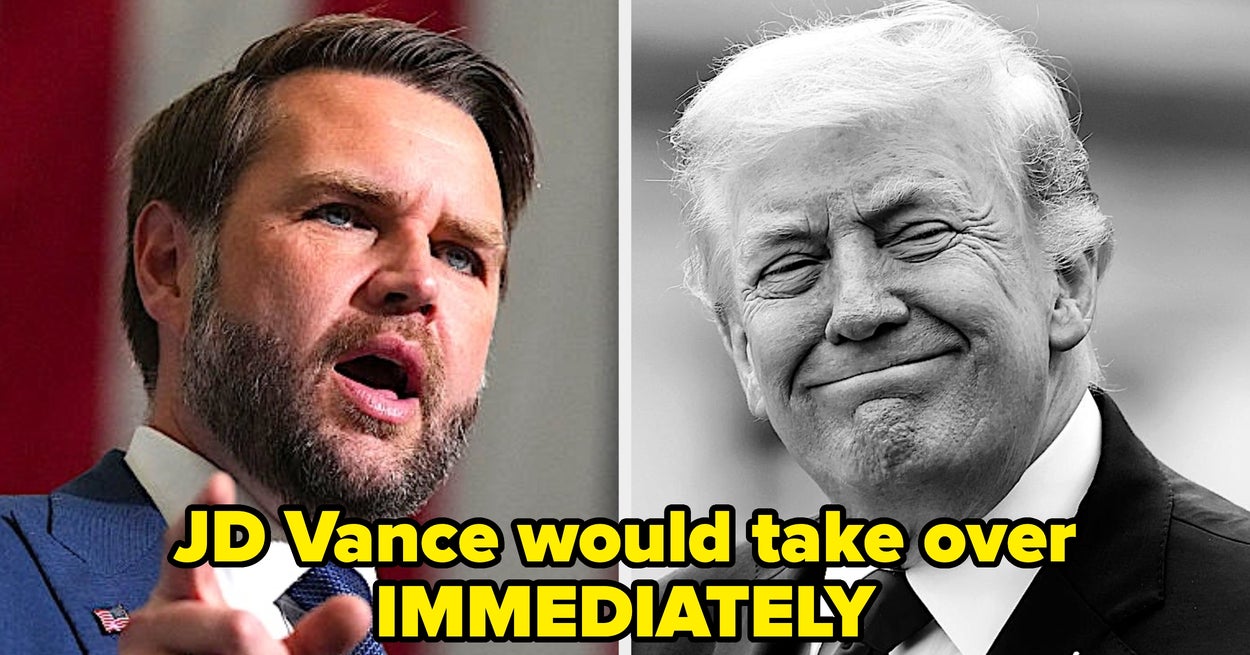
Now that Donald Trump has turned 80, he is officially the oldest president to ever be inaugurated. Thus, there is one morbid question that is hard not to wonder: What would happen if a sitting US president suddenly died?
So, let’s say Trump died tomorrow. What would actually happen in the minutes and hours after? Because, apparently, the US has a plan for almost every oddly specific question you can think of. Here’s what would happen immediately, what could unfold during the first day, and what would already be set in motion:
1.
First things first: Who becomes president — and how quickly?
Transfer of Power: There’s no waiting period, emergency vote, or even a second where the US technically has no president. The 25th Amendment is pretty direct: If a president dies, “the Vice President shall become President.”
So, if Trump were to die in office, JD Vance would become president immediately. He wouldn’t need Congress to approve him or wait until he was sworn into office to transfer. Which means the US could have a new president before the public even knew the previous president had died. 🤯
Even though the 25th Amendment makes the transfer automatic, the Constitution still requires the new president to take the presidential oath before executing the office. But there’s no traditional inauguration or required location for the swearing-in, so it can happen wherever officials can arrange it. For instance, after John F. Kennedy was assassinated in 1963, Lyndon B. Johnson took the oath aboard Air Force One before it left Dallas.
The new president would also become commander in chief. And yes, that includes the authority to authorize the use of US nuclear weapons. So, basically, someone could begin the day as vice president and end it as president and commander in chief.
2.
So, what happens to the now-empty vice presidency?
Succession Update: Unlike the presidency, the vice presidency doesn’t have an automatic replacement. Once the vice president becomes president, their old job is simply vacant. The House speaker doesn’t get promoted, and Americans don’t vote in a special VP election.
Instead, the new president nominates someone, and that person needs majority approval from both the House of Representatives and the Senate. And it’s happened before! After Vice President Spiro Agnew resigned in 1973, President Richard Nixon nominated Gerald Ford to replace him. Then Nixon resigned, Ford became president, and the vice presidency was empty again. Ford nominated Nelson Rockefeller, who was eventually confirmed by Congress.
And filling the job can take a lotttt longer than replacing a president. After Agnew resigned, the vice presidency remained vacant for 57 days before Ford took office. When Ford later became president, the job sat empty for 131 days before Rockefeller was sworn in.
3.
How and when does the public actually find out?
National Mourning: The Constitution surprisingly doesn’t require the White House to announce a president’s death within a certain number of minutes, nor does it require a televised address, a social media post, or a specific person to break the news.
How Americans find out would mainly depend on where and how the president died. Officials would need to coordinate notifications and a public announcement, while the government is already responding behind the scenes.
Public Address: The newly sworn-in President would address the country from the Oval Office or the White House briefing room, offering official confirmation and a statement of national mourning. This confirmation would then set off continuous coverage by news outlets.
4.
When and why do American flags start going down?
Presidential Proclamation: Under federal law, US flags on federal buildings, grounds, and naval vessels are flown at half-staff for 30 days from the day a sitting or former president dies.
The order also covers US embassies and other US facilities abroad, so, while much of the presidential transition is happening behind closed doors, one of the clearest signs of what had happened would begin to appear across the country and around the world.
5.
Who stays in the White House — and who moves in?
The presidency can change hands in seconds, but moving households is a little less immediate. There doesn’t appear to be a rule giving the previous president’s family a set number of hours to leave the White House.
But after JFK was assassinated on Nov. 22, 1963, Jacqueline Kennedy and her children didn’t leave the White House until Dec. 6 (two weeks later). So technically, the previous first family could still be living and mourning upstairs while the new president is already running the country from the same building. Historically, the new president doesn’t move in with his family until the previous family has moved out.
6.
Does the rest of the president’s administration reset overnight?
Nope. Cabinet officials wouldn’t automatically lose their jobs simply because the presidency changed hands, and the previous president’s executive orders wouldn’t disappear, either.
The new president would take control of the executive branch and could start making personnel changes. And they could also revoke or replace presidential actions using the powers of their new office. But existing executive orders don’t automatically vanish just because a different president takes over.
7.
And finally, what would the funeral process look like?
State Funeral: Within the first 24 hours, officials could already be preparing for a state funeral for the president. The funeral itself wouldn’t happen that same day. But instead, a series of ceremonies at the president’s residence, in Washington, DC, and at the burial site could unfold over the following 7 to 10 days.
Lying in Repose/State: This is when the president’s remains are publicly displayed so people can pay their respects. Historically, the White House has played a big role in this process. Of the eight US presidents who have died in office, seven had their remains lie in repose in the White House’s East Room.
Burial: The president is ultimately laid to rest in accordance with personal and family wishes. As for Trump, Bedminster, New Jersey, has long been talked about as a possibility, as he previously sought approval for a private family cemetery at Trump National Golf Club Bedminster. His ex-wife, Ivana Trump, is already buried on the property as well.
Now, be honest: What would your first reaction be if you woke up to this news tomorrow? And do you think Americans would come together — or just completely lose their minds? Share your thoughts in the comments below!