The husbands of two so-called ISIS brides and several Australian men suspected of being fighters for the terror group could be released from an Iraqi jail as authorities attempt to deport ‘non-combatant’ inmates.
Mohammed Ahmad, the husband of Kawsar Abbas and father of Zeinab Ahmad, is among the detainees. The two women are facing court proceedings in Australia after being charged with allegedly enslaving a Yazidi woman after their return from Syria.
Nabil Kadmiry, whose wife Kirsty Rosse-Emile returned to Australia with a cohort of ISIS brides earlier this year, is also in a Baghdad jail.
Yusuf Zahab, the son of ISIS bride Aminah Zahab, is also believed to be among the jailed men after being separated from his mother as a child and held in prisons in Syria and Iraq.
The remaining Australians in the Baghdad prison are believed to be Deniz Hasan, Jamil Ahmed Shqeir, Mahir Abser Ala, Yusuf Mohammad Yusuf, Mohammad Noor Masri, Ahmad Assaad, Majeed Raad and Hamza Elbaf, The Australian reported.
The men, who have been living in cramped, dangerous prison conditions, will now be questioned by US officials and Iraqi authorities about whether they were involved with the Islamic State terrorist group.
‘The Australians form part of a larger cohort of detainees [who will be] interviewed,’ an Iraqi Correctional Services staffer said.
‘We don’t know when they will be interviewed or how long it could take, but they will be spoken to.

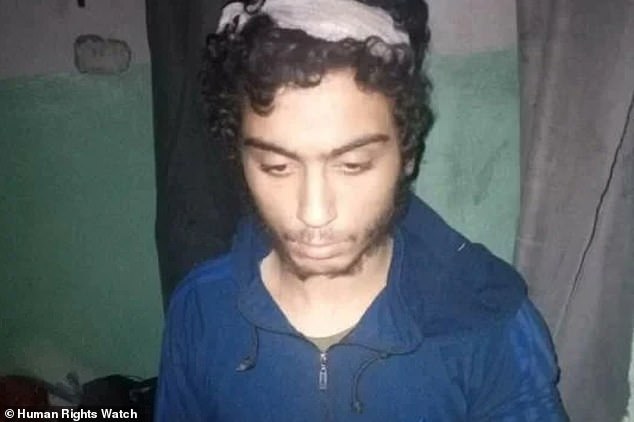
A group of Australian men are being held in an Iraqi prison because they are suspected of being ISIS fighters. Pictured: Yusuf Zahab, who was separated from his mother as a child in 2019 and has since been held in prisons in Syria and Iraq

Pictured: Suspected IS members sit inside a small room in a prison in Iraq
‘Part of Iraq’s ongoing efforts to manage the file of detainees accused of terrorism includes a handover process that contributes to achieving justice.’
The interrogations could see some of the group released from the prisons, sparking the question of where they would then go.
The anonymous staff member said conditions for the group were ‘not pleasant’, particularly as Baghdad has experienced drone strikes, rocket attacks and other security threats over the years.
‘A single cell can house many prisoners so the conditions are not pleasant,’ they said.
‘Unlike the women and children, who were stuck in a detention camp, these are prisoners accused of serious crimes.
‘Many of them, if not all, don’t have current passports, so the Australian government would need to approve their removal.’
The Daily Mail has contacted Australia’s Department of Foreign Affairs and Trade for comment on the possible release of the detainees.
The Albanese government told The Australian that repatriation efforts from Iraq had been ruled out. It did not confirm whether anyone released from custody could be sent to another country.

One of the jailed Australians is Mohammed Ahmad, pictured. His wife, Kawsar Abbas, and daughter, Zeinab Ahmad, are facing court proceedings in Australia after being charged with allegedly enslaving a Yazidi woman

Australia has seen the return of several cohorts of ‘ISIS brides’ in the last six months
The National Centre for International Judicial Cooperation announced in April it had handed over two detainees – a Finnish minor and a US citizen – to their respective countries after it was determined they did not belong to IS.
Dr Ali Mamouri, who served as a communications adviser to the Iraqi Prime Minister from 2020 to 2022 and is a lecturer at Deakin University, said countries such as Australia should be responsible for nationals who travelled to the region during the reign of IS.
‘While Australia’s caution is understandable, there is also a broader principle at stake,’ he told the Daily Mail.
‘States have both a legal and international responsibility to deal with their own citizens rather than leaving the burden entirely to Iraq and Syria – countries that were themselves among the principal victims of these foreign fighters.
‘It is also important to recognise that not all detainees present the same level of culpability. Individual assessments are therefore essential.
‘Some were taken to Syria or Iraq as children by their parents or guardians, while others may have arrived at a later stage and been arrested almost immediately without participating in combat or other criminal acts.’
Dr Mamouri said there must be close cooperation between Iraq, Australia and other Western countries because IS was a transnational movement that threatened international security.
Following the fall of IS in 2019, many male members were either killed or imprisoned. Women and children were placed in the Al-Roj refugee camp in north-eastern Syria.
Boys held in the camp were transferred to adult prisons once they reached their teenage years, sometimes slightly earlier.
Australia has seen the return of several cohorts of ‘ISIS brides’ in the last six months, including two groups, each comprising at least a dozen women and children linked to the terrorist organisation, who returned to Australia in May.
Eight orphaned children came back to Australia under Scott Morrison’s government in 2019.
Four women and 13 children were then allowed into the country by the Albanese government three years later.
The last ISIS bride has yet to return to Australia but is expected to arrive at some point after a temporary exclusion order was lifted.
Hodan Abby, 29, attempted to board a flight from Damascus to Sydney in May but was turned away at check-in due to the order, which prevented her from returning to Australia on national security grounds.