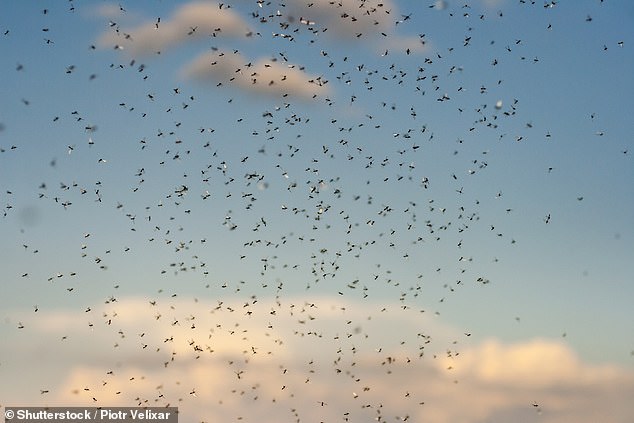
Flying ant season is back earlier than usual this year and swarms plaguing Britain are being mistaken for rain on weather maps.
Being similar in size to raindrops and the way they reflect light, flying ants are picked up on radars with the Met Office saying they can be ‘initially mistaken for showers’.
However, with ‘closer inspection’, they can be identified as flying ants, and after being spotted in last month’s heatwave, they are expected to cause more false readings in the days ahead as the hot weather continues.
The winged ants, known as alates, typically swarm during hot, humid and windless conditions in July and August. However, this year’s early heatwave has prompted them to emerge sooner than usual.
Flying ants breed throughout the summer and can appear as late as September, although experts say the largest swarms will occur between July 20 and 25.
‘Our data from the last 24 years shows 90 per cent of nuptial flights happened in July, but as experts in myrmecology (the study of ants) now predict, the peak for 2026 will hit between July 20 and 25,’ explain ant experts Best Ants UK.
The insects are often mistaken for rain on weather radar, which detects reflections from tiny particles in the atmosphere, most commonly raindrops, but in this case, flying ants.
‘An interesting feature on our radar network is the appearance of swarms of flying ants,’ said senior meteorologist at the Met Office, Aidan McGivern.

The winged ants, known as alates, typically swarm during hot, humid and windless conditions in July and August. However, this year’s early heatwave has prompted them to emerge sooner than usual

Being similar in size to raindrops and the way they reflect light, flying ants are picked up on radars with the Met Office saying they were ‘initially mistaken for showers’ as Britain recorded its highest-ever June temperature

However, with ‘closer inspection’, they were identified as flying ants, but they are expected to cause more false readings in the days ahead as the hot weather continues
‘These show up as unusual, flickering echoes and can initially be mistaken for showers.
‘Radar works by detecting reflections from small particles in the atmosphere, most commonly raindrops.
‘Flying ants are of a similar size and can reflect the radar beam in a similar way to raindrops, producing signatures that closely resemble precipitation.
‘It is a fascinating example of how the natural world can sometimes create unexpected patterns in meteorological observations.’
The flying insects appear in huge numbers as young queens and males emerge from their nests to mate, responding to the right humidity, weather conditions and time of year.
Ants have a tendency to fly earlier in urban areas than in rural locations, likely because temperatures are warmer in urban environments. This is known as the urban heat island effect.
In previous years, swarms have caused havoc at Wimbledon, with ants having plagued players during their matches for years.
Also known as alates, the ones found in urban areas in the UK are usually sexually mature queens or the male black garden variety.
The queens are the largest ants and can measure up to 15mm.
Female winged ants can live up to 15 years, but males usually die just days after mating – the sole reason they are bred.
Ant queens grow wings and take flight in order to find male mates and start new colonies.
Each year, they leave their nests to find a male mate and a new place to start building a new colony.
Large females are often seen flying alongside smaller males. This is called nuptial flight.
After mating, the female ants fall to the ground and lose their wings and will then start to look for a suitable location to start a new nest.
An expert at the Best Ants UK Team told the Daily Mail: ‘The reason they show up on weather radar is simply that there are so many of them, and they’re roughly the size of a raindrop.
‘Radar sends out a beam that bounces back off small particles, and it can’t always tell the difference between a shower and a swarm of flying ants.
‘So you get these odd flashing echoes, often over the southeast and around London, that look like rain but are actually ants.
‘It doesn’t harm the forecast itself; the forecasters know exactly what they’re looking at, but it makes for a brilliant picture of just how many ants take to the air at once.
‘Some swarms have shown up on radar more than a mile wide.
‘As for why so many right now, it comes down to a very precise set of weather conditions all lining up together.
‘Queens will only fly when it’s warm, generally above 24C, with high humidity and light winds, below about 6.3 metres per second, and they favour days when the wind is dropping compared to the day before.
‘A spell of light summer rain beforehand matters too – it softens the soil, so the queens can dig in and found their new nests, and it lifts the humidity to the level they need for flight.
‘They even prefer a day that’s warmer than the one before, effectively forecasting the weather themselves.
‘When all of that comes together after a hot summer, big, well-fed colonies release huge numbers of queens at once, which is why it can feel like the whole country is suddenly crawling and buzzing on the same afternoon.’

Ants have a tendency to fly earlier in urban areas than in rural locations, likely because temperatures are warmer in urban environments. This is known as the urban heat island effect

In previous years, swarms have caused havoc at Wimbledon, with ants having plagued players during their matches for years
Swarming both helps colonies protect themselves from predators, such as swifts and gulls, and increases the probability of reproduction.
Although it can be an unwelcome irritation for some, flying ant day actually plays an important role.
The annual swarming event not only improves soil quality but is also a source of food for many birds, which feed on the winged insects.
And ants are also responsible for the survival of another, more attractive insect, the silver-studded blue butterfly.
They tend to caterpillars and protect them from predators, in return for feeding on their secretion.
Most garden ants are content living outside, where their main food source is sugary secretions from sap-sucking insects like aphids.
However, some of these ants may enter houses in search of sugary deposits from fruit or food left out by humans.
The small size of ants can make them difficult to spot if they come indoors, but they do leave a sticky residue behind them on worktops.
This is because they are attracted to and eat sweet things, so it is possible to tell if an ant infestation has begun in your house before you even see the insects.