

The stench of Pedro Medina’s execution lingered for weeks after he was put to death by a faulty electric chair in 1997.
So nightmarish were the memories that the warden in charge, Ron McAndrew, is now a vocal campaigner for the abolition of capital punishment.
‘We didn’t execute him – we burned him alive,’ McAndrew said of Medina’s killing, which took place inside Florida State Prison at 7.06am on March 27.
McAndrew, 87, shared gruesome details of one of the most disturbing executions in US history to highlight a form of punishment he said should be outlawed.
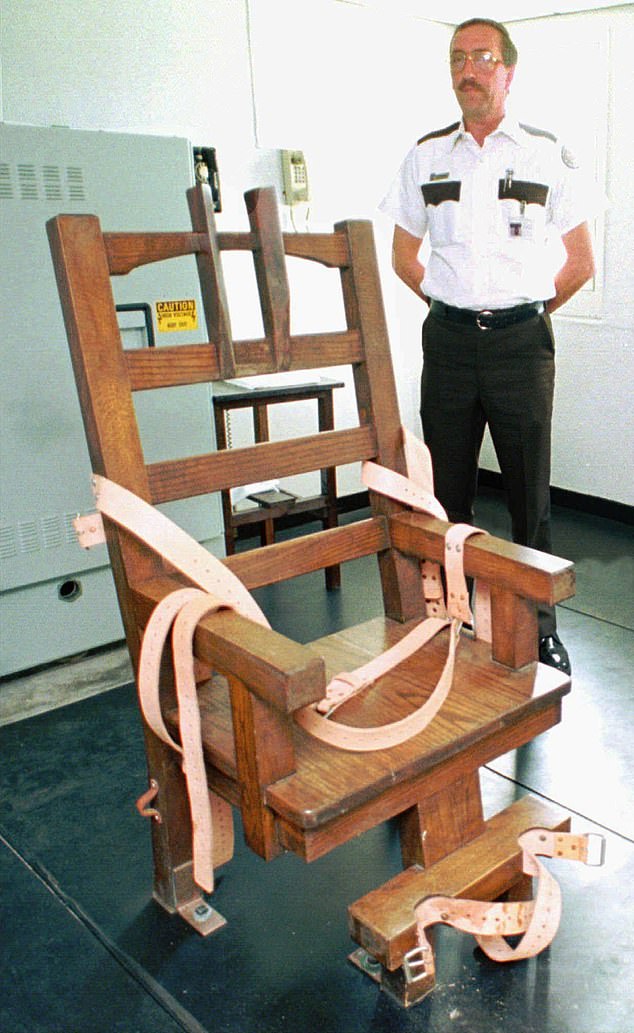
‘He caught fire. His body was twisting and he was fighting the straps,’ the retired warden told the Daily Mail, recalling what happened in the moments after a brown wooden electric chair nicknamed ‘Old Sparky’ began blasting 2,000 volts of electricity into Medina’s body.
‘It was obvious he was still alive when his head was on fire.
‘It was a horrible way to kill somebody.’
Blue and orange flames up to a foot long shot from the right side of Medina’s head as he died in the execution chamber, which sits around 47 miles southeast of Jacksonville.

A Florida State Prison guard pictured next to ‘Old Sparky’, the state’s electric chair, seen in 1996. Pedro Medina became the chair’s final occupant the following year after an execution that went horrifically wrong
They blazed for six to ten seconds, filling the austere, white-walled room with acrid smoke.
Medina, who lurched back in the chair and clenched his fists as the execution began, took four agonizing minutes to die.
With McAndrew standing by, the killer’s final words before he was engulfed in flames were: ‘I am still innocent.’
The Cuban-born murderer, who was 39 years old at the time of his death, had murdered his elementary school-teacher neighbor, Dorothy James, in 1982 after she befriended him.
Medina stabbed her multiple times before leaving her to die in her Orlando apartment, then stole her car – which he was driving when he was arrested.

Medina, who murdered schoolteacher Dorothy James in 1982, caught fire as 2,000 volts entered his body, with giant orange and blue flames shooting out of the side of his head
Despite the horrific act, McAndrew said no crime on earth would justify Medina’s dreadful final moments.
The electric chair he was killed in was first used in 1923 and had previously put 239 others to death, including serial killer Ted Bundy.
Medina was to be Old Sparky’s 240th and final occupant.
Afterward, the smell of charred flesh filled the nostrils of everyone unfortunate enough to witness the spectacle.
‘The smell was putrid,’ McAndrew recalled.
‘The smell stuck to everything. I had to have that room entirely scrubbed, all the walls and the floor and the electric chair itself, it all had something that was in the air stuck to it.
‘I thought I could never get clean after that.’
McAndrew, who oversaw eight executions, told the Daily Mail he fears Medina’s was deliberately botched to inflict even greater pain on the killer.

Executioner Ron McAndrew (pictured in 2005) oversaw the execution of Medina and seven other people. He says his experiences ended his support for capital punishment and he now campaigns for the abolition of the death penalty

The electric chair at Florida State Prison pictured shortly after its construction in 1923. It was in use for 54 years, until the execution of Pedro Medina
He recalled two electricians helping with the preparation and seeing one of them preparing a saline-soaked sponge that is typically placed on an inmate’s shaved head to guide the current directly to their brain.
‘I saw one of the men dip down into the bucket of the saline solution, and when he got the sponge, he squeezed it rather tightly,’ he said.
The executioner said he asked the other electrician at the time, ‘Did he leave enough water in that sponge?’
‘His response was, “Yeah we’re good to go boss.”‘
When the electric chair switch was flipped, that drier-than-normal sponge may have been what caused Medina to burst into flames.
The scene was eerily similar to one from the 1999 film The Green Mile, where a dry sponge caused a brutally flammable execution.
‘There have been a lot of questions about what happened there,’ McAndrew said when asked if the unidentified electrician may have targeted Medina for a particularly painful ending.
Medina’s death was so barbaric that Old Sparky was mothballed.
The device was outlawed in Florida two years later, with subsequent executions carried out by lethal injection.

A hearse carrying murderess Aileen Wuornos leaves Florida State Prison after her execution in 2002. The Sunshine State executes more prisoners than any other – and the speed at which they are being carried out is continuing to grow
McAndrew began his career as a staunch supporter of the death penalty, having lost a cousin and sister-in-law to murder.
He ended up overseeing eight executions – three by electric chair in Florida.
After Medina’s death, McAndrew was sent to Texas by then-Florida Governor Lawton Chiles to learn how to carry out lethal injections, including what cocktail of lethal drugs to use and how to strap an inmate into a gurney.
McAndrew then helped manage five of those in the Lone Star State.
Upon his return to Florida, McAndrew said the psychological toll of enforcing the death penalty had become too great. He pleaded with the Department of Corrections to allow him to become a warden instead and was granted his request.
‘Executions have a way of staying with you,’ he said.
McAndrew told the Daily Mail the process of getting to know an inmate for some time, before hauling them from their cell in shackles and strapping them to a gurney, inflicts a psychological toll on the prison staffers that is often not recognized by the public.
‘It is not like being in a foxhole and firing at an enemy that is trying to kill you,’ he explained.
‘You had them under your supervision for many years, you get to know them, and then suddenly because the governor wants to be in the newspaper, he signs a death warrant.
‘It was very easy for me to learn that the most horrible punishment is actually locking someone in a cage for the rest of their lives.
‘They call it an execution, but I can assure you it is not an execution – it is a premeditated, ceremonial, political killing. Nothing more, nothing less.’

Florida Governor Ron DeSantis fast tracked the execution of one killer after the victim’s family sent him custom blue Sharpies – the same type of pen he uses to sign all his legislation
The retired warden spoke out after The New York Times revealed the dramatic increase in executions carried out in Florida at the behest of Governor Ron DeSantis.
DeSantis signed the death warrants of 19 inmates in 2025 alone – accounting for 40 percent of all executions in the United States that year.
The Times reported that the family of Michael Sheridan, who was murdered by Ronald Heath in 1989, devised a clever trick to try and fast track Heath’s execution.
They sent DeSantis custom blue Sharpies – the type of pen DeSantis always uses to sign official orders – urging the governor to speed up Heath’s death.
It is unclear what the message printed on the pens said, but it ended up working – Heath was put to death shortly afterward.
DeSantis will complete his second and final term as governor later this year and is rumored to be angling for the job of United States Attorney General.
President Donald Trump is an enthusiastic supporter of the death penalty and will likely approve of DeSantis’s staunch pro-execution stance.
The death penalty remains legal in 27 US states. Eight of those – Arkansas, California, Kentucky, Louisiana, Montana, North Carolina, Colorado and Oregon – all have some form of moratorium which has led to a pause in executions.
A 2025 Gallup poll found that 52 percent of Americans support the death penalty, down sharply from the 80 percent who backed it in 1994.
Younger people are far more likely to oppose the death penalty than older generations.
The poll showed there is also a stark political divide – 82 percent of Republicans support capital punishment, compared to just 32 percent of Democrats.