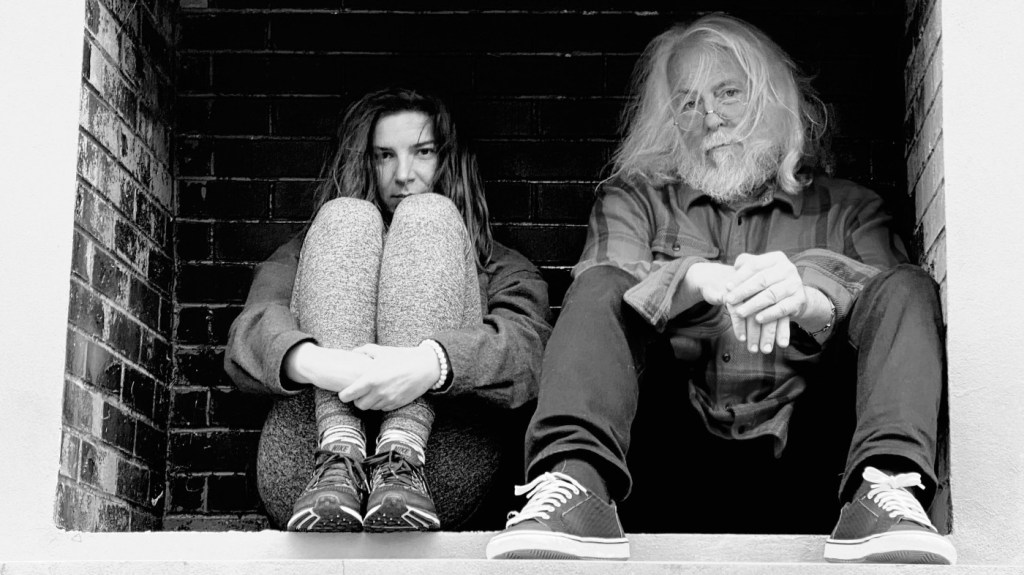
Robert Richardson, christened “Big Bad Bob” by Brad Pitt, took time of his insanely busy schedule to spend his July 4 weekend in the Czech Republic. The occasion was the world premiere of Robert Richardson: The White Devil, an eye-opening documentary directed by Czech filmmaker Jana Hojdová. The film began life as a student project in 2016, with Hojdová writing a letter on spec, not expecting a reply. But not only did Richardson reply, he invited the director to visit him in the States — little realizing that the imminent COVID epidemic meant that his houseguest would be staying a lot longer than expected.
The result of this collaboration is a candid, warts-and-all depiction of one of the most respected cinematographers in the business, with ten Oscar nominations and three wins for his work with American auteurs such as Oliver Stone, Quentin Tarantino and Martin Scorsese (who — surprisingly — turned Richardson down for Cape Fear, saying, “I’m thinking I need somebody that’s more old school”). Now 70, Richardson has mellowed with age — assuming some of the more brutal anecdotes about his tendency to fire at will are true — but he retains the edge that separates him from his contemporaries. As Tarantino puts it in the movie, “There’s Bob Richardson and there’s everybody else.”
DEADLINE: Do you think this film would have existed without COVID?
ROBERT RICHARDSON: It wouldn’t have been the same if COVID hadn’t happened. There’s no way. No, not possible, because I wouldn’t have had the time. [Laughs.] She wouldn’t have the time to force me into what she did.
DEADLINE: There’s a real energy to the film, which is not so much about you wishing she wasn’t there but just wishing she’d go. But, at the same time, you seem to know that there’s a kind of magic coming out of these interviews…
RICHARDSON: It’s interesting because I knew I was going to be there with her once it became clear she couldn’t fly home. And then it was just a matter of having to learn to accept what the length of that time was going to be. I literally say, “If lockdown goes too long, someone’s going to come down and take my home away. It’s over. Just I’m not going to be able to afford it.” And with her, she would not stop! Every f*cking day, it would be something new. It was like I didn’t want to get up sometimes, but I had no place to escape to. You could walk to the beach, but you couldn’t really get in the car and go out. If you did, you’d just go out and drive around. You couldn’t get out of the car. You’ve got to put a mask on if you want to grab groceries, and you come straight back.
But I’m grateful to her, she found everything, all the archives and all the things that had been boxed away. Some destroyed, some not, photographic albums from when I was a kid. And as a result of that, it was actually to my great benefit because it’s great for my family. So, in that, I saw a positive, and I also enjoyed some of the technical elements, like, “Alright, let’s buy a 16mm projector. Let’s put this up on the screen. Let’s see what this reel of film looks like, because we just don’t know.”
DEADLINE: So, you couldn’t help but interfere?
RICHARDSON: What else am I going to do? [Laughs.] I would buy different projectors, Super 8 projectors, and have them shipped in. Some would be bad. They wouldn’t even have bulbs. But at least we got through a lot of material, and then we even found ways to be able to project some of the videos and find old different format cameras to put, because I didn’t have those cameras anymore. They’re all defunct. I have probably 60 different cameras, but none of them are working, and I don’t have all the parts for them. You don’t have the batteries, you don’t have this, you don’t have that. You don’t have the cables. And so, we found all those things and she just was tenacious about it.
DEADLINE: It’s only been 40 years since Platoon, and yet the technology has changed so much. But you seem to be on top of it.
RICHARDSON: It’s what I like to do. I don’t see it as any reason not to think what the next step’s going to be. I remember when producers said, “Well, we now have a fast stock. It’s 500 [ISO]. You’re going to need less lights.” Well, now you have a camera that’s 6,000. I’d be like, “OK, so are you just saying that we don’t need to light anymore?” And the producers would say, “Yeah, that’s actually what we’re saying.”
DEADLINE: And you’re fine with that?
RICHARDSON: No! But sometimes you need to subtract, to learn how to get rid of light, not add it.
DEADLINE: Your story’s very rock and roll, if you don’t mind me saying. Anybody who can take six tabs of acid at one time is pretty hardcore. Is that something you’d recommend?
RICHARDSON: [Laughs] No, I don’t recommend that. I think it’s for the very limited few. And it has to be a young brain that can absorb basically having issues for the rest of your life. I never went hard. I did coke, but I didn’t do anything else. No interest. But [acid] made me see things differently.
DEADLINE: It’s a very creative drug. You don’t really become a slave to it.
RICHARDSON: No, you can sit on a grass and suddenly the grass is the universe. Which is when we were scouting for The Doors, I ate mushrooms for the tripping sequence. Oliver was completely straight that whole time.
DEADLINE: For that movie?
RICHARDSON: No, on that scout. But I wasn’t. And it helped me to see. But shooting is different. When I’m shooting. I don’t play around.
DEADLINE: How would you describe your relationship with Oliver Stone? It’s hard to know where your work starts and his work ends…
RICHARDSON: You remember the scene in The Doors? It’s outside the Whisky A Go Go [in LA] — Jim Morrison jumps up [onto a parked car], and the stars move. That’s pure Oliver. That’s not a shot where I said, “Let’s go shoot that shot.” I did things like help him with timelapse, for example. But Oliver’s work is inspirational. Look at JFK. It’s like those are words put up on a screen that have been transported to a visual medium. But it’s also very, very, very dependent upon the words that are being spoken, and the way he lets the situations play out. He allowed a lot of things to take place in that movie.
DEADLINE: You’re very physical with the medium of film. Obviously, you had to be physical with celluloid, but it does seem that you are always thinking about the language of technology and also the language of cinema, and that you’re always trying to find a way to put the two together. Am I just imagining that?
RICHARDSON: No, no, that’s it. If you look at Natural Born Killers… [Pauses.] Oliver and I were in different spaces on Natural Born Killers.
DEADLINE: In what way?
RICHARDSON: Well, my wife almost died giving birth to our second child and then his wife told my wife that Oliver had said, “Well if she dies, he’ll have no problem getting another wife.” And it did not go over. I was scouting in New Mexico, and she called and said, “I talked to Elizabeth, and I want you off that movie when you come back. You’re not making it or I’m going to divorce you.”
DEADLINE: Is that the last film you made with him?
RICHARDSON: No, I did U-Turn. But I made the movie with him and I said, essentially, “Alright, well, if that’s how she feels, that’s the end. I’m sticking with this one.”
DEADLINE: Has a movie shoot ever been too crazy for you?
RICHARDSON: Natural Born Killers was too crazy. That one went over the edge.
DEADLINE: Can you say why without libeling anybody?
RICHARDSON: I think you can hear it in the interviews. Like, Woody Harrelson goes, “I don’t know [what happened].” Robert Downey says, “It’s like, what illicit substance was not [taken]?” You just look at the film and you can feel it. Also, when I decided I would make it with him, I told him that I didn’t like the script. And he said, “Well, if you make it, you can do anything you want in support of the script. But when you make it, you have to make it with the same level of passion you would any of my other scripts.” So that’s why you see so much rear projection, and blood, and all those things that start to happen. And it is a pretty genre-bending movie.
DEADLINE: Did Quentin ever hold it against you that you did Natural Born Killers? Do you ever discuss it?
RICHARDSON: No, we don’t discuss it. It just doesn’t come up. Don [Murphy] and he, they sold the script to Oliver, and Quentin wishes it hadn’t been that way, but there was nothing he could do about it because he sold it. He’s never watched the movie. It’s so not him. A lot of the elements that are in Kill Bill — the animation and all that — are all in this film. But, no, it’s not him.
DEADLINE: Did you discuss that when you started preparing for Kill Bill?
RICHARDSON: No, never. I don’t bring up any movie before shooting. I mean, for that movie, we watched a lot of films. I’ve seen a lot of anime and things like that, so I was very interested to see what he was going to do, and it’s brilliant what he did too. Kill Bill is a masterpiece.
DEADLINE: And The Whole Bloody Affair?
RICHARDSON: I liked seeing [The House of Blue Leaves scene] back in color. I was a little upset when the black-and-white came in, but it was the only way he wasn’t not going to get an NC17, or whatever it was at that time. It’s so much fun. That’s the way Quentin is. I think all his films have done the same thing one way or another.
DEADLINE: There’s an interesting moment towards the end of the documentary where Quentin says he wouldn’t have worked with you again if you hadn’t changed your attitude. What changed?
RICHARDSON: I don’t even know what happened. [Laughs.] I don’t know what he’s talking about. Who knows if I was [a nightmare]? But that’s a crew that I worked with for 30 years and I’m right now shooting with the key grip and the gaffer, so… Sorry, folks!
DEADLINE: There’s a misunderstanding about Tarantino, because people think the personality he projects to the media is the one he brings to set. But he’s not a mercurial character on set, he’s very collaborative. Although I’m sure there are times…
RICHARDSON: Initially when we were making [Kill Bill], there were [a few incidents] because he was falling behind. I said to the guys like, “See yourself on the beach. You’re grass, and the wind’s coming. Just bend. Let it go right through you.” But generally, he was always really great. And the more he worked with the crew — like when we did each of the films after — he was brilliant, because he fell in love with the crews that we were working with, and they became close friends of his. And also, he had more trust in me as we went along in Kill Bill, and that shifted us because initially he was, “I want my own camera operator.” I said, “No, I want to operate. That’s a deal-breaker, because I want to be next to you and I want to look at the actors with you. I want that because that’s going to be us and how we talk.” So, we formed a very tight bond.
DEADLINE: When did the crane become your signature?
RICHARDSON: Well, now it’s gone more and more remote, because more and more people can’t handle the crane. Y’know, it’s a cumbersome animal to build, and to weigh in, and it doesn’t have the same flexibility that you get with a 50-foot techno or something with a remote head on it. So, you can get more out of it, but for Once Upon a Time… he said, “Let’s not use that.” I said, “OK, no problem.”
DEADLINE: Is there any news on what’s going to happen with Once Upon a Time…? There was so much shot for that movie that didn’t make the final edit. Have you ever heard whether there’s going to be a longer version?
RICHARDSON: You have to anticipate that. I would think you’d be a fool not to think there’ll be something that’s longer. I think as time moves on, he’ll go back and redo films. Look how many versions Reservoir Dogs came out in, and I think that you’re going to see more versions of Once Upon a Time… once David Fincher’s film comes out.
DEADLINE: Tarantino keeps tantalizing us with his 10th movie. Do you ever speak to him about that?
RICHARDSON: No, nobody know what he’s going to do. We know that he’s going to finish [his play], so he’s not going to shoot till after that. So, there’s a possibility sometime next summer. I have no idea what it is, but he won’t be walking down the same path he’s currently walking. I don’t know what he’ll do.
DEADLINE: Were you going to do The Movie Critic with him?
RICHARDSON: Yeah, I was. Actually, I was going to make Michael [with Antoine Fuqua]. And it was a different version. I scouted it. I was hired, and then Quentin called me. He said, “I’m going to make this film, and I want you to make it because it’s my last movie, The Movie Critic. Can you talk to Antoine and ask if he’ll let you go, so that you can finish my last film?” I called Antoine, and Antoine didn’t even hesitate. He said, “Absolutely. You two should finish together.” He went on and hired another DP, and then Quentin dropped out. He called me and said, “I’m going to change the script. It’s going to be another script.” And then he started prepping that film and it got out of whack and it went away.
DEADLINE: So, to bring us up to date, what are you working at the moment?
RICHARDSON: I just did Madden, with David O. Russell, and I was going to make Hannibal with Antoine and Denzel Washington for Netflix — Hannibal Barca being the general in Carthage — but it fell through just two weeks ago. I was on it for 10 or 12 weeks.
DEADLINE: How would you describe David O. Russell?
RICHARDSON: [Laughs.] Seriously brilliant, but he’s got a side of him that is highly unpredictable!
DEADLINE: In a sentence, what can you say about the new film that he’s made and your work on it?
RICHARDSON: I’m unsure what my work’s going to be like because I haven’t seen it. I haven’t seen a cut. I was disappointed in my work when I was doing it. We were working so fast, and we had so many pages of script, so I’m not yet sure whether I’m going to be happy with my work. What I want to be is happy with his work. If his work’s good, mine’s good.