A woman’s research into who her ancestors were during the American Revolution led to a groundbreaking discovery that reshaped the historical understanding of Florida’s role in the war.
For decades, it was commonly understood that Florida had a far less pronounced influence on America’s victory over the British than other states such as New York, South Carolina or Massachusetts.
But two years ago, Florida native Carol Garner accidentally stumbled into evidence that dismantled that commonly understood narrative.
Garner was researching her family tree in the archives of Raleigh, North Carolina, when a reference librarian suggested she speak to a man who had been transcribing and digitizing pension records of Revolutionary War soldiers.
It turned out that Garner and the man are both descendants of a soldier named John Scott, who along with another soldier named David Walden, had given detailed verbal accounts of Florida patriots’ roles during the Revolution when they applied for their pensions after the war.
Scott and Walden did not know how to read or write, but another individual had faithfully recorded their stories, which recounted patriots’ guerrilla tactics that forced the British to travel by sea, eventually contributing to England’s devastating naval loss which essentially ended the war.
‘I don’t think we should have an inferiority complex of not being as patriotic as Massachusetts or Charleston or any of those other places that had battles,’ Garner told First Coast News.
‘The patriots here were so persistent that it forced the British to go by sea up the coast,’ she added.

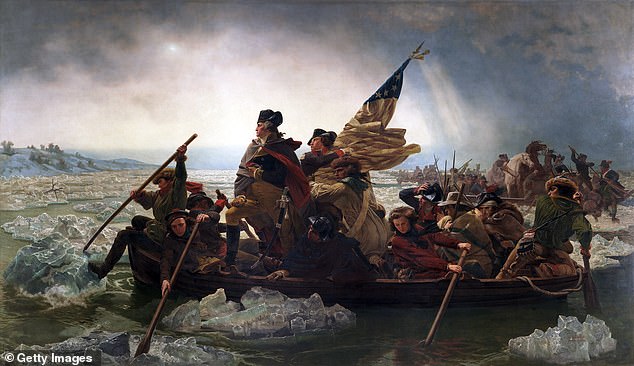
Verbal accounts from Florida patriots reveal that guerrilla tactics forced the British to avoid using a vital road and travel by sea instead, contributing to a major naval defeat. George Washington is pictured in a painting with Continental soldiers

Verbal accounts from Florida patriots reveal that guerrilla tactics forced the British to avoid using a vital road and travel by sea instead, contributing to a major naval defeat. George Washington is depicted with Continental soldiers
The reason it has taken 250 years to set the record straight on Florida’s contribution to the Revolution is that historians have long relied on letters and documents left behind by literate British officers.
Those officers were inclined to highlight Britain’s victories in formal battles that occurred in the state while ignoring skirmishes and smaller losses.
But Scott and Walden’s accounts show that the records left behind by British officers were biased and did not tell the full story.
During the Revolution, the northeastern Florida city of Jacksonville was called Cowford, and it was a critical crossing point over the St Johns River.
When the British took control of Florida in 1763, they built Kings Road connecting St Augustine to the Georgia border, and they operated a ferry in Cowford that connected the two sides of the road separated by the river.
Kings Road was a critical supply line through which the British moved artillery, supplies and men, so it was a target for the patriots.
Between 1776 and 1779, patriots constantly ambushed British forces in Cowford and on Kings Road. They hid in swamps and bushes, waiting for the redcoats to come by in their bright uniforms, then attacked.
Garner told First Coast News that one of her favorite stories from those ambushes was when Americans pounced on a regiment of redcoats, stripped them of their uniforms and sent them back to their fort naked.

During the Revolution, Jacksonville was called Cowford and served as a vital crossing point over the St Johns River. The city and river are pictured today

American troops constantly harassed the British at Cowford and along Kings Road, forcing the Crown to move troops by sea. A battle between British and American forces is pictured
‘But they didn’t kill them. They still felt enough brotherhood with other British, because they were colonists; they all came from England. They just wanted to keep them from pestering,’ she told the outlet.
The patriots then disguised themselves with the uniforms to raid loyalist plantations, stealing livestock and supplies.
The three official American campaigns to take St Augustine all failed, which is the story that has been told in history books for centuries, but Garner’s discovery has revealed that patriots’ smaller victories were a major strategic success.
Kings Road was a vital artery for the British meant to allow troops to travel by land all the way from St Augustine to Savannah, Georgia, but the constant harassment by patriots made the road unusable for the crown.
The British were thus forced to move soldiers by sea, making them vulnerable to Spanish and French ships along the coast.
Ultimately, the movement of troops by sea led to Britain’s defeat. The crown had sailed to Savannah, then to Charleston and continued north before they were flanked by a French fleet positioned at Yorktown.
General Cornwallis marched his troops into the port city and found himself surrounded by George Washington’s forces on land and the French ships at his back, forcing him to surrender.
Cornwallis’s surrender in Yorktown marked the end of the final major campaign in the Revolution and essentially guaranteed America’s official victory in the war less than two years later.

British troops forced to travel by sea were surrounded in Yorktown by Washington’s troops on land and a French fleet. Washington is depicted giving orders before the Battle of Yorktown

General Cornwallis was forced to surrender because he was surrounded, essentially guaranteeing America’s victory in the Revolution. Cornwallis’s surrender is depicted
Florida’s contribution to that legendary moment in American history is now commemorated in a plaque that was recently erected in Jacksonville.
Garner spent two years getting the marker approved, as she had to verify every claim three different ways. She submitted 25 different versions of the plaque’s text before one was finally approved.
Although the effort was lengthy and arduous, she told First Coast News that the timing with America’s 250th anniversary made it all worth it.