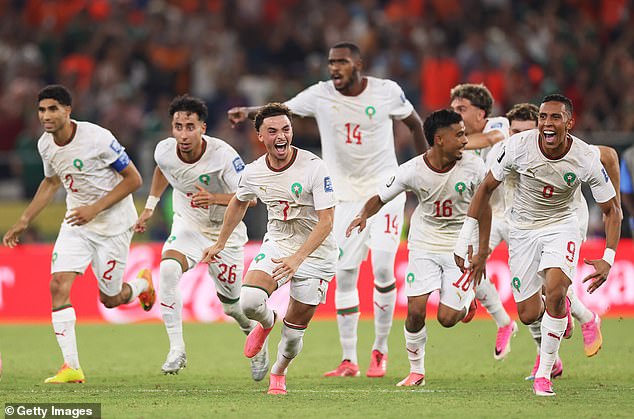
They’ve been flooding through the streets of Casablanca in every imaginable way after each of Morocco’s World Cup games: crammed into open car boots, perched in groups of four or five on scooters, children in pushchairs or on shoulders — thousands upon thousands of them, celebrating another advance to the knock-out stages.
And though it would be easy to characterise this as uncoordinated madness – an African nation miraculously defying the odds – it really is anything but that. Morocco are in the quarter finals of the World Cup because of huge and purposeful investment, driven by the nation’s monarchy and funded by minerals wealth. It makes them a serious outside bet for the 2030 tournament, which they co-host, and for a run even deeper into this one.
A fierce sense of nationhood has been central to the work Morocco have done. When Walid Regragui’s team reached the semi-finals in Qatar, all the meetings and team talks were in Arabic, with players who didn’t speak it seated next to those who did, to ensure they understood.
Yet it has been to outside expertise that the Morocco FA has turned, to develop technical, coaching and scouting structures to help them compete. It means that the African nation represents a little corner of Wales at this World Cup. First, in 2019, they recruited Osian Roberts, the former Wales technical director who had helped Chris Coleman guide the country to the semi-finals of Euro 2016. Then they turned to former Wales FA chief executive Neil Ward.
Roberts, who was approached by the Moroccans in 2019, helped create an identifiable Morocco football identity, appointed coaches for the national age-levels and strengthened Morocco’s recruitment of dual-nationality players in France, Belgium and Spain. He also helped create a grassroots coaching system – an area where he had built an outstanding reputation in Wales. Former Wales FA chief executive Neil Ward was recruited to oversee this plan, put the systems in place and build out further.
Roberts, now technical director at Serie A club Como, describes the level of football investment driven by Morocco’s King Mohammed VI and the country’s government as ‘outstanding.’ Both he and Ward say the national youth football academy in Rabat, which takes the monarch’s name, as the best such facility they have seen anywhere in the world. ‘The King and Government see the power of football and what it can deliver for society,’ Ward tells Daily Mail Sport. ‘It cultivates identity and soft power. Being World Cup hosts in 2030 has accelerated the investment.’ The renovated £70million Moulay el-Hassan national stadium at Rabat is extraordinary.

Morocco’s victory over the Netherlands on Tuesday set up a clash with Canada in the Round of 16 tonight

Back in the Moroccan city of Rabat, which takes the country’s monarchy’s name, thousands of fans lined the streets to celebrate
There are echoes, here, of how and why the Abu Dhabis and Saudis have invested in football, with Morocco’s cash coming from its new-found wealth. The country sits on an estimated 75 per cent of the world’s global phosphate reserves, used for lithium batteries and LED displays. But Morocco has the vast football-playing culture which the Gulf nations lack. ‘The game is played everywhere,’ Ward says. ‘Street football still exists on areas of scrap ground and on the beaches.’
In a nation wracked by poverty, the size of investment to make Morocco competitive has been controversial. When violence broke out in the suburbs of Agadir last December, resulting in 400 arrests and several deaths, angry youths shouted: ‘We’re sick of investments in football and nothing for anything else.’ When the three new regional football development centres which feed into the Rabat academy, and renovated stadiums are factored in, the cost will extend to billions of Moroccan diram.
The team’s extraordinary loss of the African Nations Cup has overshadowed what a strong squad they have brought here. It’s no coincidence that their four outstanding players so far at the tournament were born outside of Morocco. Captain Achraf Hakimi and breakout star Ismael Saibari, the attacking midfielder, were both born in Spain. Veteran goalkeeper Yassine Bounou, aka ‘Bono’, has a Canadian birthright and midfielder Bilal El Khannouss, briefly at Leicester City, Belgian.
The art of recruiting from the European diaspora – with Fulham’s Issa Diop switching allegiance from France only four months ago – is a finely honed one for the Moroccans. The scouting system which Roberts helped put in place is designed to connect with young players across Europe to raise their awareness of the Morocco possibility. Not to impose a choice, but to support them.
Ward feels that Morocco’s capacity to take the next giant step and become the first African or Asian world champions is contingent on an ability to hone jewels from the millions who play the game in the country itself. ‘The real test for the future is the profile of football at home,’ he says. ‘What’s missing is the development system. They need to build a better club infrastructure so they can develop these players.’
There is also an immense impatience for the national youth level coaches to deliver results – stemming from a Moroccan football culture they call being ‘dynamique’ – reacting to events as they happen. ‘They need to find a balance between performance and results; to allow coaches time. There’s so much pressure on the national under 15s and under 16s coaches to deliver too much, too soon,’ says Ward. ‘Coaches in that system are in a constant state of stress and worry. The FA will quickly change tack if they think they are not getting results quickly enough. They need to learn that things take time. But I think Morocco have potential to become a real world powerhouse.’

Four of Morocco’s standout players this summer were born outside of the African nation (Saibari and Hakimi, both born in Spain, are pictured)

A victory against the Canadians would see Morocco setup a clash with either France or Paraguay in the quarter-final
Victory over Canada in Houston creates a potential quarter-final next Thursday in Boston against France, who beat them in a Qatar World Cup semi-final which left many Moroccans feeling the team had been too awestruck. The chance to face Didier Deschamps’ team again would be cherished for all who are looking to football to further Morocco’s national identity. France spent two decades conquering Morocco in the early 20th century and its 1907 bombardment of Casablanca was the decisive battle in the country’s subjugation.
Morocco seem to hold no fears. ‘This team, and all the Moroccan youth teams, are fighting for much, much more than just football or simply winning a match,’ said Morocco’s Belgium-born coach Mohammed Ouabi, who coached Morocco to victory over Argentina in the under-20 World Cup final last year. ‘Behind them there are millions and millions of people. That gives you the energy not to give up. To keep going and to believe in yourself.’
How much is David Beckham set to pocket from his World Cup brand deals? Take on our quiz in our newsletter HERE.