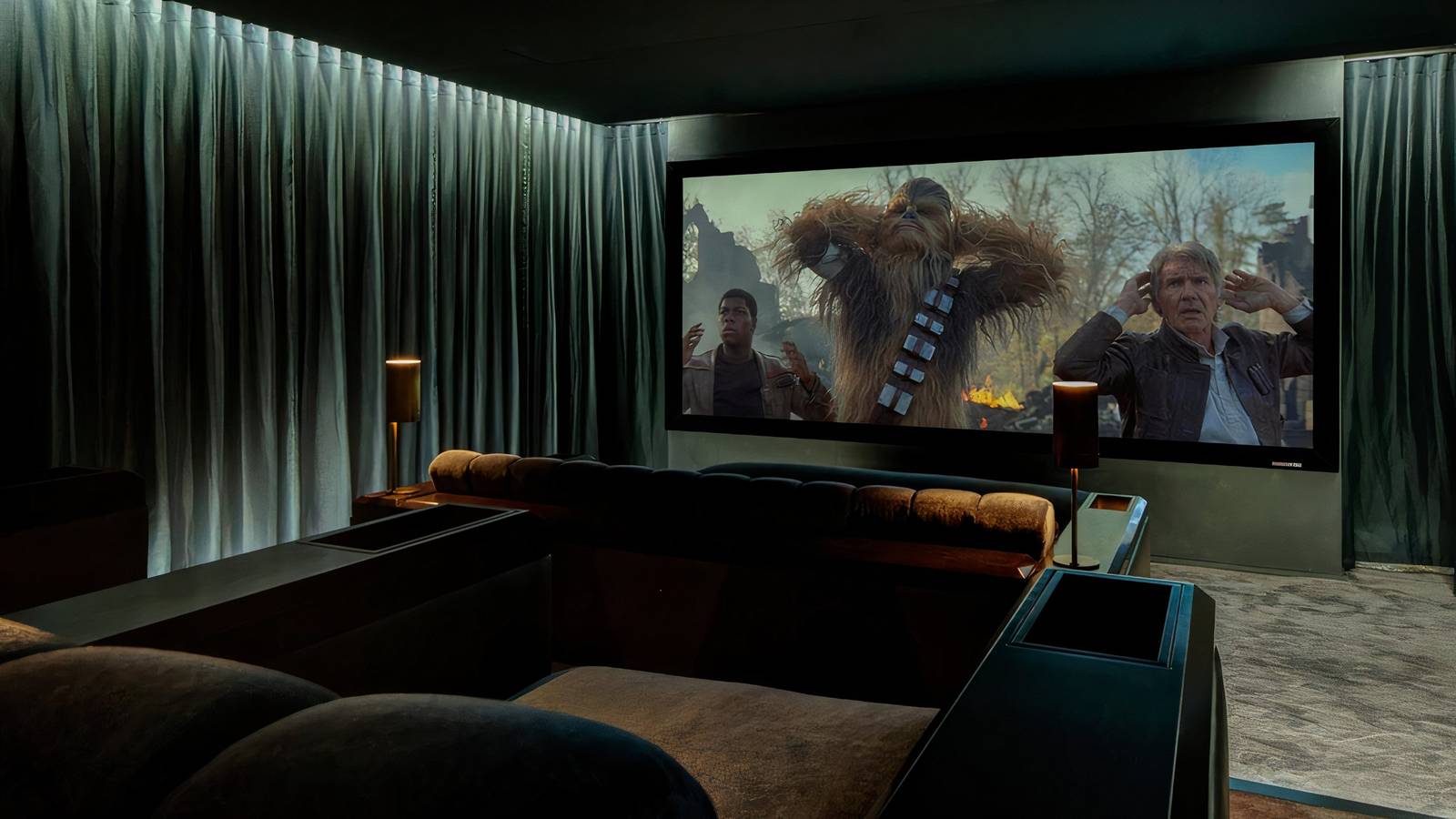
If you’re a relatively casual home theater enthusiast, you might be forgiven for thinking that Dolby Atmos is just a sticker slapped on devices to show they support any form of surround sound. Quite a few TVs and speakers have the label, sometimes even if they can’t manage more than stereo on their own.
The diehards know that Atmos is built to go big — very big. It originally premiered as a theatrical standard in 2012, alongside the Pixar movie Brave, the goal being to immerse audiences in a 3D soundscape. It supports configurations up to 24.1.10, which breaks down to a ridiculous 24 bed channels, a subwoofer, and 10 ceiling satellites, which you will never, ever see in a home that isn’t a mansion.
More plausibly, you might be entertaining the idea of going the 7.1.2 route or something north of that. That’s doable in your living room — but if you’ve just started floating the idea, there are a variety of factors to consider, some of which have steered me away. Price is the biggest, yet that’s hardly the whole picture.
A receiver and external amps are mandatory
There’s no out-of-the-box approach

I’ve said this elsewhere, but I’m a big fan of convenience when it comes to setting up an audio system. I want minimal friction between me and my entertainment. And honestly, I’m not picky about having surround sound as long as my audio is clear and punchy. I’d rather own a high-fidelity 2.0 soundbar if it means setting things up in a few minutes. For me, an all-in-one bar that simulates Atmos is ideal.
A true 7.1.2-channel setup requires a receiver. You simply won’t get a speaker-only solution that can manage that many channels. The processing demands are intense, and so are the power requirements. You likely won’t find all the speakers you need in a form factor where each is self-sufficient.
Power should be your primary consideration in this situation. That’s because some receivers process more channels than they can actually power. There are models that do support nine channels — but over that number, you’re increasingly likely to need external amps connected to your receiver’s pre-outs, assuming it has any. Simply bumping up from 7.1.2 to 7.1.4 will probably involve adding another two-channel amp, and you’re really off to the races beyond that. Whatever you do, make sure all your gear is rated for the wattage of speakers you’re using.
Wiring and positioning is going to be tricky
A weekend project, possibly longer

It goes without saying, but you’re going to be doing a lot of wiring work. That includes 10-plus speakers, HDMI and power connections, and any external amps. On its own, that’s not a big ordeal. Most people aren’t comfortable with exposed cables running everywhere, however, so you’re going to be spending at least some time (and money) figuring out how to conceal and protect them. Your partner will be rightly mad if they end up tripping over side- and rear-channel cables every time they enter the room. Then, of course, there are those ceiling channels, which not only need concealed wires, but special mounting. All these elements can transform your installation into a weekend-long project — if you’re lucky.
I say that partly because positioning speakers can require trial-and-error. For proper sound separation, speakers need to be placed at particular angles and distances from each other, which is why Dolby hosts its own installation guides. You may need to rearrange your furniture to suit that. Moreover, it’s possible to run into unexpected acoustic issues, such as boundary interference from placing a speaker too close to a wall. You’ll have to test all of this with sample audio, so it’s best to avoid locking anything in until the end of the process.
It’s no wonder Dolby suggests paying a contractor to do the work instead. You may even need special room calibration software, which might be more than you bargained for if you were just hoping to take a step up from your Sonos Beam.
Expect diminishing returns
Just how precise do you need effects to be?

There are, of course, fundamental benefits to making the leap from a system that simulates Atmos to one with the real deal. Dedicated channels mean stronger, more noticeable object placement. And each channel is going to have more range, bringing you as close as possible to the theatrical experience.
In a home environment, however, there’s only so much room to separate channels. So while a seven- or nine-channel bed will naturally offer more precise audio than a five-channel one, you may or may not be wowed when jumping between those increments. The same applies to ceiling channels. I’m certain that four satellites offer more dimensionality than two, but six might just be showing off unless you’re covering a very large area.
Remember, also, that a lot of your favorite movies are probably from the pre-Atmos era. Even if they’ve been remixed for Blu-ray and streaming releases, the original filmmakers had simpler standards in mind. More importantly, there’s only so much spatial data you can extrapolate from a vanilla Dolby Surround mix, never mind stereo. In hindsight, we’re extremely lucky that Apocalypse Now used a format called Dolby Stereo 70mm Six Track.
Then there’s the matter of volume. If you’re considering a full-scale Atmos build, you may not be overly concerned about annoying the neighbors. Yet you and your fellow audience members are only going to want the volume so high, limiting how hard all those speakers can punch.
Those speakers might not be moving with you
Plan to be flexible

It’s not uncommon to see Atmos setups with speakers mounted directly on or inside walls and ceilings. It’s aesthetically slick, and in some situations, practical. Flush speakers can avoid issues like boundary interference, and they improve room for furniture and foot traffic.
If you go this route, however, your system literally becomes attached to a single location. To rearrange it, you have to strip out any mounts, then repair the holes left behind. You may even have cable systems running through your walls, and trying to undo those will be a hassle at best, possibly an expensive one. It might be more money and effort than you’re willing to spend. You could end up tailoring your house to fit your audio system, rather than the other way around.
Chances are that you won’t mind that, since it’s not like most houses support a multitude of Atmos layouts, and no one really spends on this level of equipment without planning to stay for a while. Moves are almost inevitable, though, and wall- and ceiling-mounted systems sometimes end up being sold with a house because it’s not deemed practical to take them out. If you don’t want to partly or completely replace your sound system, focus on gear that can be packed up, even if it takes several boxes and some heavy lifting.

- Connectivity
-
HDMI eARC, Bluetooth, Wi-Fi, Apple AirPlay 2
- Audio Channels
-
9.1.4
- Surround Sound Support
-
Dolby Atmos