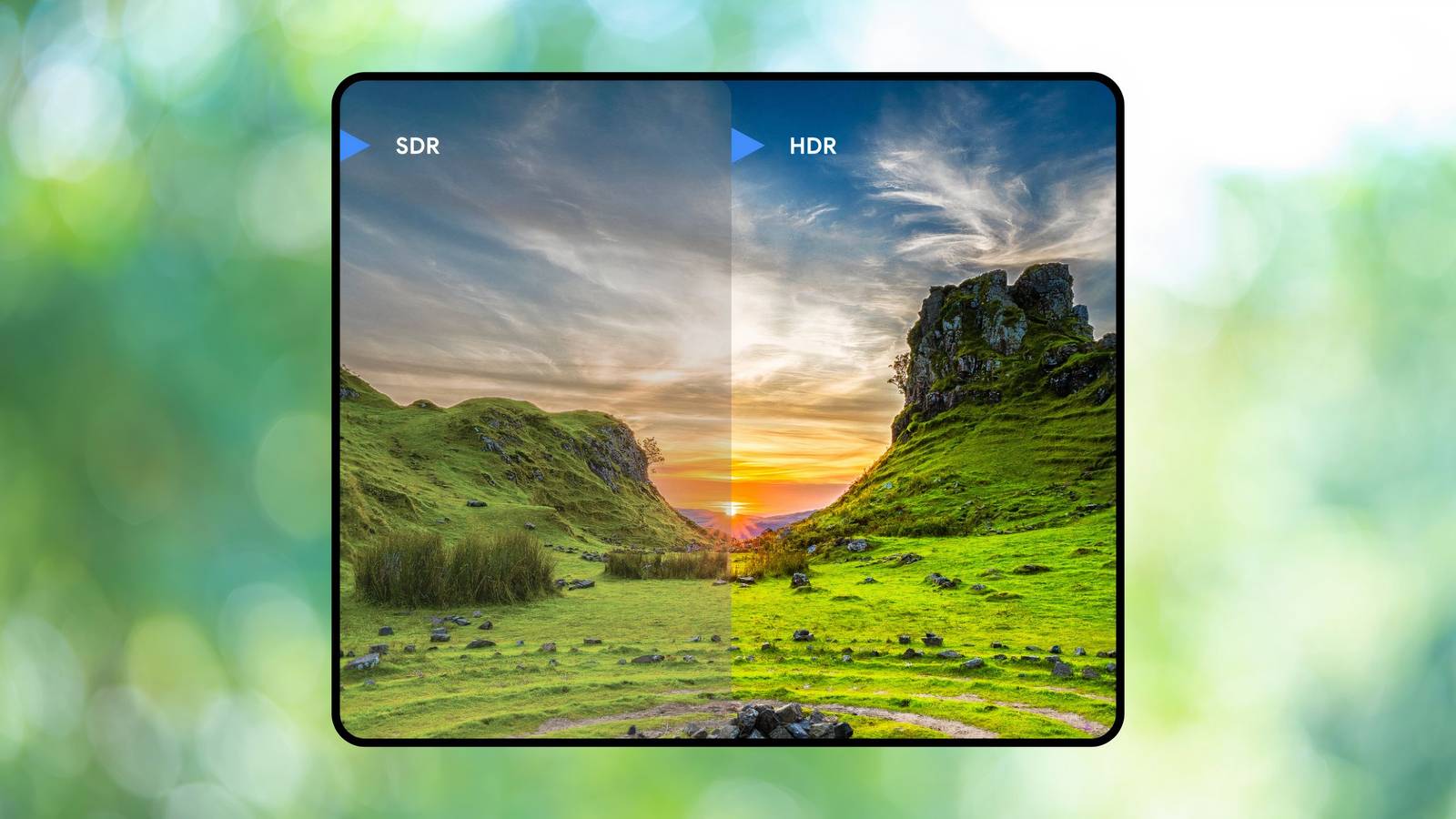
Tech announcements that truly surprise journalists are rare, since there’s usually a rumor of something coming, or it’s just logical that it would happen. I don’t need an inside source to tell me that Google is going to have new Pixel phones in the second half of every year — it would be more remarkable if it didn’t happen. Likewise, Nintendo is always going to make a new 3D Mario platformer for a console, even if it’s running later than normal for the Switch 2.
One of the latest things to catch me off-guard was Eclipsa Video, an HDR (high dynamic range) spec unveiled by the HDR10+ consortium. There just aren’t that many HDR video specs on the market, the current leaders being Dolby Vision, HLG, and the two flavors of HDR10. Until now, the two most exciting ones on the horizon have been Vision 2 and HDR10+ Advanced.
So what is Eclipsa Video, and should you care about it when you’re shopping for a TV? The answer is clear in the short term, but hazier any further out. It might take a miracle to seriously challenge Dolby.
What is Eclipsa Video?
Another spear lobbed at Dolby Vision

Though it’s under the banner of the HDR10+ consortium, Eclipsa Video is more directly a collaboration between Apple, Google, and NBCUniversal in partnership with the Society of Motion Picture and Television Engineers (SMPTE). The spec’s less glamorous name is SMPTE ST 2094-50. If you’re curious, Dolby Vision is ST 2094-10, and HDR10+ is ST 2094-40.
There are a few headlining details here, beginning with the fact that Eclipsa Video is open-source and royalty-free, just like HDR10+. That might not sound crucial until you remember that Vision — the gold standard for HDR — is the exact opposite. Anyone wanting to support it on a device or streaming service has to pay an ongoing fee. For TVs that could be just a few dollars per unit, but with mass production, amounts quickly enter the millions. Samsung — one of the founders of HDR10+ — refuses to support Vision on any of its TVs, even models costing six digits.
If the Eclipsa name sounds familiar, you’re thinking of Eclipsa Audio. That’s an open-source spatial audio format created by Google and Samsung. It was announced well over a year ago, and doesn’t seem to have gained much traction so far, presumably because it’s facing an uphill battle against Dolby Atmos. I’m going to return to that point later, for reasons you can probably imagine.
The Eclipsa Video standard also incorporates two important content metadata types. The first, called Reference White Anchor, maps the brightest parts of SDR content to a particular baseline for your screen, reserving any brightness beyond that for HDR. The idea is that you can watch SDR and HDR content at the same time without one skewing the output of the other.
Headroom-Adaptive Gain Curves are a mouthful, but allow content makers to specify how a display should compress shadows or mid-tones if it doesn’t have much performance headroom, hence the name. This is in service of preserving highlights without sacrificing much detail, and is similar in spirit to the bi-directional tone mapping both Vision 2 and HDR10+ Advanced offer. Traditionally, HDR has looked weaker on budget screens, which has obviously hampered some of its sales potential — you’re not going to sign up for the 4K HDR version of Netflix if there isn’t a dramatic upgrade. The industry is waking up to that fact.
Should you look for Eclipsa Video when you’re buying a TV?
Now we play the waiting game

Not anytime soon. In fact, the format’s announcement included a line that it would “initially address smartphones, with other devices to follow.” The first compatible hardware should be available later in 2026. It’s highly likely that new iPhones and Pixel devices will lead the charge, given that Apple and Google are the only electronics makers onboard at the moment.
Beyond that, things get very murky. Google is promising support “in an upcoming release of Chrome,” but that browser is multi-platform, so there’s no guarantee that a device it’s running on will be able to display any kind of HDR content. Your TV might technically process Dolby Atmos, but that hardly matters if you don’t have speakers that can produce spatial effects.
Eclipsa Video should eventually appear on tablets, computers, and yes, TVs, but there’s no official window for that. The tech doesn’t even have a logo yet as far as I can tell, which is a sign that you shouldn’t bother looking for TV compatibility until 2027 or later. Your real focus should be on Vision 2 and HDR10+ Advanced, which don’t have any compatible movies or shows to watch, but are at least appearing on TVs you can buy this year.
Speaking of movies and shows, I’m curious about NBCUniversal’s involvement. When compatible content does arrive, it’s likely to include services like Peacock, and one or more subsidiary studios. Apart from Universal, some of the corporation’s assets are high-flyers like DreamWorks, Focus Features, and Illumination. Having everything from the Minions to Nosferatu and Downton Abbey in your portfolio isn’t a bad way to get things rolling.
If there’s any hope of Eclipsa Video gaining a foothold, it’s in Apple, Google, and NBCUniversal making an aggressive marketing push, and combining that with dead-simple mastering tools for studios.
Realistically though, the standard is facing quite a climb. Dolby Vision and HDR10+ are deeply entrenched, the former with the edge of a long history and an instantly recognizable brand name, which is probably why so many device and platform makers are willing to pay up. You can even find those standards on many smartphones, among them Apple and Google products. Any content producers interested in Eclipsa Video are going to have to support Vision and HDR10+ anyway — so really, there’s no incentive to adopt something new unless those metadata changes offer an obvious technical advantage. It’s why Eclipsa Audio doesn’t seem to have gone anywhere. Dolby Atmos is de facto and pretty amazing, so companies likely see all the alternatives as a waste of effort. You can’t find DTS:X in that many places, despite the DTS name having once held the same prestige as Dolby.
Traction isn’t impossible. If there’s any hope of Eclipsa Video gaining a foothold, it’s in Apple, Google, and NBCUniversal making an aggressive marketing push, and combining that with dead-simple mastering tools for studios. Should enhancing a video demand a tangible amount of extra work and testing, anyone outside that trio will think twice about it. If creating an Eclipsa master is nigh-on automatic, however, it would be crazy not to try it, since it could improve the chances of content looking its best, currying favor with Apple and Google in the process.
You might be thinking that Apple and Google have the muscle to impose any standard they want on people, but you’d be wrong. Both companies have had many failed projects, including filetypes that either faded away or remained exclusive. For Eclipsa Video to succeed, its backers have to convince the rest of us that it’s about more than dodging royalties.