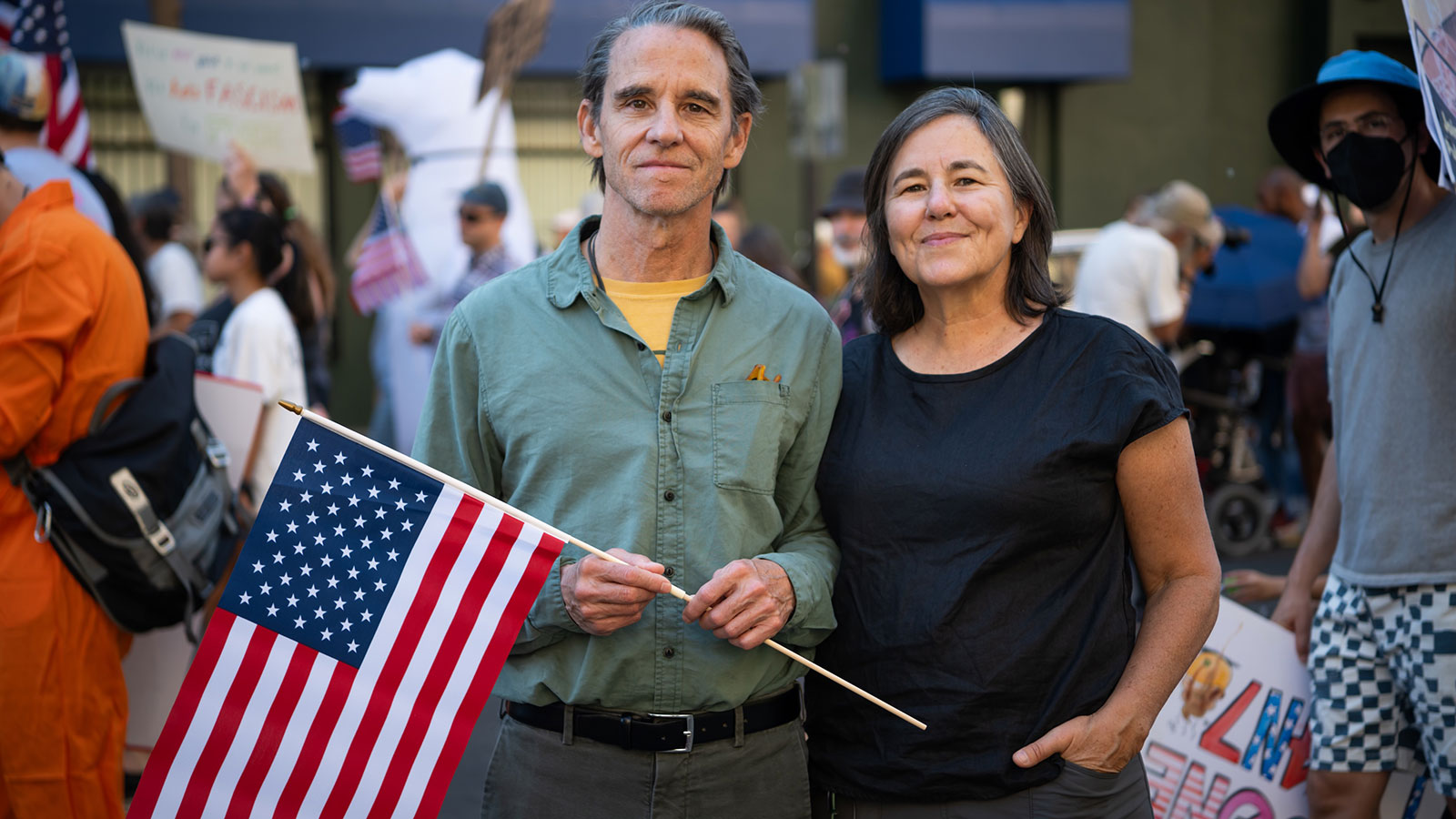
Authors and activists Annie Leonard and Andre Carothers are optimistic about the future. It’s the present that gives them pause.

“If one takes the longer view,” Leonard said in a conversation with Yale Climate Connections before their appearance at Washington, D.C.’s Busboy’s and Poets, “we’ve made a lot of progress. “Fifty years ago, a woman couldn’t have a credit card without her husband’s permission.”
“When I was born,” Carothers added, “there were still segregated water fountains across the South.”
But there has been a backlash to hard-won rights and freedoms.
“The enemies of a multiracial, healthy, and sustainable democracy [have risen] up against all the progress we have made,” Leonard said. “Our democracy is under threat.”
In response, Leonard and Carothers set out to help concerned citizens make their way through the beleaguered present to a positive future. Protest, they want people to understand, has been an essential part of the process of expanding and protecting our freedoms and our homes, including the ecosystems that support them.
But when people try to exercise these rights, too often they are vilified in the media and harassed by authorities.
Although there’s a bronze statue of Rosa Parks in the Capitol Building now, when she refused to give up her seat on the Montgomery bus in 1955, public anger forced her to flee the city.
“We are on a mission to rehabilitate the image of protest,” Leonard said.
The vehicle for this mission is a book, “Protest: Respect It, Defend It, Use It.” Through a series of historical vignettes, it shows how protest has catalyzed the socioeconomic, political, and environmental progress we take for granted today. To promote the book, Leonard and Carothers organized an extended book tour and collaborated with other activists’ projects and programs.
Leonard and Carothers’ own collaboration can be traced back decades to when they both worked for Greenpeace, itself an orchestrator of creative protest. Leonard, best known for the documentary “The Story of Stuff,” served as Greenpeace’s U.S. director and cofounded the Jane Fonda Climate PAC with the activist-actor in 2022. Carothers served as editor-in-chief of the organization’s flagship publication, “Greenpeace,” and on its board of directors before cofounding the Rockwood Leadership Institute, directing the Furthur Foundation, and working as a consultant and activist.
Visually delightful snapshots of protest
“Protest” could be described as a coffee-table book: oversize, richly illustrated, and divided into many short, easily digested chapters. It begins with separate introductions by Carothers and Leonard and ends with an afterword by political commentator Robert Reich.
In his introduction, Carothers emphasizes “the long arc of protest,” from Socrates’ performative death to the civil actions of Mahatma Gandhi, Martin Luther King, and Nelson Mandela. In her introduction, Leonard describes the tactics now used to muffle or muzzle nonviolent protestors: the demonization of dissent, administrative harassment, lawsuits, and laws prohibiting protest.
The 42 chapters profile protests from 1738 – when abolitionist Benjamin Lay denounced slaveholding Philadelphia Quakers by splashing them with blood-colored berry juice – to the 2025 “No Kings” rallies that gathered in cities around the U.S.
Interspersed among these chapters are page-spreads of pithy quotes about protest and personal reflections on nonviolent civil action from 13 activists, including Jane Fonda.
The goal was to present protest in all its varieties and worldwide, from the actions of individuals, like Rosa Parks and Greta Thunberg, to the coordinated demonstrations of thousands across an entire country, as with the first Earth Day and the George Floyd Memorials.

Bigger than a book
On the road, Leonard and Carothers have teamed up with local activists and organizers. Sometimes the book signing served as the opening session for an extended training program in which participants learned how to recognize and subvert the tactics authoritarians use to disable or dismantle democratic processes, norms, and guardrails.
Leonard and Carothers joined Jane Fonda and Greenpeace for the cinematic premiere in New York City on June 12 of Fonda’s new documentary, “Gaslit,” which she coproduced with Greenpeace. Also there were activists featured in the film, residents of “Cancer Alley” who had protested the poisoning of their neighborhoods by oil and gas facilities.
Back at their Washington, D.C., stop, Leonard and Carothers were joined by Deepa Padmanabha, law director for Alliance for Justice, and Ivan Marovic, executive director of the International Center on Nonviolent Conflict and author of “The Path of Most Resistance: A Step-by-Step Guide to Planning Nonviolent Campaigns.”

Leonard began the discussion with two observations. On the one hand, polls repeatedly indicate that most Americans strongly approve of democratic protest. On the other hand, when protests occur, the participants are often described by law enforcement and some in the media in negative terms: “agitators,” “Antifa,” “terrorists,” or “vandals.”
Deep Padmanabha discussed the increased surveillance, harassment, and prosecution of protesters. Her group advises activists on how best to handle these pressures, which must begin with a personal assessment: How much am I willing to risk?
In his exchanges with Carothers, Ivan Marovic drew on his experience with the democratic transition in Serbia. When his group had the chance to review records of the government’s campaign against them, he was surprised by the extent of silent protest: prosecutors who refused to charge, judges who waived charges, juries that refused to convict. This was, Carothers observed, akin to the discipline exhibited by Minneapolitians in the face of immigration enforcement’s threats and menace in 2026.
The D.C. stop on Leonard and Carothers’s book tour was well-attended. During the question-and-answer period, a Black woman with personal experience of the Civil Rights movement pointed out the preponderance of elderly patrons in the audience. “Where are the young people?”
“This question has come up at every event,” Leonard said. “It’s hard to be a young person now. You’re competing with laid-off federal workers for jobs. The risks of protest are higher. It’s going to be very scary. We have to acknowledge that.”
Still, “Protest” can play a role in a reexamination of how progress is made. Through its inviting design, the book can prompt the conversations we need to have to successfully resist the ongoing backlash to our progress.
This <a target=”_blank” href=”https://yaleclimateconnections.org/2026/07/a-new-book-aims-to-change-your-image-of-protest/”>article</a> first appeared on <a target=”_blank” href=”https://yaleclimateconnections.org”>Yale Climate Connections</a> and is republished here under a <a target=”_blank” href=”https://creativecommons.org/licenses/by-nc-nd/4.0/”>Creative Commons Attribution-NonCommercial-NoDerivatives 4.0 International License</a>.<img src=”https://i0.wp.com/yaleclimateconnections.org/wp-content/uploads/2020/10/ycc-favicon.png?resize=100%2C100&ssl=1″ style=”width:1em;height:1em;margin-left:10px;”>
<img id=”republication-tracker-tool-source” src=”https://yaleclimateconnections.org/?republication-pixel=true&post=139910&ga4=1401ERFF5Q” style=”width:1px;height:1px;”><script> PARSELY = { autotrack: false, onload: function() { PARSELY.beacon.trackPageView({ url: “https://yaleclimateconnections.org/2026/07/a-new-book-aims-to-change-your-image-of-protest/”, urlref: window.location.href }); } } </script> <script id=”parsely-cfg” src=”//cdn.parsely.com/keys/yaleclimateconnections.org/p.js”></script>