


Conny Waters – AncientPages.com – Archaeologists have made a remarkable find in southwestern Spain, where a 2,500-year-old bronze chariot adorned with mythological figures offers new insights into the lost civilization of Tartessos.
The Tartessian culture flourished in the southwestern Iberian Peninsula from the 9th to 5th centuries B.C. Renowned for their expertise in silver, tin, and ironworking, the Tartessians amassed considerable wealth.
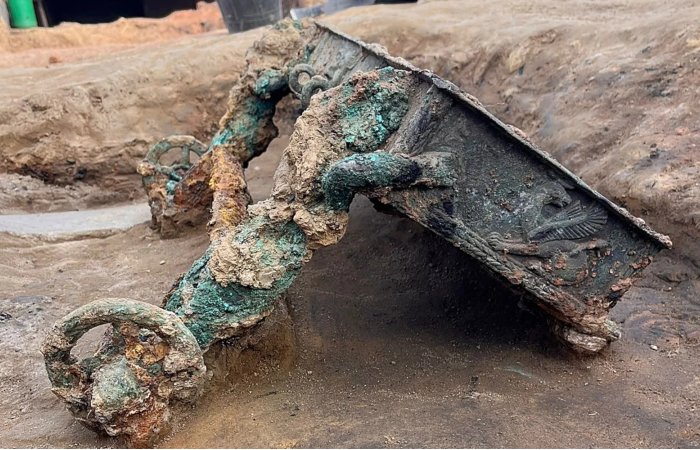
Archaeologists discovered the 2,500-year-old chariot in the ritual area known as Corridor S3 at the Tartessian settlement of Casas del Turuñuelo. Credit: Ayuntamiento de Guareña
Their civilization emerged from a blend of indigenous peoples and Greek and Phoenician settlers. However, the precise nature of their sociopolitical structure remains debated, with scholars uncertain whether they formed a city-state, a nation, or something in between.
The research team at the Casas del Turuñuelo site in Guareña announced the discovery of an extraordinary bronze votive chariot dedicated to a deity. This unique artifact has no known parallels on the Iberian Peninsula in terms of its decorative and iconographic complexity, according to co-director Esther Rodríguez.
The chariot was found during excavations in corridor S3, a ritual area where other unique structures, such as a bull’s hide-shaped altar, had previously been documented.
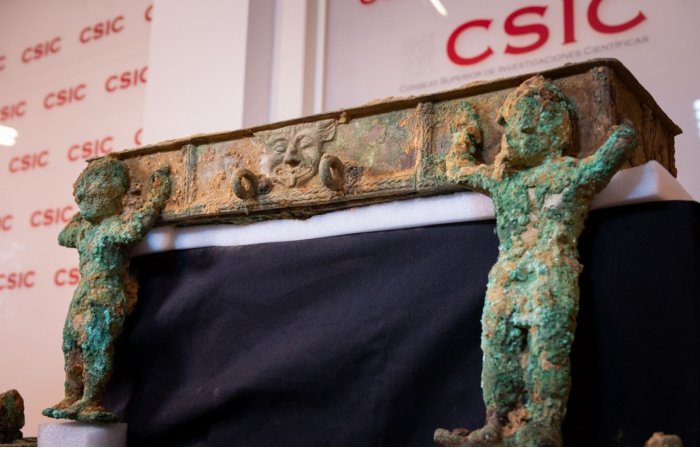
The chariot features ancient creatures grasping its sides, with the river god Acheloos at its center. Two men, resembling the titan Atlas, support the body. Credit: Ayuntamiento de Guareña
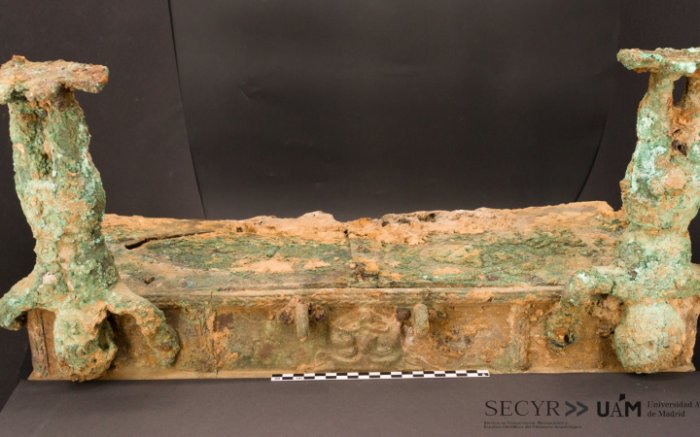
The discovery includes half of a ceremonial chariot, with two wheels and part of the main body intact. Despite its incomplete state, the preservation highlights elaborate decoration and a complex manufacturing process combining bronze and iron components.
The chariot features a frontal figure identified as Achelous, a river deity prominent in Greek and Etruscan culture, and two griffins at each end, mythological creatures with an eagle’s head and a lion’s body. It also includes two Atlas-type male figures supporting the chariot, enhancing its symbolic and iconographic significance.
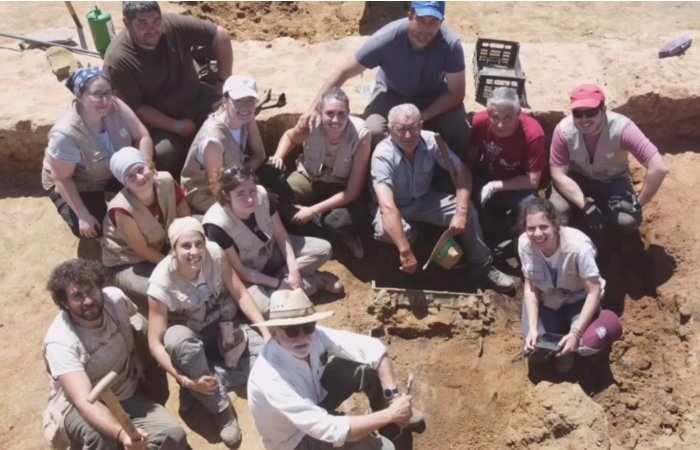
The archaeology team. Credit: Ayuntamiento de Guareña
Researchers report that no comparable example exists on the Iberian Peninsula. While some partial parallels are found in the Etruscan world, none match the decorative and construction features of this artifact.
Credit: Ayuntamiento de Guareña
The eighth excavation campaign, conducted in April and May, focused on the northern and southern sectors of the tumulus, which measures 90 meters in diameter and six meters in height. The main building beneath was intentionally sealed at the end of the 5th century BC.
See also: More Archaeology News
In the northern sector, two braziers and a bronze cauldron were recovered, further demonstrating the site’s richness. However, the volume of ceramic material found during this campaign was significantly lower than in previous campaigns.
“It has been a very positive campaign. Although we cannot yet provide conclusive information on the function of the new spaces, the material findings are enabling significant progress in understanding Mediterranean trade and Tartessos’ connections with other territories,” the researcher notes.
Source: Ayuntamiento de Guareña
Written by Conny Waters – AncientPages.com Staff Writer

