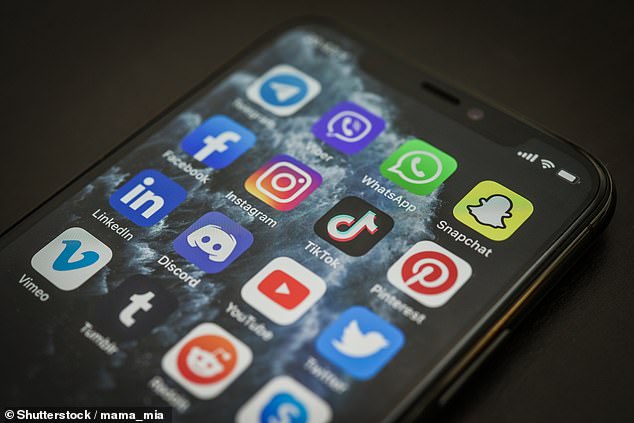
An ‘app tax’ charged by Apple and Google is costing Britons billions of pounds when subscribing to their favourite digital services, according to research.
The study found smartphone and tablet users will be forced to shell out an extra £4billion over the next five years thanks to a ‘stealth’ levy of up to 30 per cent the tech giants impose on in-app purchases.
Their rules also impose curbs which mean users can be prevented from finding potentially cheaper options elsewhere, boosting their profits.
The research, commissioned by campaign group the Coalition for App Fairness (CAF), found Britons are currently shelling out an extra £700million a year thanks to the ‘tax’.
This is equivalent to about £55 annually for a family household with four smartphone users.
But this will rise to £1.2billion in five years’ time – or the equivalent of £91 for the same household, according to the study. Over five years, the ‘tax’ is projected to cost Britons around £4.1billion.
Critics last night accused the Silicon Valley giants of using their ‘duopoly’ to ‘exploit’ millions of consumers as calls grew for the UK regulator, the Competition and Markets Authority (CMA), to step in.

A study has found that smartphone and tablet users will be forced to shell out an extra £4billion over the next five years when subscribing to their favourite apps or making in-app purchases thanks to a ‘stealth’ levy of up to 30 per cent

Apple charges a levy of up to 30 per cent to app developers on subscriptions and in-app purchases, which critics say is too high

Google also charges a levy of up to around 25 per cent to app developers on subscriptions and in-app purchases
While the ‘tax’ is paid by app developers, such as dating app Tinder, campaigners say they are passed on to consumers.
This forces them to pay up to a third more for their favourite services.
Critics also argue it hits the UK’s tech sector by sucking away profits that could be re-invested, choking off competition.
Former Tory tech minister Damian Collins said the tech giants’ fees were ‘excessive’ but that they had people ‘over a barrel’ because the vast majority of users have devices powered by Apple and Google.
He added: ‘It’s a stealth tax. These rates make it look like they’re creaming off the top and profiteering.
‘The CMA urgently needs to step in.’
Liberal Democrat MP Martin Wrigley, who sits on the Commons technology committee, added: ‘Up to 30 per cent is just outrageous.
‘You wouldn’t agree if a credit card charged you 30 per cent every time you made a purchase through a credit card.
‘It always gets passed on to consumers and it puts off app developers here in the UK. So it’s another good example of American big tech exploiting us for profit.’
Dominic Fean, of the Coalition for App Fairness, said: ‘British consumers are overpaying every time they make a digital purchase or buy a digital subscription in an app – and they don’t even know it.
‘Apple and Google have such a tight grip on the market that there’s nowhere else to go, and consumers are footing the bill.
‘The CMA has the power to change that. It just needs to use it.’
Apple, which offers its 1.5 billion or so iPhone users access to around 1.8 million apps, has faced criticism and court battles over its base rate 30 per cent charge for years. It introduced a lower rate of 15 per cent for smaller companies whose earnings are below $1 million in 2020. But critics say this remains too high.
And few consumers are aware they can find their favourite goods and services cheaper elsewhere because Apple’s guidelines limit apps from giving them the option.
Companies are not allowed to provide any other way for iPhone users to pay – such as external links or QR codes – and must go through Apple.
Google charges fees of up to around 25 per cent for in-app purchases on its Play Store for Android devices but has relaxed curbs on preventing links to cheaper deals being offered to consumers.

Former Tory tech minister Damian Collins said the tech giants’ fees were ‘excessive’ but that they had people ‘over a barrel’

Dating platforms such as Tinder are among the apps which are subject to the ‘app tax’ which campaigners say pushes up prices
The CAF research found that the cost of ‘bits’ on the popular live-streaming platform Twitch – which has around 240million monthly users globally – was £96 for 5,550 ‘bits’ if bought in-app.
But the price was just £61.85 if bought directly on the website.
‘Bits’ are the app’s virtual currency and can be used to support streamers or unlock features.
Meanwhile, signing up to novelist Margaret Atwood’s Substack blog page costs £60 a year if purchased in-app. But it is only £46 if done directly via the website.
The Digital Markets, Competition and Consumers (DMCC) Act 2024 handed the CMA powers to set caps on the fees charged as well as fine Apple or Google.
It is understood the regulator is planning to intervene this week, however it is not expected to issue fines or cap fees.
Apple does not charge the levy on free apps or those that provide tangible services, such as Deliveroo and Uber. It is broadly similar for Google.
Apple said only around 15 per cent of developers pay the ‘tax’ and that most of these pay the lower rate of 15 per cent introduced for smaller firms by the tech giant.
A spokesman added: ‘The Coalition for App Fairness is funded by a small group of developers who simply don’t want to pay for the immense value they receive from Apple’s platforms and technologies.’
They added that Apple’s rules preventing consumers from being directed towards cheaper deals help to prevent fraud and children bypassing parental controls, saying: ‘When users are directed away from Apple’s trusted payment infrastructure, they lose the protections they rely on Apple to provide.’
Google said: ‘This report confuses Android’s open platform with others that offer less choice.
‘It also disregards Play’s recent steering and fee changes which provide UK developers with more choice and some of the lowest fees in the market.’