There remains the faintest of glows in the coals of Scotland’s World Cup 2026 odyssey. Can a flame yet be teased out of them? Or is it time for the bucket of cold water?
I wonder if the answer hinges on patriotism, on the fervency of commitment to this wee bit hill and glen of ours, on the cussedness of our never-say-die spirit distilled in Scotland (from girders, no doubt) – and how all this stacks up against what we can plainly see with our own two eyes.
Perhaps, even three thoroughly uninspiring games in, the answer hinges on hope. It is still mathematically possible for Scotland to reach the knockout stages of a major tournament for the first time in our history and therefore we must hope and pray that we do.
To which the counter argument is: must we? Haven’t we embarrassed ourselves enough? We have the most joyous and mad-for-it fans in the world screaming their lungs out for possibly the most turgid and unadventurous team in the tournament. I know what a marriage counsellor would say.
It is almost as if the fates conspire to punish the Tartan Army’s ardency by providing the very antithesis of the displays these supporters dream of seeing.
Maybe it’s not about hope, but rather belief. Isn’t success in sport all about believing, about overcoming the demons of doubt that seek to derail the pursuit of greatness?

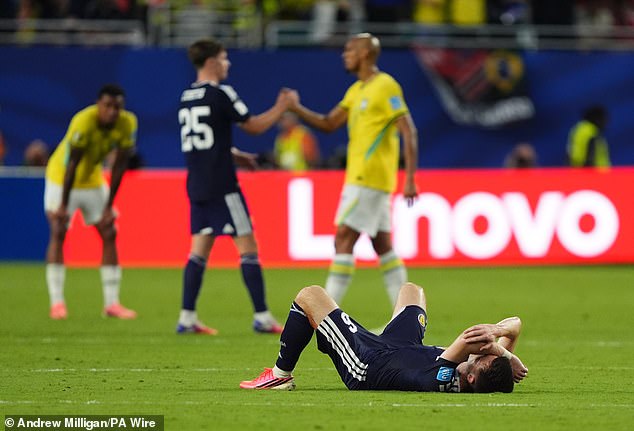
Scotland’s Kieran Tierney lies dejected after the final whistle against Brazil
I have heard the word ‘belief’ bandied about often during my recent late-night viewing.
Commentators have told me the Scotland players are full of it, that we need have no doubt on that score.
I have been forced to conclude that the commentators are full of something else – indeed, that it would be a challenge to name a team in the World Cup more lacking in belief than our overawed boys telegraphing chronic imposter syndrome with practically every kick of the ball.
What to decide, then, about the way forward? It is a pressing question for many thousands of Scotland fans currently in Miami after seeing their team’s 3-0 capitulation to Brazil.
It could be as late as Sunday before they discover whether an unimpressive win and two defeats in the group stage is enough to scrape them into the next phase.
And until they know that, they face a head-scratcher over flight bookings. Home on the first one available, please, we’ve suffered quite enough – or hang on to see if Scotland progress and then to see whether it’s to New York, Boston or Mexico City that the army must advance.
Meanwhile hotels are costing them hundreds a night. Don’t even ask about the bar bills or the inflated air fares.
I would love to report on a mass outbreak of common sense among the ranks. I must do the opposite.
‘I chucked my job and sold my car to come here so I’m no going hame noo,’ reasoned one foot-soldier with a foam traffic cone on his head. ‘I’ll stay and see what happens.’
He told the BBC he’d do it all again in a heartbeat.
Construction firm boss Rab Wood said it would cost him $5,000 (£3,780) to hang around Miami for another four days but that was exactly his plan. Read his words carefully. They go to the heart of the question we have been discussing.
‘If I had a choice I’d prefer playing Mexico in Mexico City. What a game that would be. I would take the uncertainty rather than go straight home.’
Mr Wood has watched the same three dreadful Scotland matches I have watched over the past fortnight. He is the same age as me, so his memory of our team’s fortunes in World Cups is as long as mine.
But what a game it would be, says he, if our boys faced off against Mexico next. In the history of triumphs of hope over experience, is there any to compare with seasoned Scotland fans bleeding their wallets dry in the expectation that the sun will come out tomorrow?
The follies of the army’s youth wing are forgivable. True, they could have done their homework on West Germany 1974, Argentina 1978, Spain 1982, Mexico 1986, Italy 1990 and France 1998 and pondered recurring patterns in Scotland’s performances.
But who would begrudge them their turn travelling to a World Cup? Not this armchair viewer. For lovers of our national sport – those who follow club sides or even play a bit themselves – this is a rite of passage cruelly denied to the last generation of fans by dint of Scotland not playing well enough to qualify.
I can understand older supporters making the pilgrimage too. It’s not solely about the football. It’s about the cultural melting pot, the camaraderie, the friendships forged and, in Scotland’s case, bagging the ‘party people’ prize if nothing else.
Well, they have made their point – nightly. The good people of Boston and Miami have taken Scotland to their bosom, even smiled benignly as our natives have clambered over their statues to uphold the custom of plonking traffic cones on their heads. Cultural mission accomplished.

Scotland fans will now be making their way back home… although some might stay on until the team’s fate is confirmed
But perhaps their ears should be open to a few points too. The party is over. This one, in footballing terms, was the same as all the rest in every way except one: it was worse. How I longed for a consolatory glimpse of genius, a last defiant affirmation that, yes, sir, we can boogie, as we took our slaying from Brazil.
What wouldn’t fans have given in their despair for the flair of Archie Gemmill in 1978 or the zinger from David Narey in 1982.
There was none of that. What I saw was a team suffocating under their own negativity and terror of making an already bad situation even worse.
What I heard was Scottish commentators patronising them – and us – by maintaining the fiction that these elite athletes who turn out for some of the biggest clubs in Europe were playing quite well really.
And when the final whistle blew I heard Scotland manager Steve Clarke give grumpy, monosyllabic answers to two questions from a BBC interviewer before walking away while she was asking the third. Classy guy.
Lessons to be learned? The first, surely, is that we seem singularly resistant to learning. Repeatedly, feverishly, we overestimate the performances we are likely to see from our players on the world stage.
Ours are the most exuberant fans in the world, the most expectant, the most eager to book that overdraft-inducing trip to foreign shores to roar on their heroes.
Why, we must ask, are we so susceptible to the notion that they are heroes, that they can compete with the very best in the world? Is it because, football being so vital in so many of our lives, we need them to be heroes?
The time has come for 20/26 vision. We likely will not make the knock-out stage. Even if we do, we won’t deserve to.
Our next match, if there is one, will almost certainly not be a corker. Foot-soldiers should save their pennies and stand down.
I’m sorry to do it. I really am. But consider this a bucket of cold water.