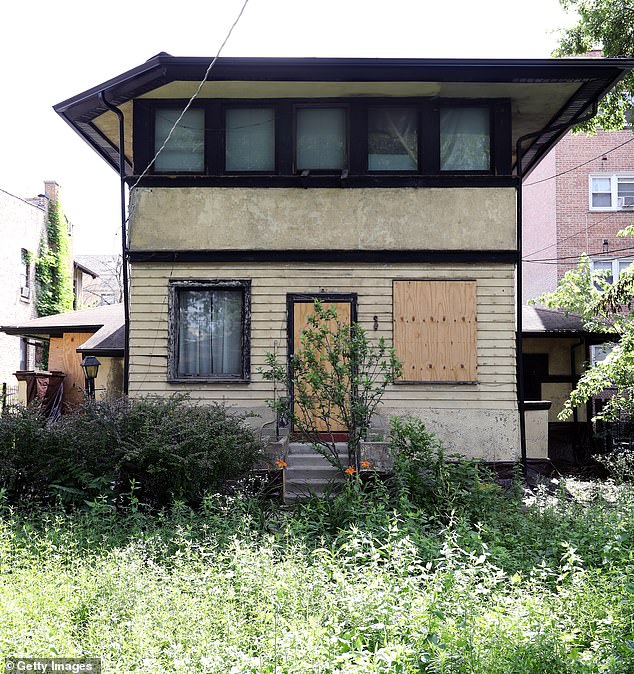
An historic Illinois home designed by famed architect Frank Lloyd Wright has sold for just over $100,000 – but it will need $3 million worth of repairs after decades of neglect.
The Joseph Jacob Walser House, a crumbling protected landmark tucked into Chicago’s Austin neighborhood, has officially been sold for just $125,000 to nonprofit community group Austin Coming Together, according to The Chicago Sun-Times.
It stands as the only single-family home on the city’s West Side designed by Wright, who created more than 1,000 structures during his remarkable 70-year career.
The low price tag comes with a hefty catch, as nonprofit leaders revealed it could cost millions to restore after deteriorating for the last three decades.
‘There are a number of things that need to be addressed,’ Austin Coming Together Director Darnell Shields told the outlet.
Photos of the residence paint a grim picture of its decline, showing boarded-up windows, hanging wooden slats, a tattered roof and a once-charming garden now choked with dead plants.
Beyond the crumbling exterior, Shields said the home is plagued by severe roof leaks, a failing load-bearing interior wall and years of overall deterioration.
He also revealed that it could cost between $300,000 and $550,000 just to stabilize the home before any restoration work can begin.

The Joseph Jacob Walser House, a crumbling home designed by famed architect Frank Lloyd Wright, sold for just $125,000

The protected landmark tucked into Chicago’s Austin neighborhood stands as the only single-family home on the city’s West Side designed by the Wright

The home is among a collection of residences dating to the early 1900s that line Central Avenue
‘It took a lot of finagling and repositioning and everybody working together… to try to cut through red tape and get the property at a cost we could stand and look at it as feasible,’ Shields added.
‘Because you know we’ve got a much longer journey ahead.’
He said the organization and surrounding community have big plans for the 123-year-old home, including transforming it into a destination where visitors can immerse themselves in its architecture, culture and storied past.
‘We’re really excited about the possibilities,’ the director said.
‘And while they’re here, visitors can support our businesses and restaurants along Madison,’ he added.
The home is among a collection of residences dating to the early 1900s that line Central Avenue, offering a glimpse into Austin’s earliest days as a Chicago neighborhood.
Wright revolutionized Midwestern architecture through the Prairie School style, favoring flat roofs, low-slung horizontal lines, sweeping overhangs and spacious, free-flowing interiors.
The buff-colored wood-and-stucco home on North Central Avenue is among Wright’s earliest Prairie School masterpieces, having been completed by the end of 1903 for just $4,000.

Shields said the home is plagued by severe roof leaks, a failing load-bearing interior wall and years of overall deterioration

The buff-colored wood-and-stucco home is among Wright’s earliest Prairie School masterpieces

The nonprofit, the Frank Lloyd Wright Building Conservancy, Landmarks Illinois and Preservation Chicago has helped the century-old home remain standing for years
Through the years, it has faced repeated preservation issues, including the removal and sale of its original art-glass windows during the mid-20th century and the enclosure of its front porches, according to Preservation Chicago.
General contractor Hurley Teague and his wife, Anne, rescued the home after purchasing it in 1970, stabilizing the property and safeguarding the architectural treasure for nearly half a century.
‘I wasn’t too much concerned about whether it was historical or what kind of story it was. This was my dream house from a child,’ Anne told Austin Weekly News in 2009.
‘It was just in me that I was going to have a big home,’ she added.
But after her death in 2019, her heirs could no longer keep up with the mortgage, leaving the historic home abandoned and spiraling further into disrepair.
For the next seven years, the home was trapped in foreclosure and demolition courts, with the chaos of the COVID-19 pandemic throwing its future into even greater doubt.
Inside, the home’s condition appears equally alarming, with images showing foundation damage, deteriorating ceilings, scattered debris and significant water damage throughout the structure due to Chicago’s harsh winters.
Yet if any buyer is up to the challenge, it is Austin Coming Together (ACT), which co-led the $41 million transformation of the former Robert Emmet Elementary School at 5500 W. Madison Street.

Wright revolutionized Midwestern architecture through the Prairie School style, with flat roofs, low-slung horizontal lines, sweeping overhangs and free-flowing interiors


Interior images show foundation damage, deteriorating ceilings, scattered debris and significant water damage throughout the structure due to Chicago’s harsh winters
The nonprofit has unified over 50 member organizations to improve education and economic development in the Austin neighborhood.
Located directly across from the Walser House, the group helped convert the vacant school into the Aspire Center for Workplace Innovation, which opened last year and focuses on job training and wealth-building.
As for the Walser home, ACT’s purchase could mark a swift and much-needed reversal for the long-rotting National Register-listed landmark.
The government-backed Federal National Mortgage Association – better known as Fannie Mae – acquired the home in January before putting it up for sale, according to the Sun-Times.
Chicago nonprofit Community Investment Corporation (CIC) purchased the house from Fannie Mae for $125,000 before ultimately handing it over to ACT for the very same price.
As part of the deal, Shields said CIC provided a $60,000 grant toward the purchase price, with the nonprofit covering the remaining $65,000, according to the outlet.
One of the home’s most unique elements, according to Shields, is Wright’s open-plan design on the first floor, which he said could become a hub for a variety of events and gatherings.
Thanks to ACT, the Frank Lloyd Wright Building Conservancy, Landmarks Illinois and Preservation Chicago, the century-old home has remained standing.

The nonprofit’s plans include transforming the home into a destination where visitors can immerse themselves in its architecture, culture and storied past

The Wright-designed home was completed by the end of 1903 for just $4,000

Photographs of the home show boarded-up windows, hanging wooden slats, a tattered roof and a garden choked with dead plants
Together, they attended court hearings, raised public awareness and took steps to board up the home and trim back its overgrown foliage as the years passed.
Frank Lloyd Wright Building Conservancy Executive Director Barbara Gordon said she strongly supported ACT taking ownership of the home.
‘ACT understands the potential waiting to be unlocked by revitalizing this landmark Frank Lloyd Wright design, celebrating Austin as a destination for notable architecture,’ Gordon said in a news release.
‘The organization’s deep roots in the community mean they know the rich stories the house can tell about how it has changed over time, and what Austin residents envision for its future,’ she added.
Landmarks Illinois Advocacy Manager Kendra Parzen also praised the nonprofit, applauding ‘its vision and determination to preserve a nationally recognized architectural and cultural asset on Chicago’s West Side.’