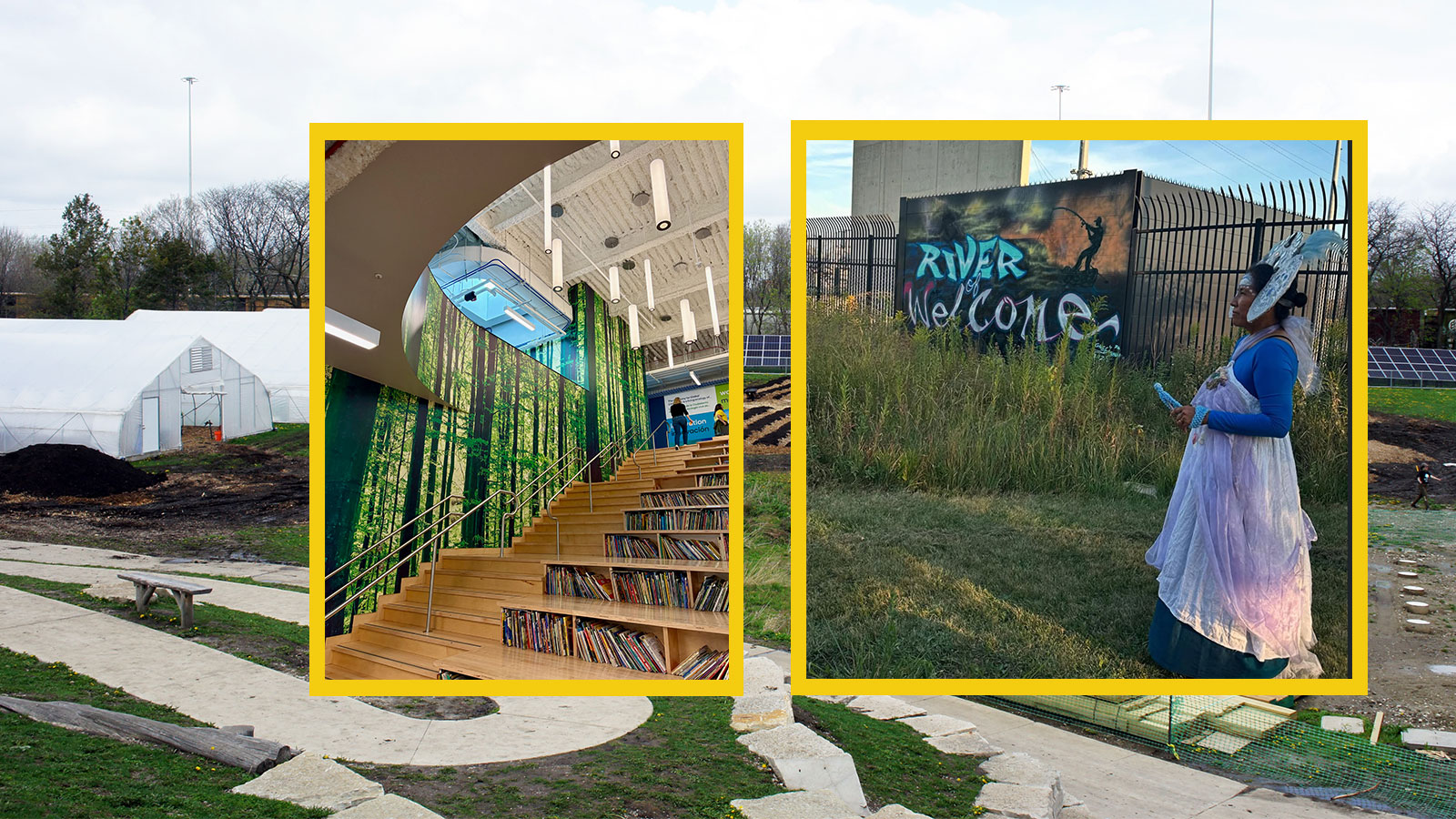
It was a gorgeous spring day as I approached the Academy for Global Citizenship, a K-8 charter school two miles north of Chicago Midway Airport. I first noticed the overgrown lots. The blocks surrounding the school were lush with rambunctious weeds. Fifteen years ago, the city demolished hundreds of public housing homes here, uprooting families and seeding the deterioration visible today.
Berenice Salas spent her teen years walking past the public housing development, known locally as the courts.
“It was public housing, but there was a computer lab there, basketball courts,” said Salas, now the coprincipal of the Academy for Global Citizenship. “It was thriving in many ways with lots of resources.”
She and her fellow educators want to rekindle the neighborhood’s spark, or “chispa,” as Salas put it in Spanish. They’re starting with land: installing a farm, rain gardens, native plants and trees, outdoor classrooms, solar panels, and geothermal energy at the school.
The academy is part of a wider initiative across three U.S. cities to bring Latine communities closer to nature. GreenLatinos, a national environmental organization, funded the $2.6 million effort in Chicago, Los Angeles, and Albuquerque with support from the Bezos Earth Fund.
School leaders expect to yield 10,000 pounds of produce in its first full year of production, which will be used to feed students and sell to the community at a reduced price. While I was visiting, I saw a group of elementary-age kids carting trays of strawberries to kitchen staff.
The effort is also improving Chicago’s Canal Origins Park, a nearly three-acre park about six miles northeast of the academy, as well as building an urban farm and expanding recreational access to the Calumet River – all in areas where Latinos can enjoy the changes.
That’s important because nearly 70% of Latines live in nature-deprived areas. Research has found myriad benefits associated with access to nature: improved mental health, increased physical activity, lower blood pressure, and a stronger sense of community. And as the weather grows more erratic due to climate change caused by fossil fuel pollution, trees and other plants can also help neighborhoods keep temperatures down and floodwaters at bay. Across the globe, trees reduce urban heat, according to a recent Nature Communications study.
“These projects are not just about beautification,” said Lucy Contreras, the Illinois state director at GreenLatinos. “They’re also about addressing historic disinvestment, pollution burdens, and inequitable access to green space in Latino and front-line communities.”

Like much of Chicago’s South Side, the six-acre Academy for Global Citizenship campus is surrounded by polluters: a highway, railroad tracks, and the airport. Local asthma rates rank in the highest percentile.
Nature as medicine
Nationally, wealthier, whiter neighborhoods are disproportionately likely to have access to nature. Chicago is no exception: Latine neighborhoods have 33% less park space than average. A 2023 study found a correlation between less green coverage and lower life expectancies in Black and Latine communities in Los Angeles.
“Urban greening isn’t only about planting trees,” Contreras said. “It’s also a public health issue.”
Heat is an especially sensitive issue in a city like Chicago, explained Juan Declet-Barreto, a senior social scientist for climate vulnerability at the Union of Concerned Scientists. In 1995, the city experienced a five-day heat wave that left over 700 people dead. Since then, the city has expanded its emergency notification system, established cooling centers, and identified its most at-risk residents.
“That heat wave happened a couple of decades ago, but it still provides lessons in terms of prioritizing the more vulnerable members of society,” Declet-Barreto said.
He offered a scenario to illustrate how immigrant families are at risk. A white-collar worker may undergo a heat wave in their air-conditioned car and office. Their employer offers them health insurance, so they regularly visit the doctor and are up-to-date on any conditions. A recently arrived immigrant, however, might get to work on the back of a pickup or bicycle. At work, often on a construction or landscaping site, they’re exposed to the sun. Their boss might not offer them health insurance or labor protections. They return home at the end of the day to an apartment where they can’t afford to run the air conditioner, if they even own one at all.
“These are two very different profiles of people with very different heat exposures along the course of their daily lives who are underneath the same sun, the same heat load, and the same global warming,” Declet-Barreto said.
Green spaces keep neighborhoods cooler
Improved tree and vegetation coverage can help offset some of these impacts, making neighborhoods feel up to 14 degrees Fahrenheit cooler.
Enter Canal Origins Park, where on the day I visited, a beaver had nearly chewed its way through one of the three oak trees. Above, a cacophony of birdsong washed over me: northern cardinals, red-winged blackbirds, brown creepers, and yellow-rumped warblers.
Like the Academy for Global Citizenship, the park is surrounded by industry, including a 30-acre data center, a chicken-processing plant, and a now-defunct coal plant. Community leaders representing the neighborhoods of Little Village and Pilsen shut down the coal plant 14 years ago. Now, they’re focused on the park, with the goal of revitalizing it.
“I grew up in Pilsen, and I wasn’t allowed to go outside and play because before gentrification happened, it was really dangerous,” said Rebecca Ramirez, a member of environmental justice group Pilsen Environmental Rights and Reform Organization, or PERRO. “My mom would just keep me locked in with my brother.”
“Me too,” added PERRO President Zitlalli Paez. “There was a lot of gang violence, and my mom would literally not let me go outside.”
The organization wants to break that cycle for the next generation. The eighth graders from the academy cleaned up trash at the park in February. And PERRO is prioritizing community feedback. Over five events, including one featuring Mexican folklorico dancers, the organization has engaged with about 190 locals to help them understand the value the park can bring to their lives. By August, the team will have something to show for its work: a $190,000 24-square-foot picnic pavilion with two tables, one with room for a wheelchair.

As we’re getting ready to leave Canal Origins, I spot a group of rowers hitting the water. I think of Salas, the academy co-principal. When she was in high school, she was part of her high school’s first female rowing club.
“We had this rickety, hand-me-down boat, but we made it work,” she recalled. “We had biking shorts – black ones and a white T-shirt – that was it.”
Her team practiced at Canal Origins Park, where they launched from a tiny dock. During practice, the oars pulled up used condoms or tampons. As they made their way up the Chicago River, however, the bad odors disappeared. The water got cleaner.
That’s what Chicago’s Southside Latine residents want, too: waters clean enough to swim in and parks green enough to cool off in.
The benefits of access to nature in schools
Back at the Academy for Global Citizenship, Salas explained that her own father used to be an organic bean farmer in Mexico. He lost that way of life when he migrated to the U.S.
“I see that with other parents who also feel very connected to our farm,” she said. “People miss that connection.”

Salas recalled a time when a student’s mom wanted to pick a squash that had dried up on the stem. She wanted to convert the dried-out squash into a natural sponge.
“That’s part of our roots,” Salas said. “A lot of these pueblitos and towns in Mexico are super resourceful because they have to be. They’re sustaining their own community with whatever they’re growing. They don’t have access to a Walmart.”
Third grader Kara Solis-Cortes participates in the academy’s Green Team. The 9-year-old tells me excitedly about the group’s recent seedling sale and honey harvest from the campus beehives.
“I don’t really have to spend a lot of time at school, so yippee!” she joked.
She’s right – many students spend a lot of time outside.
It’s an approach with real rewards: Students regularly ask to go on walks to help calm themselves down, Salas explained. The school is designed so that no matter where students are (besides the restroom), they can see out a window.
This type of education comes at a price
The academy’s leaders want other schools to replicate what they’ve built, but it’s easier said than done. The facility cost $53 million to build, made possible with private philanthropy, state funding, and federal tax credits. Its approach costs $22,100 per student a year, on par with other Chicago charter schools.
But in many ways, the value of this approach to education is immeasurable.

Eighth grader Camila Ontiveros, wearing round glasses and braces, told me she’s able to focus better when class is outside. Emily Gaytan, another eighth grader with clear hazel eyes, quietly nods her head in agreement.
It’s picture day when I meet eighth grader Joaquin Cervantes, so he’s wearing a fresh black suit. He lights up when he talks about teaching his father how to grow chilies in their backyard.
“He didn’t really know how,” Cervantes said of his father, “but me coming from this school, I learned a lot about gardening and soil. It benefits my life because now I can grow flowers and vegetables.”
This <a target=”_blank” href=”https://yaleclimateconnections.org/2026/06/nature-was-missing-from-these-neighborhoods-residents-are-changing-that/”>article</a> first appeared on <a target=”_blank” href=”https://yaleclimateconnections.org”>Yale Climate Connections</a> and is republished here under a <a target=”_blank” href=”https://creativecommons.org/licenses/by-nc-nd/4.0/”>Creative Commons Attribution-NonCommercial-NoDerivatives 4.0 International License</a>.<img src=”https://i0.wp.com/yaleclimateconnections.org/wp-content/uploads/2020/10/ycc-favicon.png?resize=100%2C100&ssl=1″ style=”width:1em;height:1em;margin-left:10px;”>
<img id=”republication-tracker-tool-source” src=”https://yaleclimateconnections.org/?republication-pixel=true&post=139747&ga4=1401ERFF5Q” style=”width:1px;height:1px;”><script> PARSELY = { autotrack: false, onload: function() { PARSELY.beacon.trackPageView({ url: “https://yaleclimateconnections.org/2026/06/nature-was-missing-from-these-neighborhoods-residents-are-changing-that/”, urlref: window.location.href }); } } </script> <script id=”parsely-cfg” src=”//cdn.parsely.com/keys/yaleclimateconnections.org/p.js”></script>