Of late there has been a surge of calls that all the Outer Hebrides should really be linked up to the mainland – and each other – by a network of undersea tunnels.
Central to this suggestion has been my sometime Western Isles MP, Angus Brendan MacNeil, who has been touting this notion for years.
It’s been kicking around for about two decades and campaigners like to point to the Faroes; increasingly, since the 1960s, the 18-isle archipelago has been stitching itself together with tunnels and, recently, Shetland councillors have been talking aloud about it too.
Some of these Faroese roadworks have been indeed spectacular. Most dramatic is a 7.1mile tunnel which connects the island of Streymoy to two sides of a fjord on the island of Eysturoy.
It includes the world’s only undersea roundabout: locals have fondly dubbed this junction ‘The Jellyfish’.
Now our own salmon-farming lobby happily agitates for comparable Scottish infrastructure: Shetland alone produces a quarter of all Scottish salmon – the UK’s most valuable food export, with international sales of £844million in 2024.
It should, frets Anne Anderson of Scottish Salmon, be a great deal more.
‘Ten years ago Scottish salmon used to have 10 per cent of the global market. Nowadays we’re slipping ever closer to 5 per cent.’

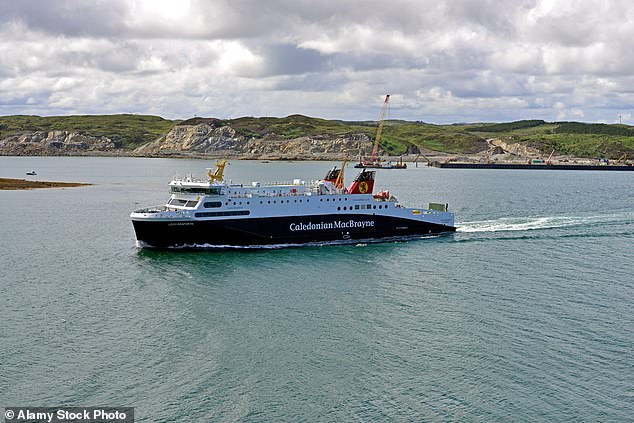
The Loch Seaforth is seen departing Stornoway for Ullapool
She blames that slide, in part, on a lack of investment in public infrastructure – and says we should look to the Faroes for inspiration: ‘Identify what works well for them and then just copy and paste and let’s get moving.’
The campaign has been lent wings in recent years by the racked performance of Caledonian MacBrayne, from the inordinate delay in completing two new ferries at Port Glasgow to the incessant breakdowns in what is an increasingly ageing fleet.
The Isle of Arran, for instance – this week, relieving at Mull – began her career so long ago I was still in school. So venerable, her lifeboats have oars.
At least, though, since the 1960s what is now CalMac has been dedicated in principle to the ‘short sea crossing’, routes almost everywhere configured so that drivers can maximise their travel by road.
Shetland, by contrast, is still served from Aberdeen. As if we were yet in the age of the paddle-steamer. That’s 190 nautical miles and the quickest passage is twelve-and-a-half hours.
But I cannot join in this fashionable enthusiasm for tunnels. Boring a road tunnel comes at eye-watering expense – between £150,000 and £300,000 per metre. Last month, plans for one between the island of Yell and mainland Shetland were costed at £402million – and would take eight years to complete.
For the service of sparsely populated communities in the Hebrides and the Northern Isles – and at a time when our public finances are not just bust, but seriously bust – that’s a huge ask of the wider electorate.
Tunnels can also be extraordinarily dangerous. They are hazardous to build – ten men died in the hewing of the Channel Tunnel, between 1987 and 1993 – and what would be a manageable road traffic accident on the open highway can, deep underground and miles from either entrance, become a catastrophe.
The Mont Blanc tunnel disaster, in March 1999, is still the most infamous. A truck laden prosaically with flour and margarine caught fire amid passage from France to Italy.
Emergency services could not get near it. Dozens of trapped vehicles detonated in turn. Thirty-nine lives were lost; the fortunate suffocated before they burned and it took five days to put out the blaze.
Sixteen companies and individuals were charged with manslaughter, 13 defendants were found guilty and one man went to prison.
But there are still more practical concerns. One is that much of the Hebridean appeal to tourists is the charm of getting there. For many, time aboard a ferry is in itself a delightful part of the holiday.
The sail into Tarbert, Harris, is perhaps the most spectacular this side of the Aegean.
Aficionados think the voyage from Mallaig to Lochboisdale – by the Small Isles and the jagged Cuillin – as enchanting as any in Britain; even the 15-minute voyage from Sconser to Raasay is enthralling.
A 20-minute subterranean trundle? How boring. Then there is the issue of biosecurity. This may sound dotty, but the Outer Hebrides enjoys a unique ecosystem, framed long ago by the Ice Age.
We have no reptiles, save the slowworm; no mustelids, save the otter. We have already to contend on most islands with rabbits – imported by irresponsible Victorian lairds – and, in my own lifetime, the irresponsible introduction of frogs and hedgehogs.
Only in the last decade have we exterminated North American mink – descendants of a failed 1960s fur farm venture – and some circus clown brought moles to Skye several decades ago. ‘I thought the garden wall would keep them in,’ he later bleated.
The absence of predators on groundnesting birds (and their eggs) has made the Western Isles an avian paradise of international importance. But who knows what might slither or pitter-patter our way by an inviting tunnel?
I wish people, too, would remember that while dramatically improved transport links can advance much, they are just as likely to diminish.

The Faroes use underwater tunnels to connect their islands
When I was a little boy, a delightful uncle was Free Church minister of Scalpay, a bustling community off the North Harris coast making the most of the herring boom and the envy of its neighbours. Scalpay simply seethed with children. It had a school, a clinic and a couple of shops and was served six days a week by a little car ferry over the briefest of straits.
Then, in 1997, a bridge to Scalpay was completed.
Tony Blair, no less, descended on it for the official opening. The bridge is there yet; the school, the clinic and the shops are long gone.
That’s before we address a still more delicate issue: the more accessible an island becomes, the more tempting it is to the stranger.
Since the millennium, the Western Isles have seen extraordinary reverse migration. Our young folk have poured out; assorted settlers have poured in. Property prices have gone gangbusters and, from demand for Sunday shops to a general reluctance to integrate, the cultural price paid has been high.
To the consternation of many, it emerged from the 2022 census that only two Western Isles parishes – South Uist and Barvas – have a majority Gaelic-speaking population.
Sometimes, yes, the boat cannot sail. Or the passage is, um, excessively exciting; or the ship will not start at all.
But give me that maritime order any day to dank passage by the underworld.