Europe baked under a ‘heat dome’ on Wednesday as temperatures neared 40C and a deadly heatwave tightened its grip across the continent.
France recorded its hottest-ever day for the second day running, with temperatures topping 40C in more than 50 departments since the latest heatwave began on June 17.
‘It’s difficult to live alone and without air conditioning,’ said 62-year-old retiree Martine Belloc in Bordeaux.
The extreme weather is being driven by a persistent pattern that traps hot air over the region for days, allowing temperatures to keep rising. Scientists say such events are being intensified by global warming.
France’s national temperature indicator – an average of daytime and nighttime temperatures across 30 stations – reached 30C on Wednesday, the hottest since measurements began in 1947.
This week’s heat has already claimed lives, including two brothers aged two and four who died in a family car in the French town of Carpentras on Monday.
The Carpentras prosecutor’s office said, that according to the initial autopsy results, the children died ‘from exposure to excessive heat… subject to the results of further analyses currently underway’.
The children’s mother has been charged with involuntary manslaughter after giving conflicting versions of events to police about how they became locked in the car.
The French weather agency put three-quarters of the country under a red alert for extreme heat starting at midday Thursday until the same time Friday.

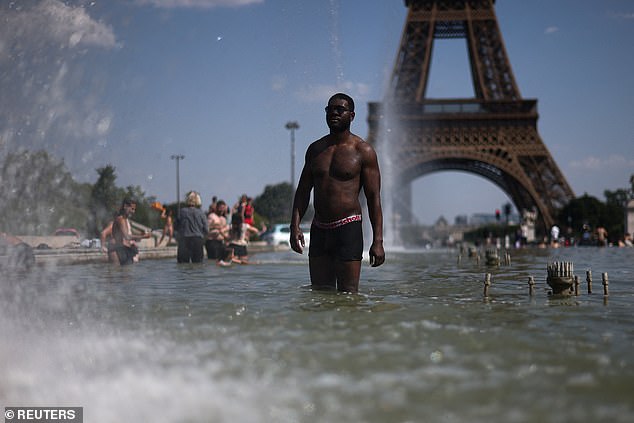
People cool off in the Trocadero Fountain near to the Eiffel Tower

Stable workers bathe their horses in the Berounka River to cool them off during a heatwave in Prague

A man cools off in the Trocadero Fountain near to the Eiffel Tower as temperatures rise during a heatwave affecting a large part of the country, in Paris, France, June 24, 2026

Beachgoers swim on Viking Bay beach as the UK experiences its hottest day in June on record during a heatwave in Broadstairs, Kent, Britain

Youths jump into the Canal Saint-Martin during a heatwave in Paris in Paris on June 24
The warning encompassed tens of millions of people. In the usually temperate Brittany region of northwest France, a heat-related equipment failure knocked out power to tens of thousands of households that had to endure without electric fans.
Meanwhile, the U.K. recorded its hottest June day, with 36 C (96.8 F) reported at Gosport and Wisley in southern England. The national weather forecaster issued a red alert for heat in much of central and southern England, as well as Wales.
Sales of fans and air conditioners skyrocketed across France, where most buildings are not designed to deal with extreme heat.
On Monday, hypermarket operator Carrefour had sold 30,000 units by 6.30pm – ‘a thousand times more than on a normal day’, chief executive Alexandre Bompard said.
Sales on Amazon nearly doubled last week compared with the same period last year, whilst electronics outlet Fnac Darty reported double-digit growth.
The heatwave caused the country’s a major power outage with a heat-related transformer incident on the electricity grid leaving around 68,000 households on Wednesday without electricity in the northwestern Finistere department of Brittany.
While teams worked through the night to fix the issue, which took place late Tuesday, power is not expected to be restored in full until the end of Wednesday at the earliest.
Britain is braced for an unprecedented heatwave with temperatures soaring – but how does today’s experience compare to 1976?

Share your most vivid memories of the great heatwave in our group chat. Hosepipe bans, scorched lawns and sleepless nights, tell us what it was really like.
Click here to join the chat
Up to 106,000 clients of the French power network were left without power by late Tuesday, as the scorching temperatures strains infrastructure built for the days before man-driven climate change made heatwaves longer, more frequent and more intense, according to scientists.
With four more French departments being put under the highest heat alert category Wednesday, an estimated 44million people in the country are affected.
Added to the 31 departments currently on orange alert, more than 90 percent of the French population is exposed to extreme heat, with temperatures of 39C to 41C expected on Wednesday from Brittany to the Paris region, and in much of the south-west.
John Beeler, a 45-year-old American engineer, said he and his wife were baking in Paris.
‘Visiting Paris in this heat is awful,’ he told AFP, wearing a fisherman’s hat and holding a small fan.
‘We’re suffocating in the streets, we’re suffocating in the subway and we’re even suffocating in our rental,’ he said, adding they would be moving to an air-conditioned hotel room.
And, further south, Italy’s health ministry declared a red heatwave alert in 16 cities on Wednesday including Milan and Rome.
In the coming days the heatwave is expected to extend into eastern Europe.
Poland’s weather service issued high-level heat warnings for the western part of the country from Thursday to Saturday, forecasting temperatures could break the record of 40.2C set in 1921.

A man washes his face to cool off during a hot day amid a heatwave in Madrid, Spain, on June 23

People look on as a flamenco dancer performs in Plaza de Espana in Seville, Spain, on June 23

A woman uses a fan at Plaza Mayor on June 23 in Madrid, Spain

Beachgoers sunbathe on Viking Bay beach as the UK experiences its hottest day in June on record during a heatwave in Broadstairs, Kent, Britain, 24 June 2026

A woman uses a bottle of water to cool off at El Retiro park on June 23 in Madrid, Spain

A woman shield her face from the sun while walking on Oxford Street, in London, on June 23
Croatia’s popular Adriatic coast was also put under red alert for Friday and Saturday.
Hungary, already under a second-level heat alert, said it was raising that to the maximum level from Saturday to Tuesday as temperatures continued to rise.
The current heatwave is ‘significantly exacerbated by human-induced climate change’, without which the current temperatures would have been 2 to 4C cooler, according to a scientific study published this week.
But some relief could start to come from the west on Wednesday, when Spain’s national weather service said temperatures would drop in most of the country.
By Wednesday afternoon, only parts of the Basque country in the north will still be marked red, and on Thursday no part of Spain will be rated either red or orange.
But no quick relief is in sight across the rest of western Europe.
From Wednesday until at least Friday, central and southern Netherlands will be under a code orange for extreme heat.
Anyone living in Amsterdam with a city pass may swim for free in six city outdoor pools, while national rail company NS will run fewer trains on a number of routes starting Wednesday due to the expected heat.

People cool off in the Trocadero fountain in front of the Eiffel Tower as temperatures rise in Paris during a heatwave affecting a large part of France, on June 23

People swim at Canal Saint-Martin to cool off during heatwave in Paris, France on June 23

Girls cool of their feet as they enjoy a boat ride at El Retiro park on June 23 in Madrid

A woman uses a fan next to Plaza Mayor on June 23 in Madrid, Spain
In the UK, a red weather warning for extreme heat covering an area stretching from London to Swansea and Somerset to Birmingham was issued by the Met Office from 9am today to 9pm on Thursday.
During the peak of the heatwave on these two days, the temperature could come close to the UK’s all-time high of 40.3C, which was measured in Lincolnshire in July 2022.
The latest heatwave is also expected to surpass the record for June of 35.6C set in Hampshire in 1976.
A combination of extreme heat and humidity could impact public health, infrastructure, power and water supplies, the Met Office said, and cause heat-related issues for a range of sectors such as transport, energy and water supply.
There could also be an increase in water safety incidents during the heatwave, the agency said, as more people are likely to visit coastal areas, lakes or rivers.
The agency’s spokesman Grahame Madge said: ‘The Met Office is flagging 39C as a headline maximum temperature on Thursday, most likely for somewhere in London or the South East.
‘It is possible we could see temperatures higher than the 39C if the final values are at the upper end of our narrow range.
‘It is important to remember that the temperature value is only one element of this extreme heatwave story.

Children cool off as they play football under a fountain next to the Manzanares river on June 23 in Madrid, Spain

Calves stand at the entrance of their barn amid heatwave, in La Rippe, western Switzerland on June 23

A dog cools off at a fountain next to the Manzanares river on June 23 in Madrid, Spain
‘The other major factor is the high humidity, which for many will make the intense heat even harder to endure.’
James Bowen, assistant general secretary at the National Association of Head Teachers, said that ‘pretty much every school up and down the UK will be having to make some form of adaptation this week in light of the extreme heat.
‘I think it’s fair to say that the school estate in the UK is not well prepared for this level of heat,’ he said.
National Rail warned of disruption to Gatwick Express, Great Northern, Southern and Thameslink services until Friday.
Avanti West Coast said it planned to run fewer services than usual between Tuesday and Thursday, and that there was ‘a risk of further disruption’.
And Chiltern Railways said it had axed more than half its services until Friday ‘to ensure the safe operation of the railway’.
Eurostar has cancelled four trains planned to run between London and Paris on Wednesday and Thursday ‘due to expected adverse weather’.
After some of France’s most visited sites, such as the Louvre museum and the Eiffel Tower, decided to limit visiting hours, the management of one of Belgium’s best-known monuments, the space-age Atomium in Brussels, said it will close earlier to visitors from Wednesday to Friday.

View of a giant screen announcing the early closure of the Eiffel Tower due to the heatwave as temperatures rise in Paris during a heatwave affecting a large part of France, June 23

Rosa, 65, who is disabled, swims in the Mediterranean sea as she is helped by her brother Antonio, 55, as temperatures rise, during a heatwave affecting a large part of Spain, on Barceloneta beach, in Barcelona, Spain, June 23

A shopper rests with her puppy in the shade in the town centre in Huddersfield in Northern England on June 23
The UN has warned the weather over the next five years will likely see more shattered heat records.
Akshay Deoras, a senior researcher at the University of Reading’s National Centre for Atmospheric Science, in England, said it was clear what was behind the rash of heat records.
‘Human-driven climate change has provided the springboard for this event, loading the atmosphere with extra heat and making extreme temperatures far more intense than they would have been in the past,’ he said.
A study found that human-caused climate change led to the deaths of 1,500 people across Europe during an unusual May heatwave.