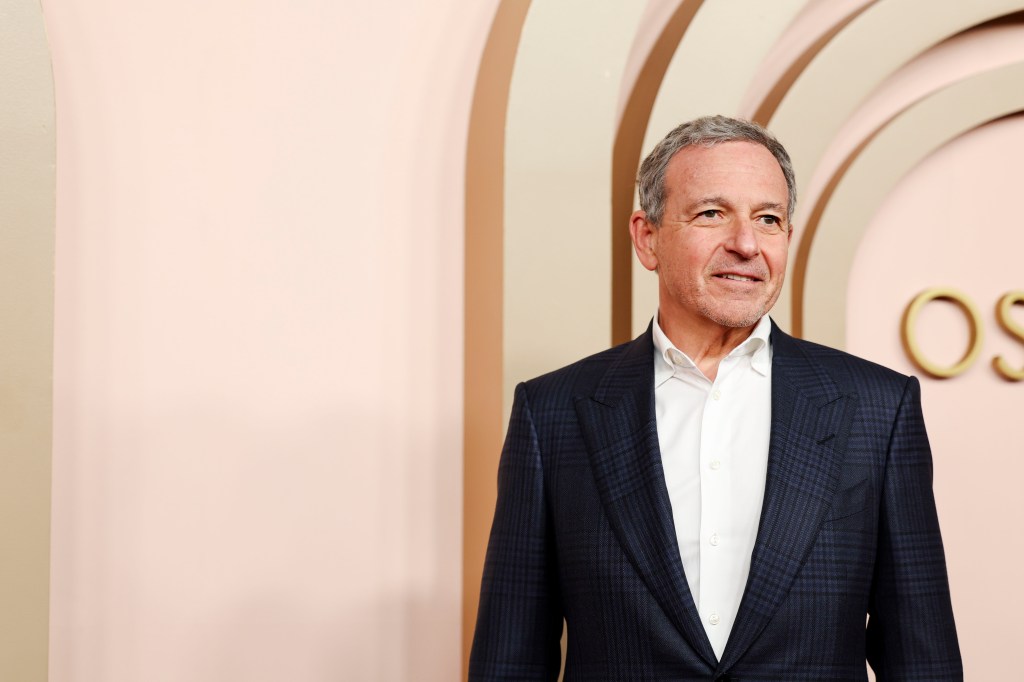
Former Disney CEO Bob Iger believes his successor, Bob Chapek, did too much too fast after taking the mantle in 2020.
“There was no urgent need to make drastic changes,” Iger recalled. “And yet he did, and he brought in bureaucracy and he brought in layers of management.”
The result in November 2022 was Chapek’s ouster from the company and Iger’s return as CEO. Under pressure to improve the long-troubled track record of succession at Disney, Iger passed the CEO baton to Josh D’Amaro last February and has formally exited the company. The Financial Times spoke with Iger, D’Amaro and others in a series of interviews conducted during the springtime for a 5,000-word article published last weekend.
Iger pushed back on longtime rumors that he maneuvered against Chapek, using his connections with the board to poison them against the new CEO. “Another misperception is that when I was out of Disney, I was fomenting and trying to undermine him, which was completely untrue,” Iger said.
The article’s writer, FT global media editor Daniel Thomas, recounts from his visits with Iger that the exec “prefers not to even say Chapek’s name now – instead habitually referring to him as ‘my former successor.’”
Even though “we were humming” at the end of 2019, Iger was looking for a solution to succession, a part of corporate governance that had long bedeviled Disney. Board member Mark Parker’s move to become executive chairman at Nike seemed to offer a blueprint. “I thought, that’s the model. I’ll be executive chairman. I’ll focus on creativity. We will avoid going through a public succession process,” Iger is quoted as saying. ”It was a construct which, I’ve not clarified this publicly, would have me basically managing the creative side of the company.”
Chapek did not respond to the FT‘s requests for comment, the outlet said. Apart from a synergistic sit-down with ABC News anchor David Muir on the day of the succession announcement, Disney has kept a lid on the former and current top execs, making Iger’s comments the first extensive inside account of that previous set of missteps. A number of press reports have characterized the management team’s actions during that period, advancing the widely held view that Iger undermined Chapek.
Even though Chapek and the board had signed off on the structure after Iger’s exit as CEO, “that became the tension quite quickly after that,” the exec said. “It quickly went bad. Covid made that a lot harder, in fairness to him and everyone.”
Cut to 2023, when Iger said he had “no time to think about” the board’s offer to have him return on a rescue mission. Wife Willow Bay told him, “You have to say yes,’” the exec remembered. “She said: ‘You know you love those people, and you love the company.’”
Within a couple short days, Iger was back in his old corner office, sitting behind the 1930s desk that Chapek had jettisoned when he took the helm. “The team had done their best to put the office back the way it was the last day I had been in it,” Iger said. From there, “It was off and running.”
While he is a minor voice in the article, D’Amaro does nothing to contradict Iger’s depiction of events. Under Chapek’s leadership and at a time when Covid was decimating the company’s theme parks, sports and theatrical businesses, “it felt like the world was falling apart,” the new CEO said. “Are we going to survive this? It was a very difficult time.”
The lengthy article contains a few other small nuggets, many of which date to Iger’s first run as CEO, the go-go span from 2006 to 2020 that cemented his reputation as an all-time entertainment boss.
Iger, 75, says Disney discussed making a run at the James Bond franchise and acquiring Twitter. They also talked about trying to merge with Apple and held brief talks with the tech giant, but “they didn’t seem interested.” Late Apple CEO Steve Jobs and Iger became close after Iger came in as CEO, smoothed relations with Pixar and then engineered an acquisition of the animation house. He also pulled off a game-changing distribution deal with Apple, putting ABC shows like Lost and Desperate Housewives onto iTunes, a then-unimaginable deal.
He also acknowledges that an expensive, bruising proxy war with activist investor Nelson Peltz got “a little ugly.” Shareholders ultimately spurned the attacks on Iger’s leadership that were mounted by Peltz, who blasted what he deemed as the studio’s “woke” shift toward projects like Black Panther, the first superhero film to feature a primarily Black cast.