For 15 consecutive days the sun beat down on Britain and the temperature hovered at 32C (89.6F).
And yet, it would appear, schools managed to stay open and, for the most part, the nation enjoyed the record heat or else simply soldiered on.
That was back in 1976 when it seems we took the temperatures – and the queues at standpipes and the traffic as thousands headed for the beach – in our stride.
However, fast forward half a century amid a shorter hot spell, and tens of thousands of children won’t be at school today or else will leave early.
And many workers are expected to take the day off – either heeding warnings to avoid travel or else simply heading for the local park, pool or the nearest beach.
The Army has cancelled ceremonial operations – including the Changing of the Guard at Buckingham Palace – in London and Windsor to protect its soldiers’ ‘wellbeing’ while lidos are fully booked days in advance.
Scorching temperatures caused by a ‘heat dome’ have even closed a bridge linking Wales and England – Monmouthshire County Council told pedestrians they would not be able to walk across the Old Wye bridge in Chepstow on Tuesday.
Recently reopened, the Grade I-listed bridge was left off limits again due to the high temperatures.

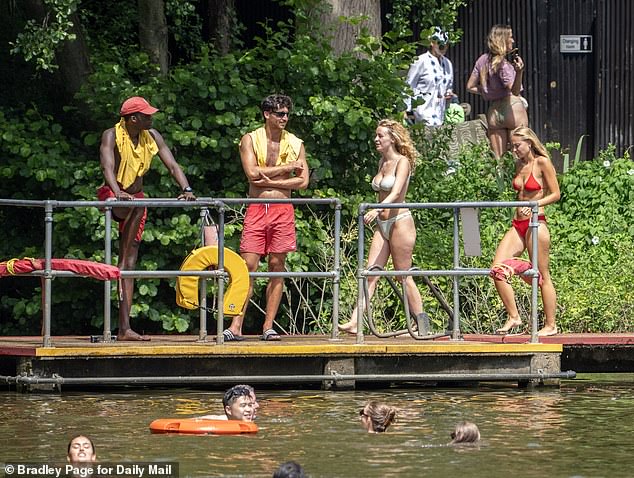
Swimmers and lifeguards were pictured at the bathing ponds on London’s Hampstead Heath

People sunbathed and swam at London Fields Lido outdoor swimming pool on Tuesday
Wednesday is expected to be the hottest June day on record, with temperatures due to rise to almost 40C in parts of the country.
This would smash the previous record of 35.6C set in London in 1957 – and Southampton in 1976.
On Tuesday 740 schools announced that they will be at least partially closed this week.
The total is likely to be higher given that some councils do not publish closures and certain schools do not appear on the lists.
Many children were sent home early on Tuesday after the Met Office issued a rare red extreme heat warning covering parts of southern England, as well as the Midlands and southern Wales.
The UK Health Security Agency has also issued a red health alert warning that there is a ‘risk to life for even the healthy population’.
After-school clubs, end of year trips, sports days and post-exam celebrations were being cancelled. Work will be set for many pupils to complete at home.

Sunbathers on the beach at Brighton during the 1976 heatwave in the UK

The scene at the Serpentine in London’s Hyde Park as people enjoy the heatwave in 1976

One man jumps into the fountain in Trafalgar Square as the temperatures soared that year
The highest temperature on Tuesday was 34.6C in Wisley, Surrey, while Scotland and Northern Ireland recorded their hottest days of the year so far with temperatures of 28.8C and 26.4C respectively.
June’s record temperature and the hottest of the year so far – 35.1C – was recorded at Kew last month.
Temperatures could creep nearer the UK’s overall record of 40.3C, set in July 2022.
On Tuesday the country’s lowest temperature – 10.5C – was recorded in Fair Isle, the UK’s most remote inhabited island which sits between the Orkney and Shetland Islands.
And the most rain fell in Northolt, London, where 32mm fell from the skies amid overnight thunderstorms during which 3,000 lightning strikes hit the capital in two hours.


A person sunbathed at a park as the UK prepared to experience what could be its hottest June day on record
Two homes caught fire in London, reportedly as a result of lightning strikes, and the city’s fire brigade received more than 400 calls in the early hours of Tuesday.
The Department for Education said it does not normally advise schools to close during hot weather because attendance is ‘the best way for pupils to learn’, but that heads should take ‘steps necessary to make sure children are safe and comfortable’.
Teachers’ union NASUWT, called for a ‘legally enforceable maximum classroom temperature’.
However, Chris McGovern, a former head and Ofsted inspector who now runs the Campaign for Real Education, said: ‘We need to toughen up a bit. Learning is worth a bit of discomfort. If it isn’t, then schools are not doing their job.’ Network Rail has advised passengers to travel only if ‘absolutely necessary’.
During the 1976 heatwave there were 15 consecutive days of temperatures reaching 32C somewhere in the UK.
The Daily Mail front page from June 26 reported 33C (92F) with a headline, ‘The Heat is Really On’.
Online, those who recalled 1976 insisted ‘we just got on with it’ and a Facebook user told of the advice to share a bath with a friend.