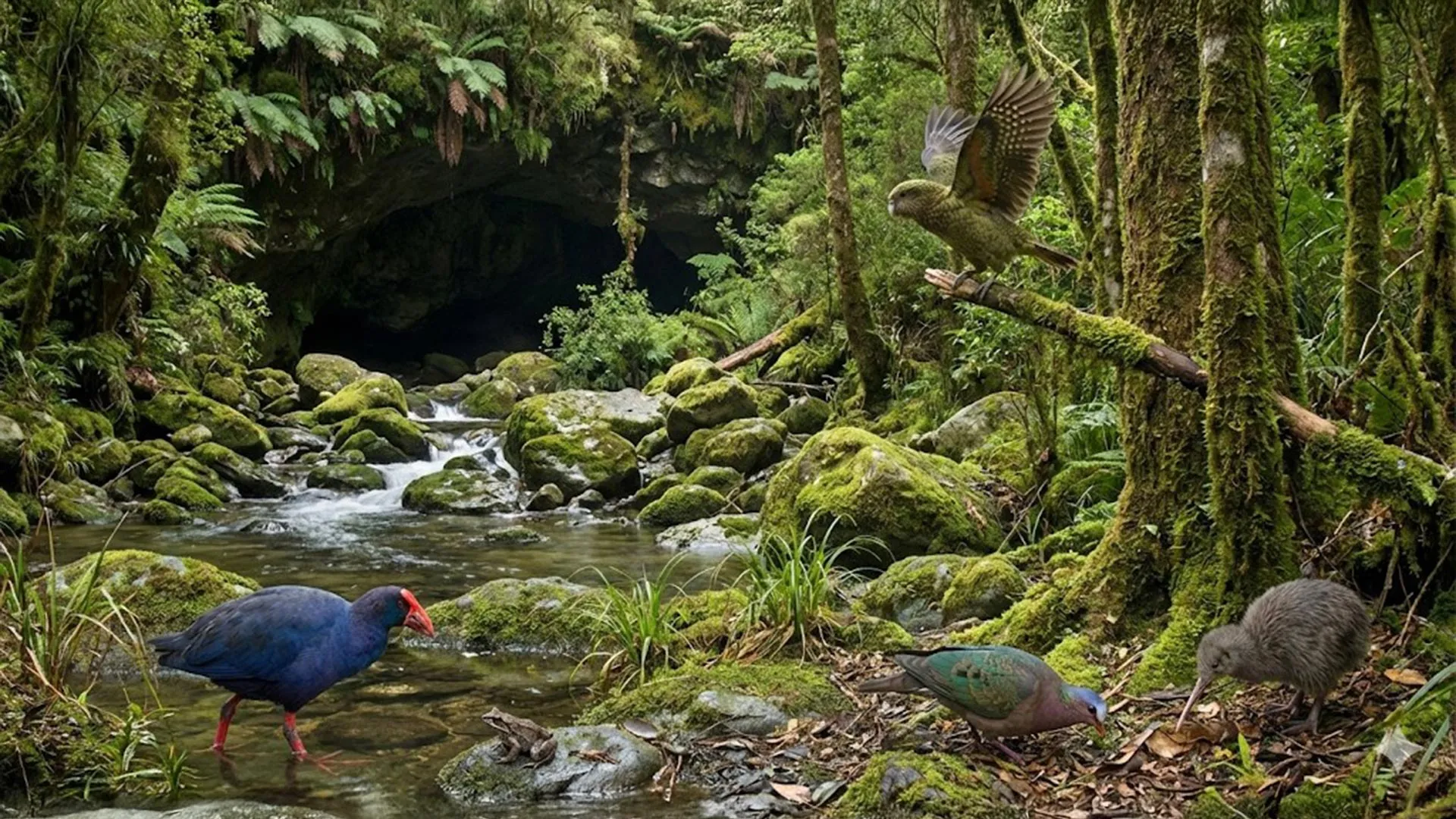
A remarkable fossil discovery inside a cave near Waitomo on New Zealand’s North Island is giving scientists an unprecedented look at a long vanished ecosystem. Researchers from Australia and New Zealand have uncovered the remains of ancient birds and frogs that lived around 1 million years ago, including a previously unknown relative of the iconic kākāpō.
The find marks the first time scientists have recovered a large collection of terrestrial vertebrate fossils from this period in New Zealand’s history. Preserved within the cave were fossils belonging to 12 bird species and four frog species, offering a rare snapshot of a world that existed hundreds of thousands of years before humans reached the islands.
The research, published in Alcheringa: An Australasian Journal of Palaeontology, suggests that New Zealand’s wildlife was already undergoing dramatic changes long before human settlement. Powerful volcanic eruptions and rapid climate shifts repeatedly reshaped habitats, driving extinctions and opening opportunities for new species to evolve.
Ancient Birds Lost to Time
Lead author Associate Professor Trevor Worthy of Flinders University says the fossils reveal a bird community unlike anything seen in New Zealand today.
“This is a newly recognized avifauna for New Zealand, one that was replaced by the one humans encountered a million years later,” says Associate Professor Worthy, from the College of Science and Engineering at Flinders University.
“This remarkable find suggests our ancient forests were once home to a diverse group of birds that did not survive the next million years.”
In biology, the term “avifauna” refers to the collection of bird species living in a particular place and time. The fossils indicate that the birds inhabiting New Zealand a million years ago were substantially different from those present when people eventually arrived.
The study involved paleontologists from Flinders University and Canterbury Museum, as well as volcanologists Joel Baker of the University of Auckland and Simon Barker of Victoria University of Wellington.
According to the researchers, approximately 33-50% of species disappeared during the million years before humans reached Aotearoa New Zealand.
Volcanoes and Climate Change Reshaped Ecosystems
Scientists believe these losses were largely caused by natural environmental upheaval.
“These extinctions were driven by relatively rapid climate shifts and cataclysmic volcanic eruptions,” says co-author Dr. Paul Scofield, Senior Curator of Natural History at Canterbury Museum.
The discovery helps fill one of the largest gaps in New Zealand’s fossil record.
“From our excavations at St Bathans in Central Otago over many years, we have a snapshot of life in Aotearoa between 20 and 16 million years ago. These new findings cast light on the 15 million year period from then to 1 million years ago, which is largely absent from New Zealand’s fossil record,” says Dr. Scofield.
“This wasn’t a missing chapter in New Zealand’s ancient history, it was a missing volume.”
Fossils are often compared to pages in Earth’s history book. In this case, researchers say they have uncovered an entire section of that story that was previously unknown.
A Possible Flying Ancestor of the Kākāpō
One of the most exciting discoveries is a newly identified parrot species called Strigops insulaborealis. It is an ancient relative of the kākāpō, one of New Zealand’s most famous birds.
Today, the kākāpō is the world’s only flightless parrot. It is also one of the heaviest parrots and is known for its unusual nighttime lifestyle. However, the newly discovered ancestor may have been very different.
Analysis of the fossilized bones suggests it had weaker legs than modern kākāpō. Because today’s birds rely heavily on their strong legs and climbing ability, researchers think the ancient species may have spent less time climbing and possibly retained the ability to fly.
Additional research will be needed to determine whether it truly could take to the air.
The cave also contained fossils from an extinct ancestor of the takahē, another distinctive New Zealand bird. Researchers also identified an extinct pigeon species closely related to Australia’s bronzewing pigeons.
“The shifting forest and shrubland habitats forced a reset of the bird populations,” adds Dr. Scofield.
“We believe this was a major driver for the evolutionary diversification of birds and other fauna in the North Island.”
Volcanic Ash Helps Date the Fossils
One reason the discovery is so important is that scientists can determine its age with unusual precision.
The fossils were trapped between two layers of volcanic ash preserved inside the cave. One ash layer came from an eruption about 1.55 million years ago. The second was produced by a massive eruption approximately 1 million years ago.
This natural geological sandwich provides clear age limits for the fossils.
Researchers say the younger eruption likely covered much of the North Island in meters of ash. While rain and erosion eventually removed much of that material, some remained protected inside caves.
The older ash layer also reveals something else remarkable. It shows that the fossil site is the oldest known cave on New Zealand’s North Island.
Rewriting New Zealand’s Natural History
Associate Professor Worthy says the fossils provide a crucial benchmark for understanding how New Zealand’s wildlife evolved.
The fossils “provide a critical, missing baseline for New Zealand’s natural history.”
For many years, scientists focused primarily on the ecological changes that occurred after humans arrived in New Zealand roughly 750 years ago. The new evidence shows that powerful natural forces had already been transforming the islands’ wildlife for hundreds of thousands of years.
“For decades, the extinction of New Zealand’s birds was viewed primarily through the lens of human arrival 750 years ago. This study proves that natural forces like super-volcanoes and dramatic climate shifts were already sculpting the unique identity of our wildlife over a million years ago.”