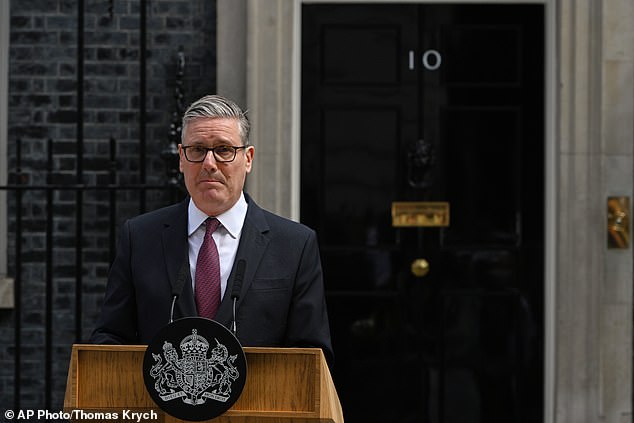
In a desperate last–gasp attempt to claim his contemptible premiership was anything but a car crash, Sir Keir Starmer used his resignation speech to reel off a series of dubious boasts and half–truths about his ‘achievements’ in office.
From the steps of Downing Street, the most unpopular Prime Minister in modern times also conveniently failed to mention the litany of judgment errors, U–turns and scandals that dogged his tenure from the get–go.
Here, analysis by the Mail’s reporting team lays bare the reality behind the claims about his legacy and the countless failures and despised policies he conveniently left out.
CLAIM VS REALITY
HE SAID: ‘An economy that is stronger, growing faster than our peers’
REALITY: The UK economy grew by 0.6 per cent in the first quarter of this year – faster than any other G7 country.
But the Bank of England has said the figure ‘overstated’ growth. And Britain has not led the G7 in any other quarter since Labour came to power.
The IMF predicts the UK will grow by just 1 per cent this year, behind the US and Canada.
Labour’s manifesto also targeted GDP growth per head. But last year the UK lagged behind the US and Japan on this measure.
Meanwhile, inflation and the cost of borrowing on bond markets is the highest in the G7.

Sir Keir Starmer used his resignation speech to reel off a series of dubious boasts and half–truths about his ‘achievements’ in office
HE SAID: ‘Wages rising faster than inflation in every single month since we came to power’
REALITY: Wages are growing more quickly than inflation – but only just. Latest official figures show pay in real terms – after taking into account the cost of living – is climbing by just 0.3 per cent. That is down sharply from 3.3 per cent when Labour came to power.
And even that meagre growth is only down to inflation–busting pay settlements being lavished on the public sector.
For the four–fifths of the workforce, pay has been falling in real terms since October, according to the Resolution Foundation think–tank.
HE SAID: ‘Investment secured’
REALITY: Business investment appears to have slowed since Sir Keir entered Downing Street.
Firms hit the handbrake at the end of 2024 and investment was also sluggish last year.
Last year and 2024 were the weakest years for business investment growth since the pandemic.
Major failures include AstraZeneca scrapping plans to invest £450 million in a vaccine manufacturing plant in Merseyside and ChatGPT maker OpenAI shelving a major data centre investment in Britain due to soaring energy prices and red tape.
HE SAID: ‘Infrastructure being built’
REALITY: Rail link HS2 could cost as much as £112 billion even after Labour ministers ordered the top speed to be cut and it may not fully open until 2043 after further delaying it.
Plans for a new runway for Heathrow, the Lower Thames Crossing road tunnel and the Sizewell C nuclear plant are also mired in delay.
A report last year found £198 billion of infrastructure projects were rated ‘red’ – meaning delivery ‘appears to be unachievable’ – twice the figure from a year before.
A pledge to build 1.5 million homes by 2030 is also expected to be missed.

British Prime Minister Keir Starmer hugs his wife Victoria, as he announces the timeline for his resignation, outside 10 Downing Street yesterday
HE SAID: ‘An end to austerity’
REALITY: State spending as a share of GDP shrank between 2010 and 2020 under so–called ‘austerity’ policies but leapt back during the pandemic.
Under Labour it has ballooned again, thanks to higher spending by government departments, welfare payments and debt interest.
But the Government’s plans assume that – to meet Budget targets – there will be some belt tightening in many areas outside protected departments such as the NHS.
That would mean spending falling – in real terms by 4.4 per cent a year – in unprotected areas such as social care, courts and prisons.
HE SAID: ‘The fastest fall in NHS waiting lists for 17 years’
REALITY: There are 6.11 million patients currently waiting for 7.22 million treatments on the NHS in England.
While this is down 400,000 since Labour came to power nearly two years ago, the drop isn’t the result of hospitals doing more procedures.
Rather, they were paid £32.5million over the last year to find around 600,000 patients they believed no longer required care and simply deleted them.
Lists also fell by 600,000 over a three–month period in 2020 under the Conservatives.
HE SAID: ‘The biggest improvement in rights for workers and renters in a generation’
REALITY: The Employment Rights Act gives workers ‘day one’ rights to sick pay and parental leave, cracks down on zero–hours contracts and makes it easier for unions to hold strikes.
But the Government’s first impact assessment calculated it would cost businesses £5 billion a year when all of its many measures are finally implemented, hitting economic growth.
The Renters’ Rights Act makes it illegal for landlords to evict tenants without a reason and bans fixed–term contracts.
But there are concerns it will push up rents while forcing landlords to sell up.
HE SAID: ‘Small boat crossings falling’
REALITY: The number of Channel migrants so far this year is lower than last year – the second–highest year on record – but Labour cannot claim all the credit.
High winds in spring suppressed arrivals and there have been 11,054 confirmed so far this year, about 7,300 fewer than the same point last year. But the past week has seen a spike, with more than 1,900.
And the running tally is only a few hundred behind the same point in 2022, which went on to be the record year.
HE SAID: ‘Protecting young people from social media’
REALITY: Sir Keir faced accusations that he dithered and delayed over whether to implement a social media ban for children – and U–turned only when fighting to save his premiership.
Pressure mounted on Labour to take action to keep children safe online after Australia became the first country to ban social media for under–16s in December.
After initially opposing a similar move in the UK, last week the PM finally announced the Government would stop under–16s using ten of the biggest social media platforms, including TikTok, Instagram and X.
HE SAID: ‘Half a million children being lifted out of poverty because of the choices that I made’
REALITY: Sir Keir’s plan to lift 550,000 children out of poverty by 2030 relies mostly on the lifting of the two–child benefit cap, effective from April this year, which has been criticised for ‘rewarding worklessness’.
In the next five years, 450,000 children will benefit – with families receiving £300 a month for each extra child. The largest families may get more than £10,000 extra annually.
But the cost will total £13.6 billion over that time, paid for by taxing working families and businesses.
HE SAID: ‘Securing trade deals’
REALITY: In a significant coup, the PM oversaw the completion of a major deal with India which had been in the making for five years.
More recently, his Government also struck a deal with the oil–rich Gulf Co–operation Council. But a pact with the US, which could potentially be the most valuable, hasn’t materialised.
A ‘deal’ made with Donald Trump last year has unravelled as his relationship with the US President deteriorated. And a promised zero–tariff regime for British steel exports never got off the ground.
WHAT HE FAILED TO MENTION
THE ‘FREEBIES’ SCANDAL
Sir Keir was hit with a scandal over gifts that he accepted just months after entering Downing Street, setting the direction of travel for his doomed premiership.
In September 2024, it emerged he breached parliamentary rules by failing to declare some of his wife’s high–end clothes were bought for her by his biggest personal donor, Lord Alli.
He also accepted several thousand pounds–worth of glasses and suits from the Labour peer, who had a temporary No10 security pass, leading to the ‘passes for glasses’ scandal.
And there were tickets to concerts and football matches from other sources. The PM was forced to pay back £6,000–worth of ‘freebies’.
THE MANDELSON AFFAIR
Arguably his biggest error of judgment was appointing Peter Mandelson as ambassador to the United States despite warnings about his ‘close ties’ with Jeffrey Epstein, even after the financier was first convicted of procuring an underage girl in 2008.
The PM was also warned over Mandelson’s China links and business interests, but pressed ahead with the appointment despite being told it was a ‘general reputational risk’.
He was forced to sack the former Labour peer last year when details surrounding his ties with the late paedophile were exposed publicly in the Epstein Files published by the US Department of Justice.
When it emerged earlier this year that Mandelson had failed to pass initial security vetting checks, Sir Keir claimed that he hadn’t been told about it, raising more questions about his leadership.

Prime Minister Keir Starmer, right, talks with Britain’s ambassador to the United States Peter Mandelson during a welcome reception at the ambassador’s residence in 2025
CHAGOS ISLANDS DEBACLE
Sir Keir was forced to ditch his much–criticised deal to hand control of the Chagos Islands to Mauritius after Donald Trump branded it an ‘act of total weakness’ and a ‘very woke thing’.
It would have seen Britain transfer sovereignty of the islands and lease back the joint US–UK Diego Garcia air base for 99 years to the tune of around £35 billion.
But he needed Mr Trump’s approval, which he failed to secure, and it was shelved after defence chiefs also warned it would make the air base ‘inherently less secure’.
SOFT JUSTICE
More than 60,000 prisoners were let out of jail early by Sir Keir’s Government, which also reshaped the sentencing system so that most offenders will now serve less time.
The early release scheme – introduced in autumn 2024 to free–up space in jails – saw lags popping bottles of bubbly at the prison gates and vowing to be life–long Labour supporters.
Since then, Labour’s Sentencing Act has gone even further. From September, many criminals will be eligible for release after serving just one third of their sentence.
Last week victims of appalling child sex grooming gangs expressed outrage after receiving official letters telling them their abusers may now enjoy heavy sentence discounts thanks to the reforms.
BALLOONING WELFARE
Sir Keir’s Government planned to save £5billion by 2030 by restricting access to the personal independence payment (PIP), the main type of disability benefit. But he was forced to scrap the proposals when faced by the prospect of a backbench rebellion, and PIP claimants have since topped 4 million.
In the meantime welfare spending, which stood at £315 billion last year, is predicted to soar to £408bn (including the state pension) by the end of the decade and account for one in four pounds spent by the Government.
YOUTH WORKLESSNESS
The number of people aged 16 to 24 classed as not in education, employment or training (NEETs) surged past a million at the start of this year for the first time in more than 12 years.
It has been blamed on Labour’s employer National Insurance hikes and steep increases in the minimum wage.
RECORD TAXES
Over the course of two Budgets, Chancellor Rachel Reeves has put up taxes by £66 billion.
The overall tax burden is on course to rise to 38.5 per cent of GDP – a post–war record.
Among those being punished are those dragged into paying higher rates of income tax after the Chancellor extended a freeze on thresholds. The OBR estimates that will drag 780,000 more people into paying income tax and 920,000 into paying the higher 40 per cent rate.
DOCTORS’ STRIKES
Labour spent its time in Opposition blaming the Conservatives for junior doctors’ strikes and claimed it would resolve the industrial dispute.
Sir Keir allowed then Health Secretary Wes Streeting to agree a deal with the British Medical Association within weeks of forming his Government – at a cost to taxpayers of around £1billion.
But this was given away with no conditions on performance or future pay, paving the way for the union to launch fresh strikes the following year, with the dispute rumbling on.
SCHOOL FEES
Labour’s VAT on private school fees has been blamed for pupil numbers in the independent sector falling to their lowest level in a decade. There has been a reduction of 22,000 since the tax was imposed in January last year, as families were priced out. In addition, more than 100 private schools have closed.
The revenue raised was meant to pay for 6,500 extra teachers, but state schools actually saw a reduction of 1,900 during Sir Keir’s first year.
Report by David Barrett, Martin Beckford, David Churchill, John–Paul Ford Rojas, Jason Groves, Eleanor Harding, Sam Merriman, Mark Nicol and Shaun Wooller