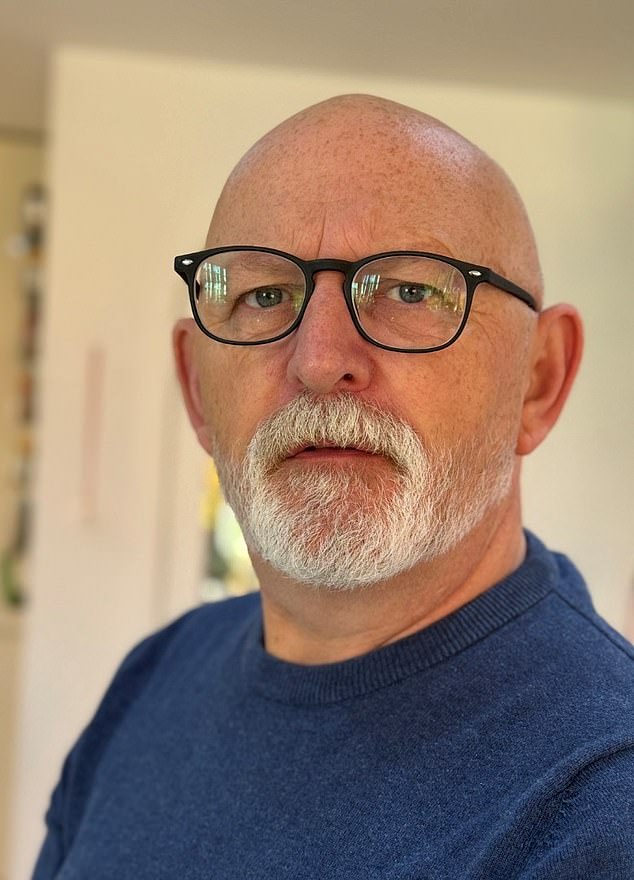
The driver of a train who was killed in a horror crash which injured 100 people has been named as 60-year-old Shaun Burton.
One train smashed into the back of the other on the same line near Bedford just after 5pm on Friday.
The collision killed the train driver instantly and left nine people fighting for their lives in hospital.
In a tribute, Mr Burton’s grieving family said: ‘We are devastated by his loss. Our thoughts are also with those affected by this incident.’
Of the 100 victims, 11 people were very seriously injured, a further 32 were seriously hurt, and 57 others suffered minor injuries, the East of England Ambulance Service (EEAS) said.
It was the highest number of casualties of any rail disaster in the UK for 20 years.
Both trains were heading for London. The first, a 3.50pm service from Nottingham to St Pancras stopped on the track.
Then the 4.40pm Corby train, which had stopped at Bedford station just two minutes prior, crashed into the back of it.

Driver Shaun Burton, 60, died in the crash between the two trains in Bedford on Friday afternoon

Specialist crane equipment has also arrived this morning at the crash site which will be used to lift the two trains off the tracks
The crash was declared a major incident by the British Transport Police, as police and paramedics rushed to the scene.
Network Rail today described the crash as a ‘tragic, isolated incident’ and announced that rail services will be disrupted until June 28 while a ‘complex recovery operation’ begins to remove the damaged trains and carriages.
The black box was recovered from the wreckage of the train this morning.
Rail investigators removed it from the Luton Airport Express yesterday and placed an evidence sticker on the side.
The data recorder will help investigators piece together what happened before the service ploughed into the back end of a stationary passenger train at 5.15pm on Friday near Bedford.
Specialist crane equipment also arrived this morning at the crash site, just south of the Elstow interchange between the A421 and the A6, which will be used to lift the two trains off the tracks.
King Charles joined senior politicians in offering their condolences following Britain’s worst train disaster in 20 years.
The monarch said he was ‘greatly saddened’ and his ‘thoughts and sympathies’ were with the family of the deceased and those affected.
The Rail Accident Investigation Branch (RAIB) said on Saturday that its inspectors continued to gather evidence at the scene.
‘RAIB will conduct a full, independent safety investigation into this tragic accident,’ the agency said in a post on X.
‘We will provide a further update in the coming days once we know more.’
The front of the 4.40pm departure from Corby to London St Pancras was crushed when it crashed into the rear of the 3.50pm departure from Nottingham, to the same destination.
The Corby train also had damage to the rear of the carriages which had been shunted into the ones in front.
Mobile phone footage showed blood-covered victims on carriage floors and others staggering around a nearby field.
One survivor likened the crash impact to ‘a bomb explosion’ and said most people in his carriage were ‘bleeding profusely’ or couldn’t stand.
Passenger Pete Knapp described people ‘crying, screaming’ and said some seemed to have major injuries.
Dr Knapp said: ‘There was a moment of being flung into the chair in front, and then I saw smoke.
‘People were crying, screaming, people were so scared and confused.’
The 40-year-old said he saw people with ‘life-threatening, major injuries, minor injuries’ as well as ‘people with bandages, people who couldn’t see straight’, while others like him were still able to walk.

New photos taken today show the crash site in what is Britain’s worst train disaster in 20 years

Investigators begin their work in the aftermath of the train crash near Bedford on Friday evening
Brett Byatt, another passenger on board, told the BBC he was among three or four people in his carriage who were not injured, adding: ‘Everyone else had either a serious wound that was bleeding profusely, or a situation where they couldn’t stand, or couldn’t move their neck, or I saw a woman’s snapped leg.’
Mr Byatt, a teacher, who lives in Bedford, said he was feeling ‘angry’ the morning after the collision.
‘I don’t know at whom, who specifically, but it’s more about we’ve got one of the oldest railway networks and signal failures happen a lot, and now I’m just wondering… why wasn’t that signalled to my train and why did that train driver lose his life over this?’ he said.
Prime Minister Sir Keir Starmer said in a post on X that he had spoken with the chief executive of EEAS.
‘I expressed my gratitude to the air ambulance crews, the emergency services who responded under extremely difficult circumstances, as well as the NHS staff taking care of the injured,’ Sir Keir said.
Rail expert Tony Miles, from Modern Railways magazine, said the crash was puzzling ‘because if the track is occupied, it shouldn’t be possible to clear the signals’.
Mr Miles said that while a driver could theoretically decide to cross a red signal if they wanted to, ‘they would normally only do that because they had been given permission by a signal box because there was a fault’.
He added: ‘Obviously it’s a rear-end collision, they were going in the same direction, so the rear one was going faster than the one it caught up with for some reason.
‘So the question must be how that train has got into contact with the train that it was following.
‘It’s either gone past a signal that was telling it should stop, or the signal was faulty, or the driver has made a mistake in some way. Over the years, all those different scenarios have happened.’
Speaking at a press conference near the scene on Saturday, British Transport Police Chief Constable Lucy D’Orsi said: ‘There will be a lot of questions as to what exactly happened on (Friday) night.
‘I would like to reassure everyone that specialist investigators from British Transport Police are working with colleagues at the Rail Accident Investigation Branch to gather the facts and determine what has happened.
‘They are extremely experienced and I would ask that we all refrain from speculation.’
Police chiefs said the response by emergency services was outstanding, and praised locals for their ‘immense kindness’ to passengers in the crash aftermath.

Rail investigators have removed the black box from the wreckage of the Bedford train crash that killed the driver and injured 100 others


The National Union of Rail, Maritime and Transport Workers (RMT) was ‘devastated to learn that a train driver and former RMT rep has tragically died’.
Eddie Dempsey, its general secretary, wrote on X: ‘The thoughts of RMT are with their family, friends, colleagues and the Aslef trade union at this awful time.’
Ampthill Road remained closed between the Interchange Retail Park roundabout and Manor Road in Kempston Hardwick all day on Saturday.
There was a huge emergency response to the crash, which happened just south of the Elstow interchange between the A421 and the A6, with air ambulances and fire engines sent to the scene.
Network Rail said on Saturday that part of the East Midlands route remained closed as the emergency response continued and teams assessed damage to the trains and infrastructure.
The company said it would provide updates when it had a clearer understanding of the recovery work required and when services can safely reopen, adding that passengers should check with their train operator for the latest travel advice.