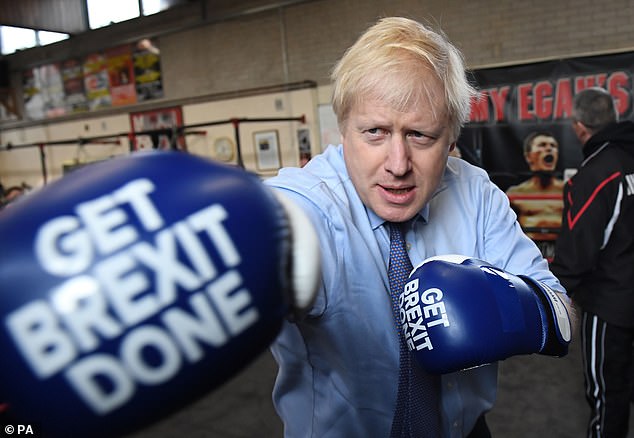
It was ten years ago that the people of this country voted to leave the European Union, and I look back on that moment with undiminished joy – and continuing amazement.
There were 17.4million people who had the courage to take back national control from the institutions of Brussels – more than have ever voted for any proposition or party in the history of our democracy.
Their decision was all the more astonishing when you consider the size and influence of the opposing coalition. Every major political party was in favour of remaining in the EU. So were the vast majority of MPs. So were most of the broadcasters and the respectable media folk; the universities; the churches; the CBI.
All of them warned the public against leaving – they even flew in Barack Obama, the former President of the US, to tell us that we would regret our temerity.
Well, he failed in his mission.
The people defied the Establishment. They stuck up two fingers to the boss class, and they voted for their ancient and hard-won privilege – to decide who runs their own country.
They voted, fundamentally, for the right to elect and remove from office those who make the laws. They voted to protect British democracy from a slow but remorseless strangulation – a gigantic agenda to subordinate national parliaments and governments in a single European political entity, with its own parliament and its own seat of government in Brussels.
In voting against that project, the people were not hostile to the EU, and certainly not hostile to other member countries. They simply did not believe that the goal – a federal EU – was right for Britain.

The fundamental problem is that we have a massively high-taxing, high-spending Labour government that has earned a global reputation for persecuting wealth creators
They voted for the integrity of their democracy, and for freedom, and they showed a deep wisdom. They were heroic to ignore the threats and cajoling of the other side, and they were 100 per cent right.
Ten years on, anyone seriously in favour of reopening that argument is out of his or her tiny mind; though the truth, sadly, is that such people exist. Ever since that glorious morning in June 2016 there have been enthusiasts at work on a barely concealed plot to take us back in, and to put the yoke of Brussels back on our necks.
T hey will never succeed, and to understand why you just have to imagine the campaign. To persuade the British public to go back into the EU, you would have to get them to agree to a series of ascending absurdities.
To rejoin the EU, we would have to renew our payments to EU coffers – grossly corrupt and badly administered as they are. We would be handing over between £12 billion and £15 billion of taxpayers’ money, every year – to be spent by anonymous officials in Brussels on everything from subsidies for Spanish bullfighting to Potemkin Greek tobacco farms.
We would deprive the Treasury of this cash at a time when we can barely afford to fund our own defences.
It’s insane. It’s never going to happen.
Then we would be asking the public to hand back legal control of our borders when control of immigration has never been more politically salient or important. Thanks to Brexit the government of this country can decide who can – legally – come to this country. We can decide that whole categories of people can be excluded, for instance.
We can exclude people from particular countries or groups of countries. We can keep out people with certain types of criminal record. We can control our borders, at least in law, in a way that was simply impossible in the EU.
Rejoin the EU, and we hand back that control to Brussels.
In any version of Rejoin, we once again become part of the giant zone of free movement, in which 480 million people have the right – should they so choose – to pour over our borders and avail themselves of our welfare state.
Whatever Keir Starmer or Andy Burnham may say about having a ‘reset’ with the EU, there is no serious UK politician who would have the guts to campaign to go back to EU free movement. There is not a snowball’s chance in Hades of getting that one past the British people, and it gets worse.
Rejoining the EU means once again giving up control of our own legislation – accepting once again that we are part of the empire of EU law, enforced by the European Court of Justice, when many of those laws have been designed and imposed without UK interests in mind – and sometimes against the specific opposition of UK ministers.
When I first got into Parliament I was put on something called European Standing Committee B, whose job was to ‘scrutinise’ EU legislation. It was an absolute farce. We could do nothing to amend those rules. We just sat there, alternately whingeing and rubber-stamping what Brussels had decreed.
Since we left the EU, the Brussels machine has churned out about 10,000 to 12,000 new directives, regulations and other legal instruments, many of them actively harmful to the interests of British business. Rejoining would mean that we had to swallow the lot of them – and then whatever else the EU wanted, under the qualified majority vote system, until the crack of doom.
Whoever is mad enough to campaign for Rejoin is going to have to persuade the British people to accept a haemorrhage of democratic control, and to cap it all we will be obliged – under EU rules – to join the euro.
Any acceding state is expected to give up its national currency in favour of the single European currency, which means that UK monetary policy – the interest rate on your mortgage, for instance – is set in Frankfurt rather than in London.
None of this is going to happen. Water will sooner flow uphill, pigs fly and the sheeted dead gibber in the streets.
We are out, we are free, and instead of pointlessly and painfully re-opening the old arguments we should embrace our freedom – and double down.
Yes, this country has its share of woes, but there is not a single major economic problem affecting the UK that can be solved by going back into the EU, and most of our problems, especially with productivity, would end up substantially worse.

Rejoining the EU means once again giving up control of our own legislation – accepting once again that we are part of the empire of EU law
It is true that our economy is not growing as fast as it should or could. But that is nothing to do with Brexit – our trend growth since leaving the EU has been about the same as France and Germany: sometimes faster, sometimes slower.
The fundamental problem is that we have a massively high-taxing, high-spending Labour government that has earned a global reputation for persecuting wealth creators.
Starmer had the chance to cut the welfare budget – and chickened out. With the result that Labour is squeezing businesses until the pips squeak.
By far the best hope for the UK is that we somehow end this socialist nightmare, and the victory of the Tories in Aberdeen South is the best possible omen. The Conservatives made a coherent and compelling economic argument – and we won. We need that to happen again.
Sooner or later, this country is going to have a 1979 moment – an economic turning point at which we recognise that we can’t go on with debt of £3trillion, and tax higher than it has ever been, and a welfare budget that is sapping the strength of the economy like some vast and debilitating fungus. When we finally turn this thing round – cut the wasteful spending, cut taxes, cut regulation – then, with the right government, we will be able to use Brexit to supercharge that growth.
Taking back control has already delivered far more benefits than people appreciate.
It was because we were outside the EU’s so-called ‘common foreign and security policy’ that we were able to take a much tougher approach with Putin on Ukraine, for instance. It was precisely because we were outside the institutions of the EU single market – the European Medicines Agency – that we were able to approve a series of vaccines weeks ahead of the EU 27, at a time when about 1,000 people were dying from Covid every day.
Brexit not only saved lives at a critical time, but also boosted the economy – because the speed of our vaccine rollout meant that we came out of lockdown measures about nine months faster than other European countries; and that meant we had the fastest economic rebound in the G7. What this country therefore needs is a government that has the balls to go further, to build on Brexit, not turn the clock back.

Brexit has enabled us to do free trade deals around the world, and we have cut tariffs on thousands of products that we don’t grow or make in this country
Thanks to Brexit-enabled rules immigration is now falling steeply – and what we need is a Conservative government that finally makes use of Brexit freedoms to stop illegal immigration as well.
The reason I was able to announce the Rwanda policy in April 2022 – to send illegal cross-Channel arrivals straight to Kigali – is that we were no longer subject to EU asylum rules.
The people-smuggling gangs hated that Rwanda policy. They knew that it would destroy their business. It is a tragedy that Starmer was so woke and so pathetic as to shelve Rwanda.
But one day we will have the right pro-Brexit government – and get it done.
Brexit has enabled us to do free trade deals around the world, and we have cut tariffs on thousands of products that we don’t grow or make in this country. Why should we have a tariff on bananas or mangoes or oranges just because the EU has one? The answer is that we shouldn’t, and thanks to Brexit we don’t.
One day we can go further, and do a proper free trade deal with our biggest single national export market – the United States.
It’s crazy that the Americans stop BA from exercising cabotage rights to pick up and set down passengers within the US, for instance, and crazy that they have artificial restrictions on the imports of British goods from cauliflowers to shower trays.
In fact, Britain should be the agent of integration for a transatlantic free trade zone – from Greece to California, where something that is safely put on the market in one Western country is deemed good for all markets. That’s the way to strengthen the West against the growth of China.
You may say it’s visionary, and so it is, but it’s also the right idea, and it’s only possible thanks to Brexit. Even under this Labour government we are seeing real divergence between the UK and the EU, as we use Brexit freedoms to do things differently.
We have started to diverge in our approach to financial services, for instance – an industry that has continued to grow, post-Brexit, in spite of all the predictions of doom. Very few in the City now want to go back in.
We are producing our own simpler and less restrictive laws on gene-editing, pesticides and artificial intelligence (AI).
Look at the shape of the new economy – look at the way the world is changing. Why the hell would we want some EU directive on AI thrust on this country, when the leading AI research lab, DeepMind, since bought by Google, actually began in the UK – and the EU doesn’t even have an AI industry?
Ten years on, I am more convinced than ever that we did the right thing. In their sublime wisdom the people of this country voted for democracy – for the right to choose and sack their rulers.
That is a good and beautiful principle in itself, and has already proved its worth. But the truth is that under Labour, Brexit is an unfinished revolution.
So let’s clear away the Labour government – human bollards in the path of growth – and get on with it.