Millions of years ago two massive stars circled each other in a cosmic dance. Then one of the stars went supernova. The blast likely flung the exploded star’s companion across space, setting it adrift in the cosmos for tens of thousands of years before it, too, succumbed to the same explosive end.
That, at least, is what astronomers believe may have happened to a newly identified pair of stellar remnants. Using observations from NASA’s Fermi Gamma-ray Space Telescope, researchers suggest that two clouds of supernova debris were once part of a binary star system—a pair of stars bound together by gravity and orbiting a common center.
“There are so many striking connections between the two remnants,” said Miltiadis Michailidis, a postdoctoral fellow at the physics department at Stanford University, in a statement. “They’re likely related, giving us the first known example of a binary system where both stars have undergone supernova explosions.”
On supporting science journalism
If you’re enjoying this article, consider supporting our award-winning journalism by subscribing. By purchasing a subscription you are helping to ensure the future of impactful stories about the discoveries and ideas shaping our world today.
When a star explodes, it expels powerful shock waves that can accelerate charged particles to near-light speeds, creating cosmic rays. As these cosmic rays slam into nearby clouds of gas, they produce gamma rays—the highest-energy form of light. By detecting these gamma rays, astronomers can trace the lingering remnants of ancient supernovae long after the original stars have vanished.

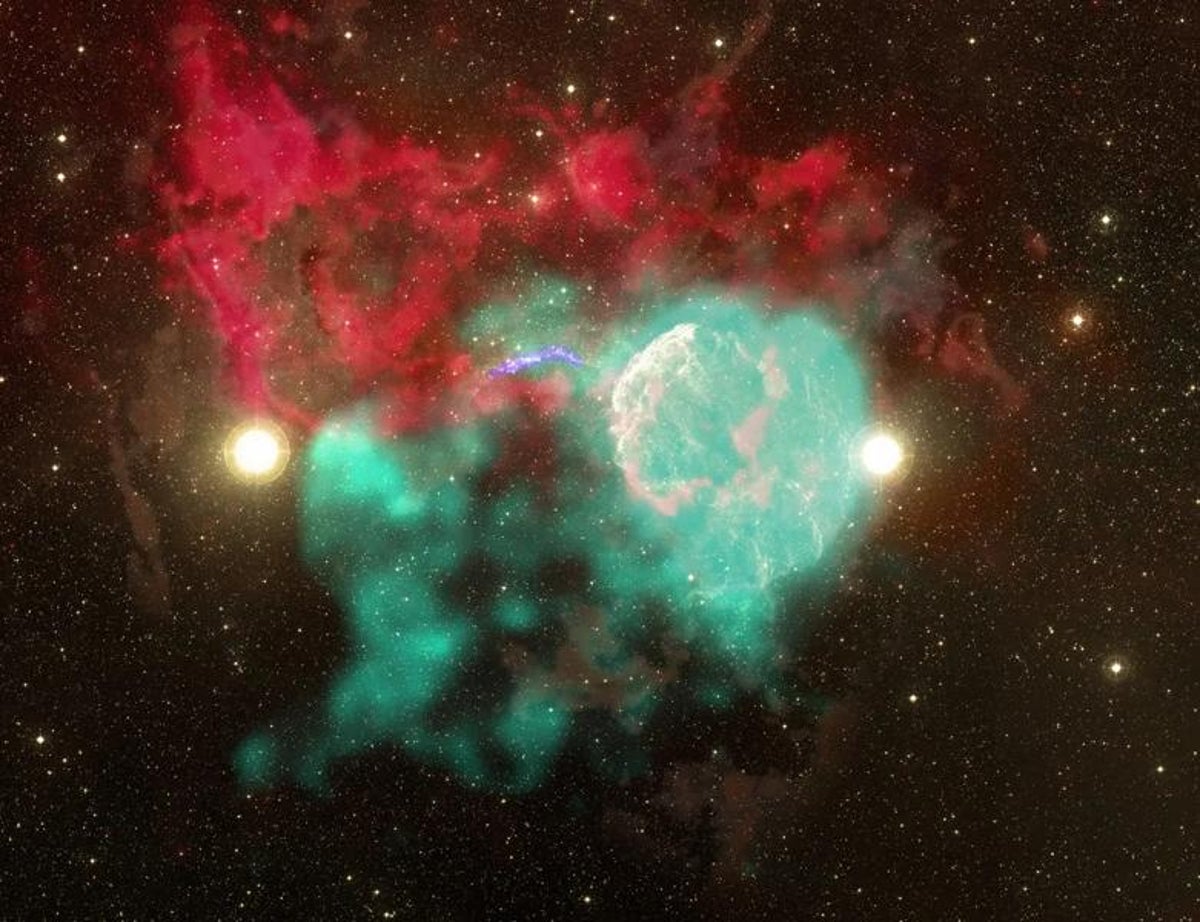
This multiwavelength scene shows the Jellyfish Nebula supernova remnant (right), the interstellar cloud it’s interacting with and a distinctive curving filament to its upper left.
NASA Goddard Space Flight Center/M. Michailidis et al. 2026; DSS (optical); NASA/WISE/JPL-Caltech/UCLA (infrared); NASA/Swift (ultraviolet)
Using 16 years of Fermi observations, researchers examined two remnants in the constellation Gemini: the well-known Jellyfish Nebula (IC 443) and a much fainter neighbor called G189.6+3.3. Both remnants appear to be interacting with the same dense gas clouds. Computer simulations further affirmed the observations. Together with estimates placing the objects at roughly the same distance from Earth, the data suggest that the two remnants share not only a neighborhood but potentially a common origin.
The researchers also calculated that the odds of the observed alignment having occurred by chance are less than 1 percent. “We can now connect the glowing remains of two massive stars to a powerful pair that evolved together over thousands of years,” said Elizabeth Hays, project scientist for Fermi at NASA’s Goddard Space Flight Center in Greenbelt, Md., in the same statement.
If confirmed, the interaction between the Jellyfish Nebula and G189.6+3.3 would provide a rare target for studying how massive binary stars evolve and die. The discovery could also help astronomers better understand the origin of some of the highest-energy particles in the universe.
It’s Time to Stand Up for Science
If you enjoyed this article, I’d like to ask for your support. Scientific American has served as an advocate for science and industry for 180 years, and right now may be the most critical moment in that two-century history.
I’ve been a Scientific American subscriber since I was 12 years old, and it helped shape the way I look at the world. SciAm always educates and delights me, and inspires a sense of awe for our vast, beautiful universe. I hope it does that for you, too.
If you subscribe to Scientific American, you help ensure that our coverage is centered on meaningful research and discovery; that we have the resources to report on the decisions that threaten labs across the U.S.; and that we support both budding and working scientists at a time when the value of science itself too often goes unrecognized.
In return, you get essential news, captivating podcasts, brilliant infographics, can’t-miss newsletters, must-watch videos, challenging games, and the science world’s best writing and reporting. You can even gift someone a subscription.
There has never been a more important time for us to stand up and show why science matters. I hope you’ll support us in that mission.