One of the biggest problems astronomers face when they peer into the night sky is that the heavens above appear two-dimensional.
To the eye, that’s obvious; as far as your vision can tell, all the planets and stars are mere dots of light affixed to a flat sky. Even big telescopes don’t change this perspective much because the vast majority of objects observed are still too small and distant to resolve their structure.
This lack of a perceivable third dimension can lead to a lot of confusion. In particular, how do you know if what you’re seeing is something relatively dim and nearby or something extremely bright but halfway across the universe?
On supporting science journalism
If you’re enjoying this article, consider supporting our award-winning journalism by subscribing. By purchasing a subscription you are helping to ensure the future of impactful stories about the discoveries and ideas shaping our world today.
Happily, we’re not completely helpless here. There are multiple ways to determine an object’s distance, although they, too, come with difficulties. Those difficulties are why, even now, with all our sophisticated technology and scientific advancement, it’s still easy to be fooled by cosmic imposters—objects that look like one thing when they are in fact quite another. But sometimes, if you’re lucky, the imposters turn out to be worthwhile discoveries in their own right.
When the James Webb Space Telescope (JWST) lifted off in 2021, one of astronomers’ greatest dreams launched along with it: to clearly see closer to the edge of the observable universe and thus observe very young galaxies. Light is pretty zippy—it’s the fastest thing in the universe—but the cosmos is vast, so when we look at very distant galaxies we see them as they were not long after the universe itself was born because their light took so long to reach us.
On top of that, the expansion of the universe stretches the wavelengths of such ancient light via a phenomenon called redshifting—and the effect grows stronger over distance. Normal galaxies emit copious visible light, but across great distances, that light becomes so redshifted that it arrives at our planet—and our telescopes—as infrared. To realize the dream of glimpsing early galaxies, JWST is optimized for infrared, so its vision extends well beyond even that of the Hubble Space Telescope.
And, indeed, shortly after launch, JWST seemed to make those dreams come true. Some of its first images were dotted with tiny red objects—possibly extremely distant galaxies. But given the sky’s “two-dimensional” illusory appearance, how could we know for sure?
One way is by using a technique called photometric redshift. Galaxies emit light across the electromagnetic spectrum, but wavelengths in the extreme ultraviolet (UV) are absorbed very efficiently by pervasive clouds of hydrogen in intergalactic space, which blocks most of that UV light from more distant objects. This tends to make remote galaxies extremely faint at those wavelengths.
For very remote galaxies, however, redshifting stretches even that extreme UV light into infrared wavelengths. This gives astronomers a way to gauge a galaxy’s distance using what’s called the dropout technique. They use a series of filters that each block a different, specific set of wavelengths. A faraway galaxy will be visible at longer wavelengths in this setup but will disappear at shorter ones where the UV emission is faint. The wavelength at which the dropout occurs—determined by which filter it’s seen in—can reveal a galaxy’s approximate redshift.
This method isn’t terribly precise, but it’s quick, making it handy for flagging objects of interest for more careful follow-up observations. This imprecision helps explain why astronomers began publishing papers claiming all sorts of fantastic results from JWST’s early images—including the existence of galaxies apparently redshifted to such a high degree that they pushed our cosmological models past the breaking point. But were those galaxies real?
Confirming these bold claims required the time-consuming process of taking the candidate galaxies’ spectra by parsing their light into thousands of individual colors. Different elements such as oxygen and hydrogen emit light at very specific wavelengths; discerning such details allows astronomers to nail down an object’s actual redshift—and thus its true distance—with excellent accuracy. And the subsequent spectra for many of those extreme candidates showed them to be galaxies much closer to us with colors that, via the dropout technique, made them only look like they were very distant.
Fast-forward to 2025, when a team of astronomers used JWST to observe the Bullet Cluster, a galaxy cluster relatively near to Earth. As part of their observations, they employed the dropout technique to look for extremely distant galaxies that coincidentally happened to be far in the background in the image. And, in a paper posted in April on the arXiv.org preprint repository, they reported the discovery of two objects called Bullet-BD1 and Bullet-BD2; both are red dots displaying dropouts in the filters that would indicate they are extremely distant, very young galaxies.
But scientists are cautious by nature, so they followed up with deeper spectroscopic observations via JWST, as well as cross-referencing against archival images of the Bullet Cluster. And it’s good that they did, because those follow-ups showed these objects weren’t galaxies at all but instead extremely low-mass brown dwarfs located in our own Milky Way!
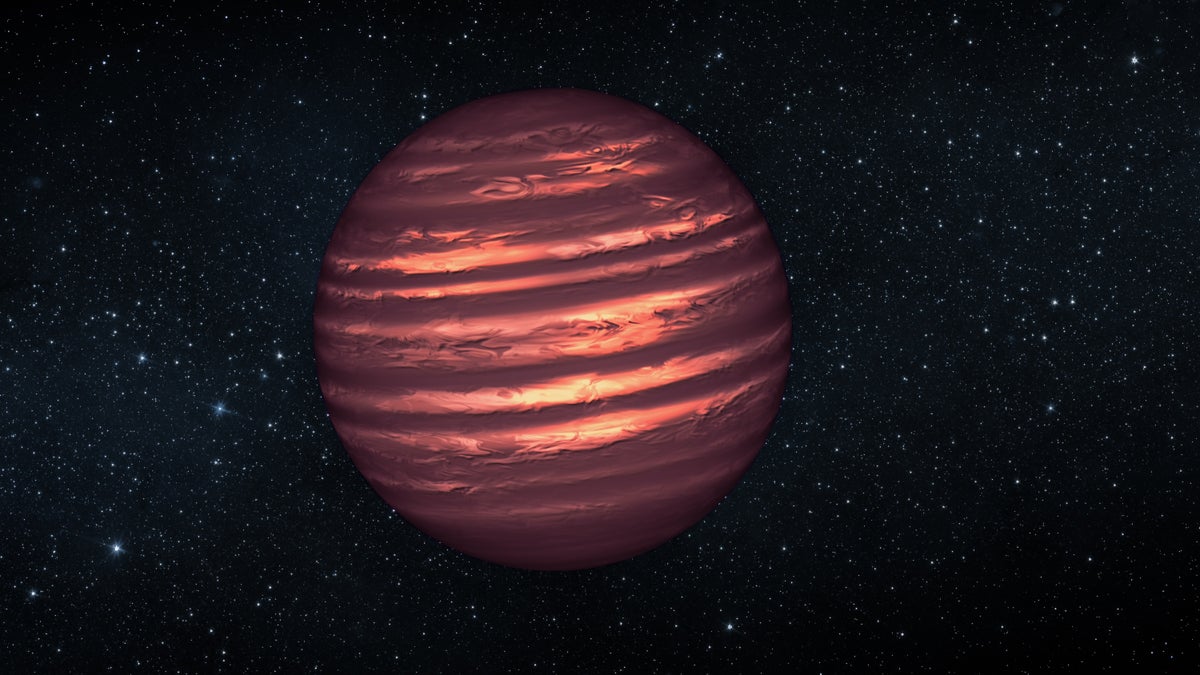
Brown dwarfs are weird objects that have masses that are intermediate between those of giant planets and small stars. Astronomers started finding them in the 1990s, and about 3,000 are now known (though thousands more candidates await confirmation). They’re very faint in visible light wavelengths but can be quite bright in infrared ones, as long as they aren’t too far away—which was exactly the case for Bullet-BD1 and Bullet-BD2. But just because these objects aren’t nascent galaxies in the distant cosmos doesn’t mean they’re any less interesting. They are (literally) quite cool, with temperatures of about 125 and 27 degrees Celsius—the latter is the temperature of a warm spring day! Unlike stars, which generate energy from thermonuclear fusion in their cores, brown dwarfs are too small to have ongoing fusion power. So once they form, they generally just cool over time.
Bullet-BD1 and Bullet-BD2 are among the lowest-temperature and lowest-mass brown dwarfs known, which makes them important for astronomers looking to understand exactly how brown dwarfs form—a topic that is still hotly debated. Finding these two by coincidence also implies that other as-yet-unseen brown dwarfs litter our galaxy. We don’t have great statistics on these objects just yet because we know of so few of them, making this pair a nice addition to the menagerie.
If there’s a lesson here, it’s that revealing imposters isn’t always disappointing. Sometimes you look for big, splashy galaxies at the edge of the observable universe, and what you actually find are a pair of equally splashy brown dwarfs in your own backyard.