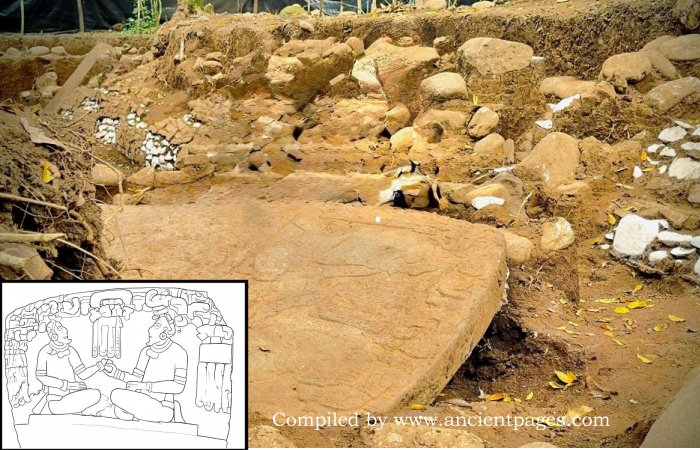
Conny Waters – AncientPages.com – During the archaeological salvage project led by the National Institute of Anthropology and History (INAH) in the San Lucas subdivision of Coatepec, Veracruz, researchers uncovered pre-Hispanic cultural remains. These include civic-ceremonial structures likely dating to the Early Classic period (200-600 AD) and displaying features previously unrecorded in the region.
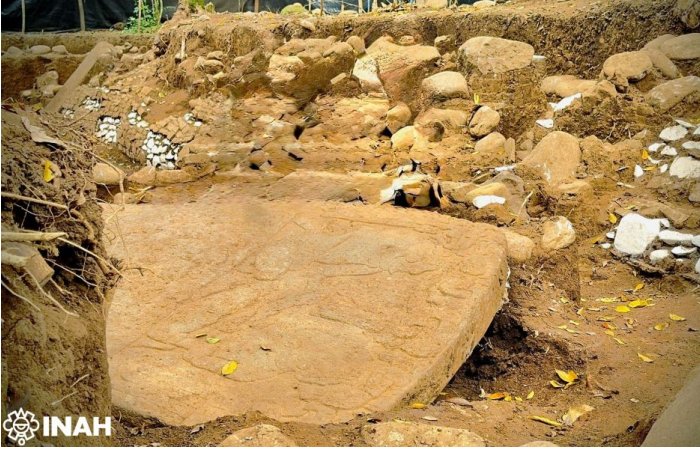
The discovery of a monolithic sculpture measuring 1.88 meters in height was a highlight. Credit: INAH
The Secretary of Culture of the Mexican Government, Claudia Curiel de Icaza, emphasized that “every structure, object, and symbol that emerges from archaeological research reminds us that Mexico possesses one of the deepest and most diverse cultural heritages in the world. This discovery provides new knowledge about our past and reaffirms the importance of protecting heritage as a common good.”
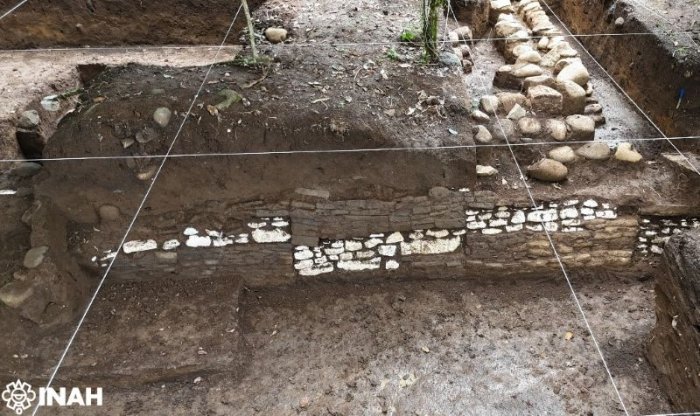
The white decoration, not found in the region, was likely achieved through firing. Photo: courtesy of Lino Espinoza.
The discovery includes a platform measuring 30 meters long and 12 meters wide, constructed with flagstones and white, gypsum-textured dressed limestone. This effect was achieved through a specific firing process used to decorate the walls. The platform features linear and square-like designs, as well as circular stones on two sides, which are unique to the region and have not been previously documented.
Two Figures Receiving A Fluid From A Divine Entity Above Them In A Vessel
A monolithic sculpture was found with the structure, measuring 1.88 meters high, 1.47 meters wide at its widest point, and 0.68 meters wide at its narrowest point. Its thickness ranges from 22 to 25 centimeters. The sculpture features engravings depicting two elite figures, seated and dressed in elaborate attire, receiving a fluid from a divine entity above them in a vessel. Notably, one figure displays possible Mayan features.
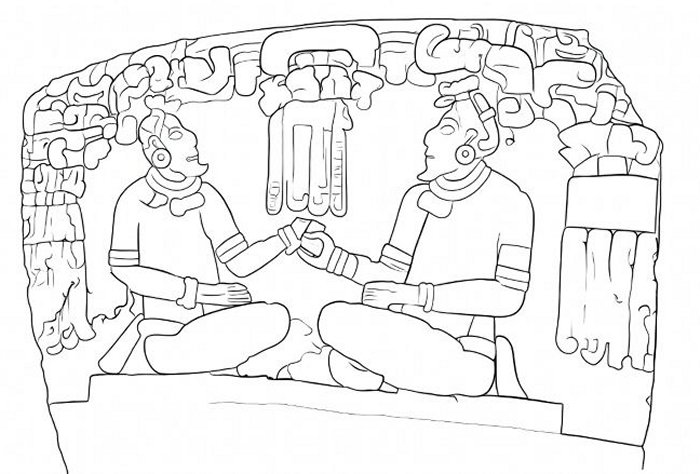
Preliminary drawing of Stela 2. Courtesy of Lino Espinoza.
Both the structure and the sculpture were found in good condition. The structure will require restoration, consolidation, and maintenance. The sculpture has already been treated with consolidants, and any potentially damaging soil elements have been removed.
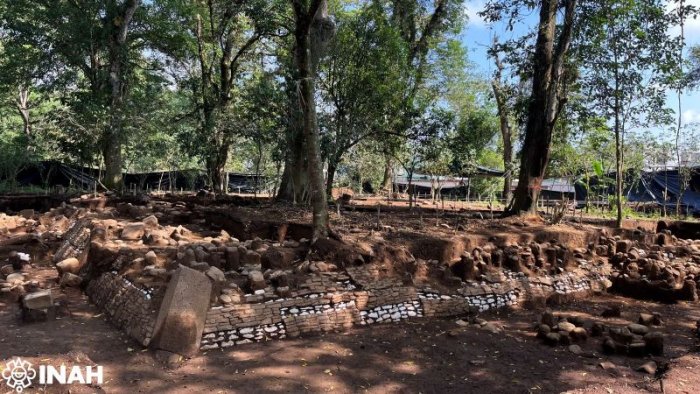
The structure is built with flagstones and white-faced limestone. Credit: Omar Ramírez.
During salvage operations, archaeological surveys led to the recovery and identification of pre-Hispanic cultural materials associated with the structure. These include charred corn remains offered as offerings, buried vessels, and a greenstone bead broken into four pieces. The artifacts will be sent to the laboratory for analysis and are currently under the care of an interdisciplinary team coordinated by archaeologists Alberto Vázquez Domínguez and Lino Espinoza García from the INAH Veracruz Center.
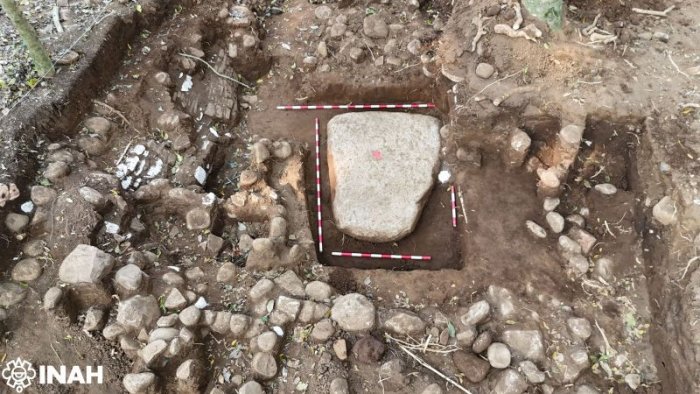
View of the stela at the site of its discovery. Credit: INAH
Although the term Totonac is often used to refer to populations between the Cazones and Papaloapan rivers, there are no indicators of that civilization in this area. Specialists suggest the materials belong to a local culture with Gulf Coast attributes.
See also: More Archaeology News
The archaeological salvage work is taking place on private property, which has been under investigation since late 2025. Fieldwork is expected to conclude in mid-August 2026, with material analysis scheduled for completion in February 2027.
Source: INAH
Written by Conny Waters – AncientPages.com Staff Writer