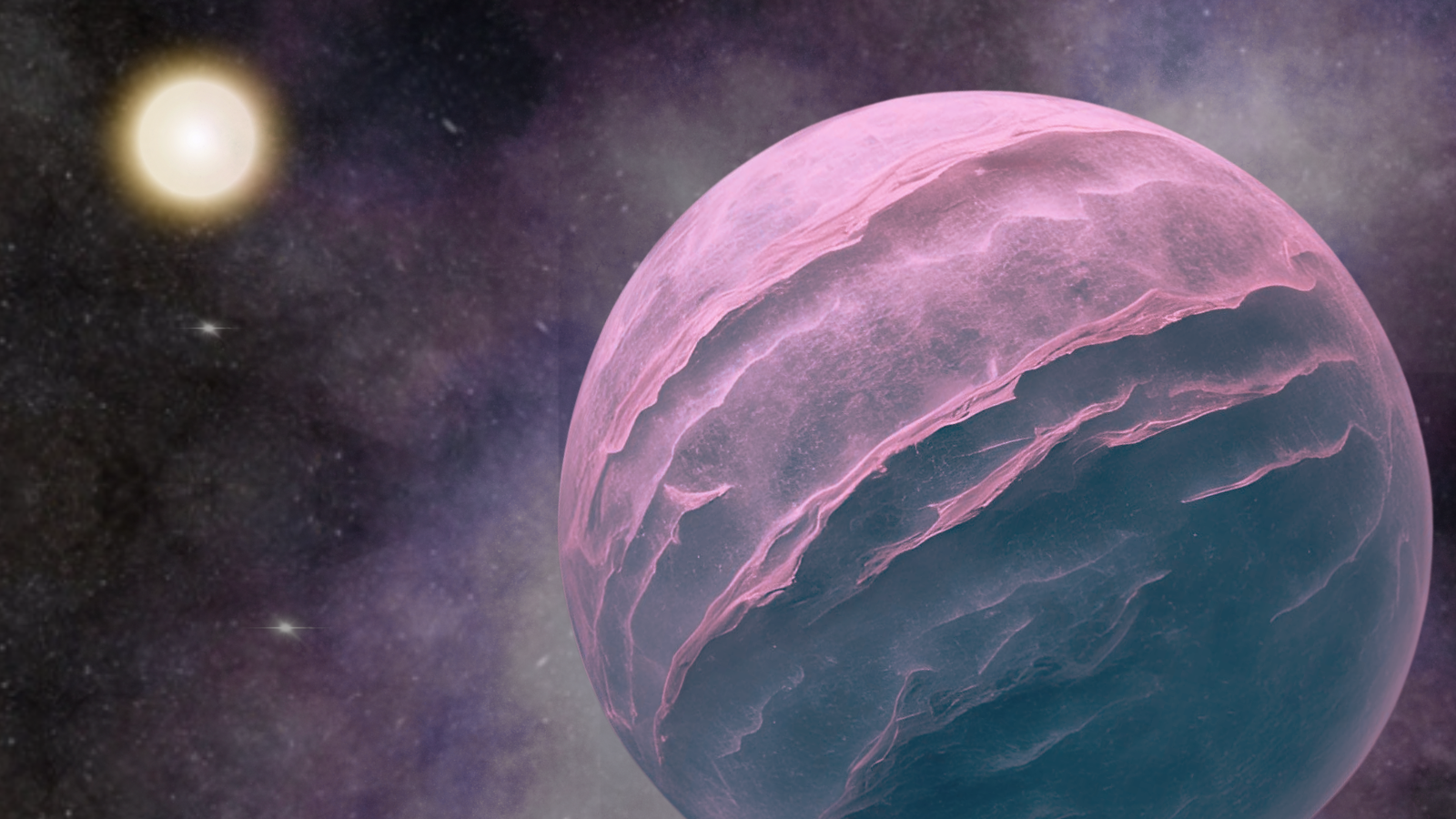
Using the James Webb Space Telescope, astronomers have discovered that the well-known “Pink Planet” harbors a salty surprise and an exotic atmospheric chemistry. The discovery marks an advancement in the study of cold objects beyond the solar system.
Initially discovered in 2013, GJ504b orbits a sun-like star located around 57 light-years from Earth. With a mass around 25 times that of Jupiter, this Pink Planet may not be a planet at all despite its moniker. It may instead be a brown dwarf, a failed star that formed like a star but was unable to gather enough mass to achieve the nuclear fusion of hydrogen to helium in its core. Thus, astronomers refer to it as a “planetary-mass companion,” which means a planet-size object orbiting a parent star.
GJ504b remains one of the coldest planetary-mass companions discovered using ground-based telescopes, with a temperature of around 550 degrees Fahrenheit (290 degrees Celsius). Although, that still makes it hot enough to bake bread. Now, James Webb Space Telescope (JWST) data reveals it has a key ingredient for bread making too: salt located in its atmospheric clouds, unlike anything astronomers have seen before.
“The Pink Planet is the coldest companion ever discovered using ground-based instruments,” team leader Aneesh Baburaj of Northwestern University said in a statement. “Many teams all around the world performed follow-up observations to study its light, but it was too faint for ground-based instruments. That made it a perfect target for JWST.
“When we finally obtained its spectrum, it immediately looked interesting. But once we started digging deeper into the data, we realized it was not like anything we have analyzed before.”
The Pink Planet is cold and old
The team studied this planetary companion by measuring its faint electromagnetic radiation emissions and filtering out the bright glare of its parent star.
They found the relative coolness of the Pink Planet is a result of the planet’s age. Both gas giant planets and brown dwarfs are born blisteringly hot but cool off as they get older. This new research estimated that GJ504b is between 2.5 billion and 4 billion years old.
Breaking down light from the Pink Planet into individual wavelengths, the team was also able to determine its chemical composition. This is possible because elements absorb and emit light at characteristic wavelengths, meaning they leave “fingerprints” on light passing through their atmospheres.
“In the past, other astronomers observed the companion for an entire night with some of the biggest telescopes in the world to obtain a spectrum,” Baburaj said. “And they could not see the object. With JWST, our entire observation took around two hours, and we were successful.”
The JWST data revealed a rich cocktail of chemicals in the atmosphere of the Pink Planet that included water, carbon dioxide, methane, and ammonia. However, these observations didn’t match modeling of the planetary companion’s atmosphere until the team factored in something completely unexpected: clouds of salt deep in the atmosphere.
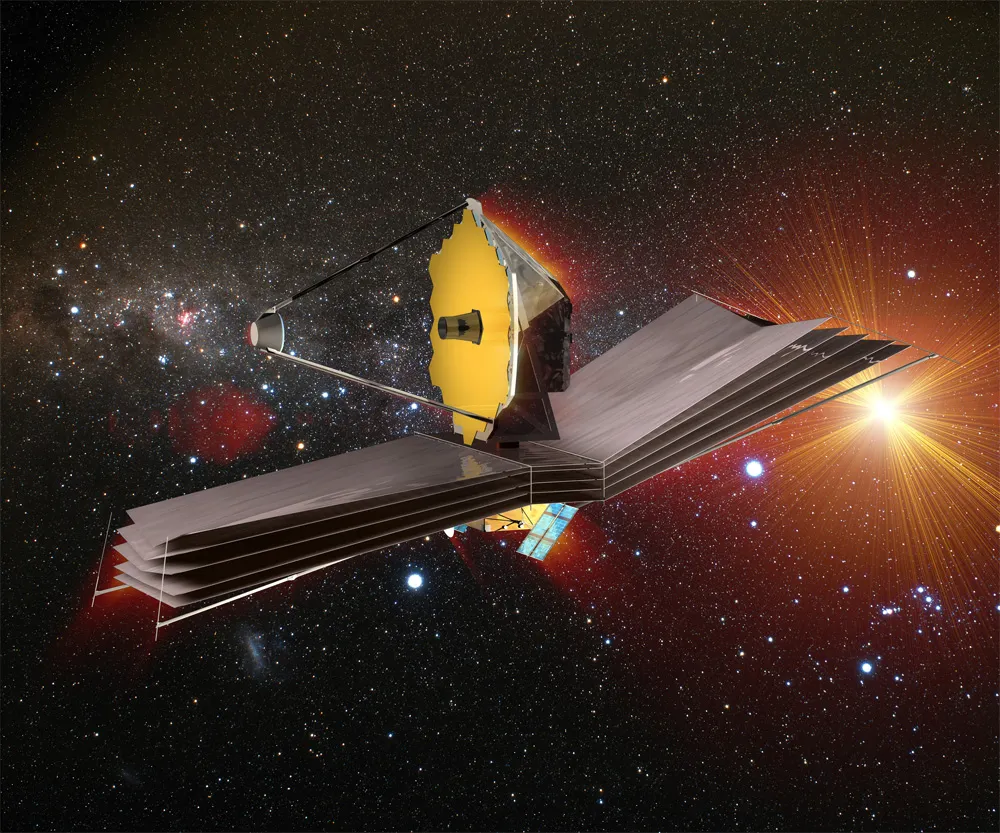
“We ran simulations with clouds, and the results aligned with what we know about cold planets,” Baburaj said. “We tried three different types of clouds, and salt clouds fit best. When we accounted for salt clouds, it subdued the signature of molecules hidden deeper in the companion’s atmosphere. Then, the results became physically possible.
“This is the first time we’ve found that salt clouds are critical to explaining the spectrum of an object. It’s a good reminder to account for clouds in our models.”
Though this mystery may be solved, there are still questions surrounding GJ504b that will only be solved with further investigation. The Pink Planet seems to be unusually rich in elements heavier than hydrogen and helium, which astronomers call metals. This means the team still can’t pin down the origin of the Pink Planet; did it form like a planet, or like a star?
That means they aren’t quite ready to determine if GJ504b is a gas giant planet or a brown dwarf… or should that be Pink Dwarf?
The team’s research was published on Thursday (June 18) in The Astronomical Journal.