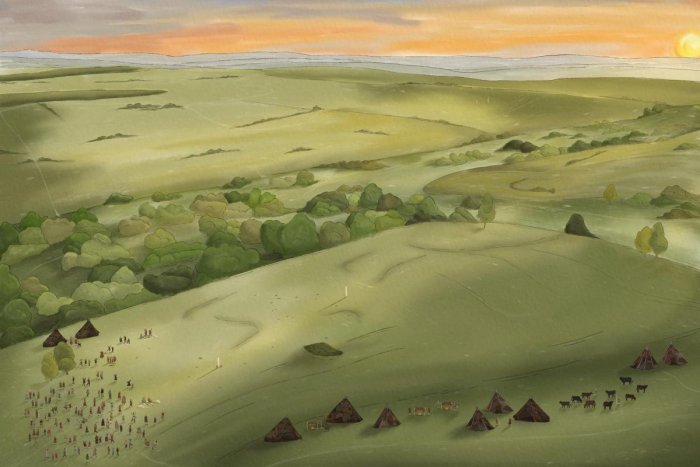
Conny Waters – AncientPages.com – As thousands gather at Stonehenge for the summer solstice on June 21, a team from Wessex Archaeology, led by Phil Harding, has announced the discovery of an ancient structure that may have served as an early prototype for Stonehenge’s solstice alignment.
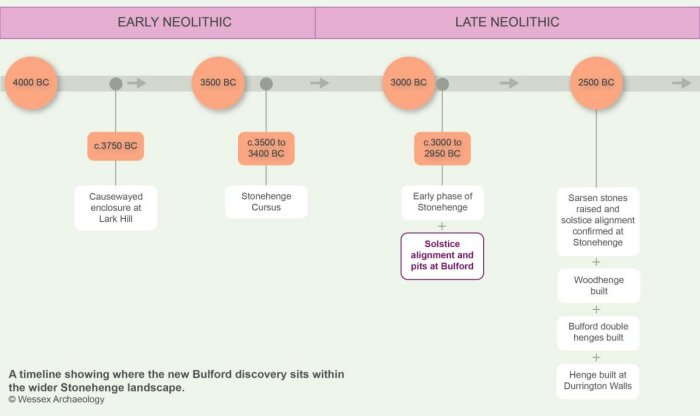
Images: Timeline and reconstruction of summer solstice celebrations as they might have appeared at Bulford 5000 years ago Credit: Wessex Archaeology
Radiocarbon dating places the structure at around 5,000 years old, providing the earliest known evidence of solstice alignment in the Stonehenge area. This suggests that people celebrated the solstice here at least 500 years before the stones at Stonehenge were aligned.
Located 5 km from Stonehenge in Bulford, Wiltshire, the site dates to the earliest phase of Stonehenge, when the first earthworks were constructed. Excavated through the Ministry of Defence’s Army Basing Programme, the site likely hosted major religious gatherings, with evidence of feasting and large-scale celebrations similar to today’s solstice events at Stonehenge.
The central structure likely consisted of two wooden poles, set 120 meters apart, aligned with the rising sun at the summer solstice and the setting sun at the winter solstice.
Only the pits where the poles once stood remain, and these are not open to the public. Dr Fabio Silva, a leading skyscape archaeologist, confirmed the solstice alignment through analysis for Wessex Archaeology. Using reconstructions of the ancient sky, landscape, and horizon, he demonstrated that the structure aligned with the solstices to within one degree.
This simple construction likely served as a site for solstice celebrations before more permanent monuments were built. The team suggests a similar structure may have existed during Stonehenge’s earliest phase, though any evidence would have been removed by later activity.
“In a few days’ time, Stonehenge will be filled with people celebrating midsummer solstice. But what few will realise is that 5,000 years ago on a nearby hillside overlooking modern day Bulford, people were doing the exact same thing – revering and celebrating the sunrise on midsummer’s day. The sun was incredibly important to these prehistoric communities, and they could plot and record its midsummer rising to a high degree of accuracy.
This discovery is probably one of the greatest finds of my career and what makes it so important is just how early it is. Up till now, our knowledge of this ancient feat of astronomy was based on Stonehenge and other monuments of a similar period, but what we’ve discovered at Bulford is 500 years earlier than the famous stones we know so well. It makes me incredibly proud to be an archaeologist,” Dr Phil Harding, Archaeologist at Wessex Archaeology who led the excavations, said.
Excavations at Bulford from 2015 to 2017 uncovered 48 pits, radiocarbon dated to approximately 2950 BC. Artifacts such as pottery, animal bone, worked flints, and charcoal indicate that large groups gathered here briefly, likely to celebrate the solar cycle. One pit, possibly a ‘viewing station’, contained a rare disc-shaped knife, deliberately placed and possibly symbolizing the sun disc.
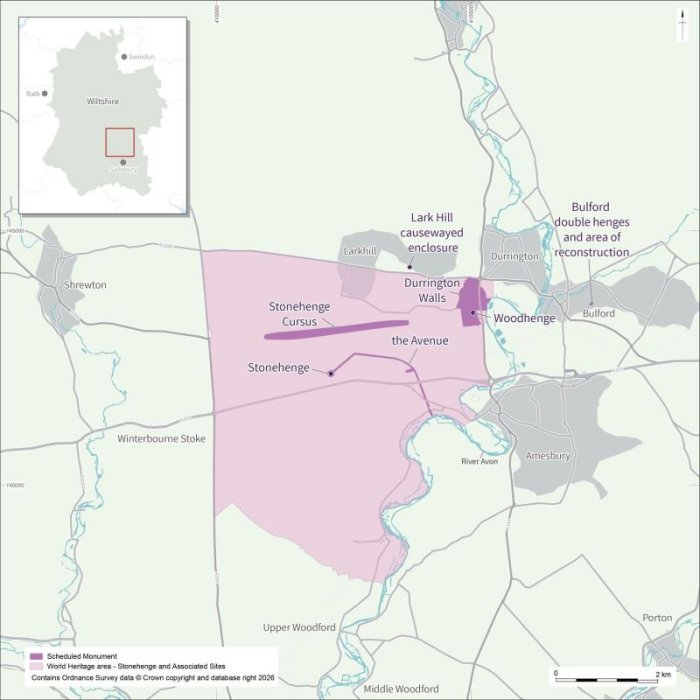
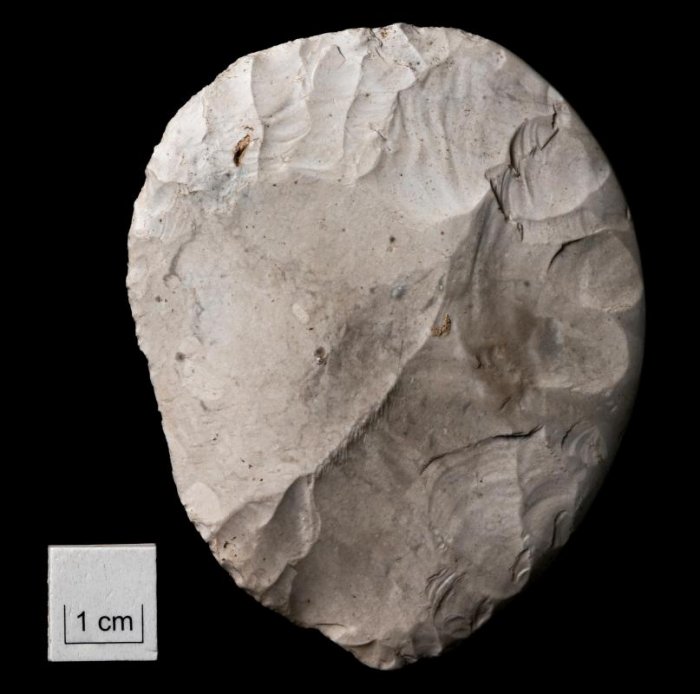
Images: Location map and disc-shaped flint knife found at Bulford by Phil Harding Credit: Wessex Archaeology
“The discovery at Bulford is fundamental because it’s the earliest example of people building things here that aim directly at the solstice. When we talk about the solstice, we’re talking about religion. About how prehistoric peoples understood the cosmos, the world, and their place in it. What we see at Bulford, and later at Stonehenge, is a way of celebrating and marking the passage of time, but it’s also about making sure the world keeps working as it should. It’s likely their way of saying to their deities, please keep us in mind, keep us warm and safe. It’s a religious event. That’s why it’s so important,” Dr Matt Leivers, Senior Research Manager at Wessex Archaeology, said.
Dr Fabio Silva, Skyscape Archaeologist at Stone x Sky and the Skyscape Academy, who conducted the analysis that confirmed the alignment, said: “This discovery helps us understand Stonehenge not as a singular creation, but as part of a much longer conversation between people, the land, and the sky. The alignment shows that communities were already engaging with both the summer and winter solstices in the Stonehenge landscape, centuries before the sarsen stones were raised. Rather than marking the beginning of a story, Stonehenge now more clearly appears to have emerged from traditions and practices with much deeper roots in this landscape.”
The ceremonial site was uncovered during excavations south of the Salisbury Plain Training Area ahead of development to provide accommodation for service personnel.
See also: More Archaeology News
“When we started working on the necessary excavations ahead of the construction of new accommodation for soldiers returning from Germany, none of us could have guessed what we would find. Following deeper study, what at first seemed innocuous has completely re-written our understanding of the ceremonial landscape around Stonehenge. It’s incredibly exciting,” Richard Osgood, Senior Archaeologist at the MoD’s Defence Infrastructure Organisation, said.
Source: Wessex Archaeology
Written by Conny Waters – AncientPages.com Staff Writer