Jan Bartek – AncientPages.com – The ancient Heerlen curse tablet was used to call on deities and demons to harm enemies. Found in Heerlen, a town in the Netherlands, this artifact comes from the Roman province of Lower Germania and dates back to the second century A.D.
Researchers at Heidelberg University have managed to decipher the tablet’s inscription.
What makes it unusual is its ancient Greek inscription in the Egyptian style, rather than in Latin, as Dr Rodney Ast, Academic Director at the Institute for Papyrology, explains.
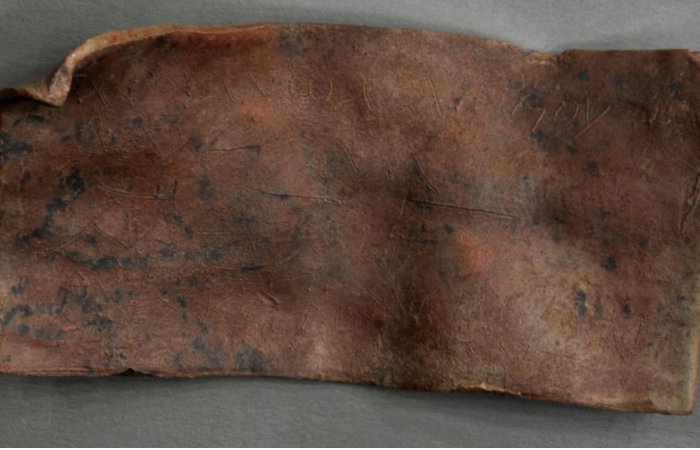
Heerlen curse tablet with an ancient Greek invocation of deities and demons in the Egyptian style. Credit: Elke Fuchs, Institut für Papyrologie, Universität Heidelberg
Researchers at Heidelberg University have managed to read the tablet’s inscription. These ancient curse tablets, called defixiones in Latin or katadesmoi in Greek, were usually made of lead, which people thought had special binding powers. Dr. Ast says the tablets were inscribed with spells or charms and then buried to influence or bind rivals in legal, athletic, or romantic situations.
Dutch archaeologists found the lead tablet in a pit under the town hall square in Heerlen, where the Roman settlement of Coriovallum once stood. The artifact is 9.3 by 4.8 centimeters and has three separate groups of characters. Experts at the Institute for Papyrology studied it using reflectance transformation imaging (RTI), a method that uses multiple photos taken under different lighting conditions to reveal fine surface details.
One interesting thing about the tablet is that it invokes various deities and demons in the Egyptian style, yet the text is written in ancient Greek. Most curse tablets found in Northern Europe are in Latin. The Heerlen curse tablet also has three magical symbols called “Characteres.”
Dr Ast says these symbols were probably meant to send the message to supernatural powers. After the symbols, the tablet lists the names of two men and two women, described as fellow slaves. According to the Heidelberg papyrologist, “The tablet served either as a curse against these four slaves or as a curse in their name against an unnamed person.”
The group of people named on the tablet is unusual, the researcher notes, because it has two men with Latin names and two women with Greek names. Dr Julia Lougovaya, a Research Associate at the Institute for Papyrology, says, “It cannot be ruled out that one of the two women was the author of the inscription and had brought the supposed ability to communicate with divine powers through such curses with her from Roman Egypt.”
Magic was important in ancient civilizations along the Nile, says Prof. Dr. Joachim Quack, Director of the Institute for Egyptology at Heidelberg University. Some magical practices, especially those for protection and healing, were officially accepted as part of religious life. Others, which served personal interests at the expense of others, were usually kept secret.
See also: More Archaeology News
The Egyptologist explains, “In the early centuries A.D., Near Eastern, Egyptian, Jewish, and sometimes even Christian traditions increasingly merged and spread throughout the entire Roman Empire of that time – a development that the discovery from Heerlen impressively underscores.”
The curse tablet will be displayed at the Heerlen Museum. The inscription, which experts at the Institute for Papyrology of Heidelberg University deciphered, will be published in a scholarly work so researchers can study it further.
Written by Jan Bartek – AncientPages.com Staff Writer