

Earth got some of the key ingredients for life from asteroids in the inner solar system – with a little help from the solar system’s largest planet, Jupiter, according to a recent study.
To figure out why we’re all here, and whether anyone else might be out there in the universe, scientists have to start with a more basic question: how did Earth get its supply of the chemicals that make up living cells?
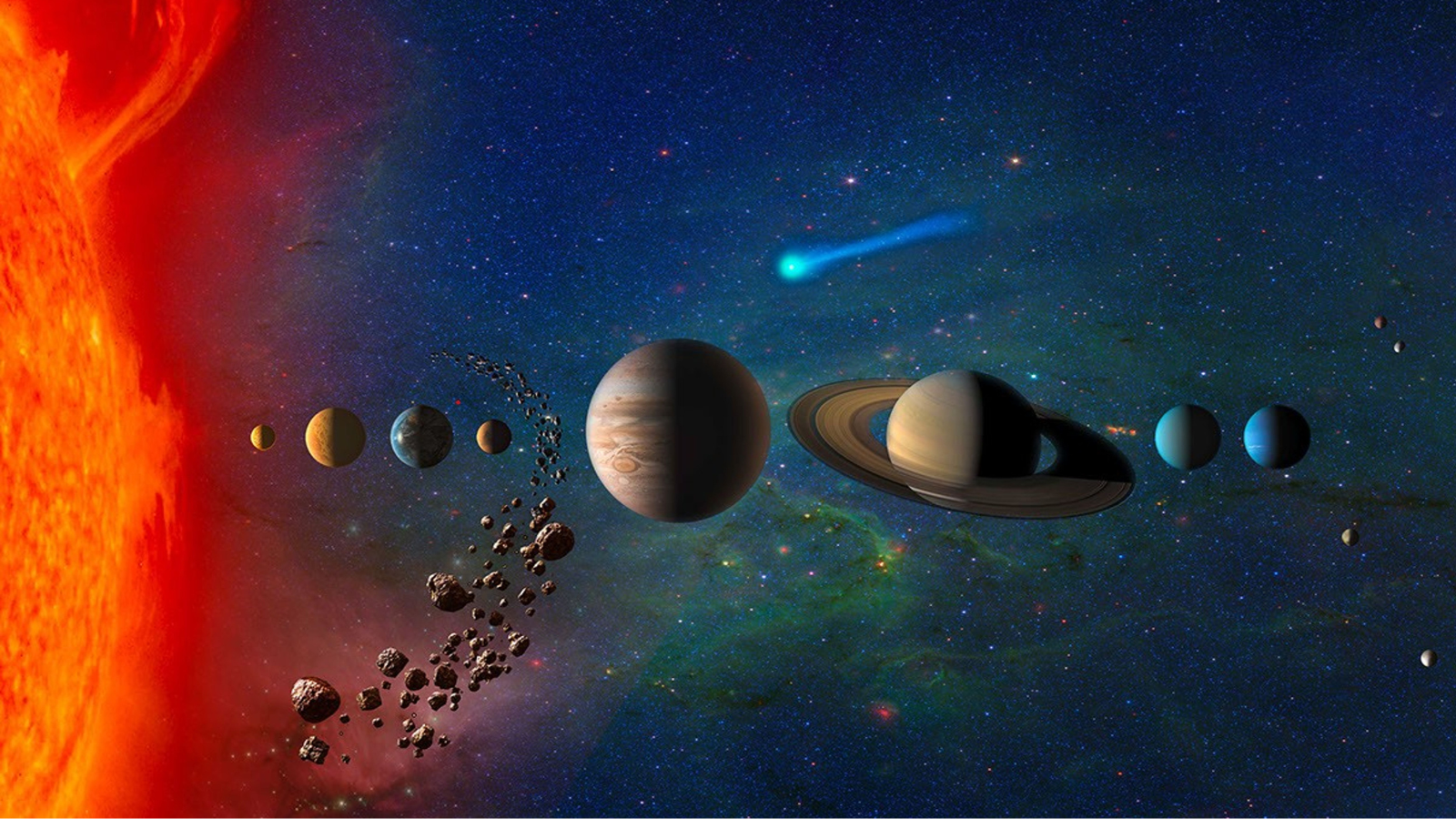
According to Rice University planetary scientist Rajdeep Dasgupta and his colleagues, Earth’s stockpile of phosphorus and nitrogen, two chemical elements essential to life, came mostly from chunks of rock that formed in the inner solar system. And that process might not have happened without Jupiter looming just outside the asteroid belt.
“For our own solar system, Jupiter’s presence and growth history indeed seem to have played a critical role in determining the distribution of the basic chemical ingredients necessary for habitable worlds,” said Dasgupta in a NASA press release. “It remains an open question whether a life-essential elements budget similar to Earth’s can be estimated without a Jupiter-like planet in the population.”
Jupiter scores an assist
Dasgupta and his colleagues combined lab experiments and computer simulations to map the proportions of nitrogen and phosphorus, two chemical elements essential to life, in the early solar system. Life as we know it is literally built on these two elements; you can’t build amino acids without nitrogen, and you can’t build DNA or RNA without phosphorus.
Other elements are also essential: carbon, hydrogen, oxygen, and sulfur, but how Earth got its phosphorus, in particular, has gotten less attention from researchers so far.
When scientists are investigating how Earth might have received the ingredients for life, one big clue is the ratio of each element to the others. Those proportions can form sort of a chemical fingerprint pointing back to the elements’ original source. In this case, looking at the ratio of phosphorus to nitrogen in present-day Earth’s rocky bulk could shed some light on where Earth’s phosphorus came from.
In the lab, the researchers simulated how different elements sort into layers as a newly formed asteroid cools, causing molten rock to crystallize. They also used computer simulations to model how different groups of planetesimals, clumps of metal and rock that coalesced out of the swirling disk of dust around the newborn sun, became the seeds of potential planets, formed and moved around the early solar system – moving phosphorus and nitrogen with them.

It turns out that present-day Earth contains phosphorus and nitrogen in about the same proportions as rocky planetesimals that formed in the inner solar system, the area between Jupiter and the Sun, around 4.3 to 4.2 million years ago.
Dasgupta and his colleagues’ models suggest that these chunks of rock, part of our solar system’s second generation of planetesimals, probably brought their shares of phosphorus and nitrogen to Earth as our planet was still forming. In a lot of cases, Earth’s gravity probably captured these objects and pulled them in, adding them to its growing bulk. Others got flung toward the accreting planet by collisions or close encounters with other objects, and Jupiter played a key role in that process.

Jupiter formed before Earth, and its tremendous gravitational influence shaped how material flowed through the disk of gas and dust that orbited the young sun.
Before Jupiter loomed onto the scene, material in the disk tended to flow outward, carrying its stores of phosphorus and nitrogen with them. However, Jupiter’s hulking presence blocked most of that flow, keeping more of that rock, dust, and gas trapped in the inner solar system.
As the second generation of planetesimals was forged in the inner solar system around 4.3 to 4.2 million years ago, with Jupiter presiding, they formed with a higher ratio of phosphorus to nitrogen than their older siblings out beyond Jupiter’s orbit.
Thus, the solar system’s most massive world played a key role in distributing elements throughout the solar system, including those vital to life that were later delivered to Earth by asteroids that impacted our planet in its infancy.
Dasgupta and his colleagues published their work in the journal Science Advances.