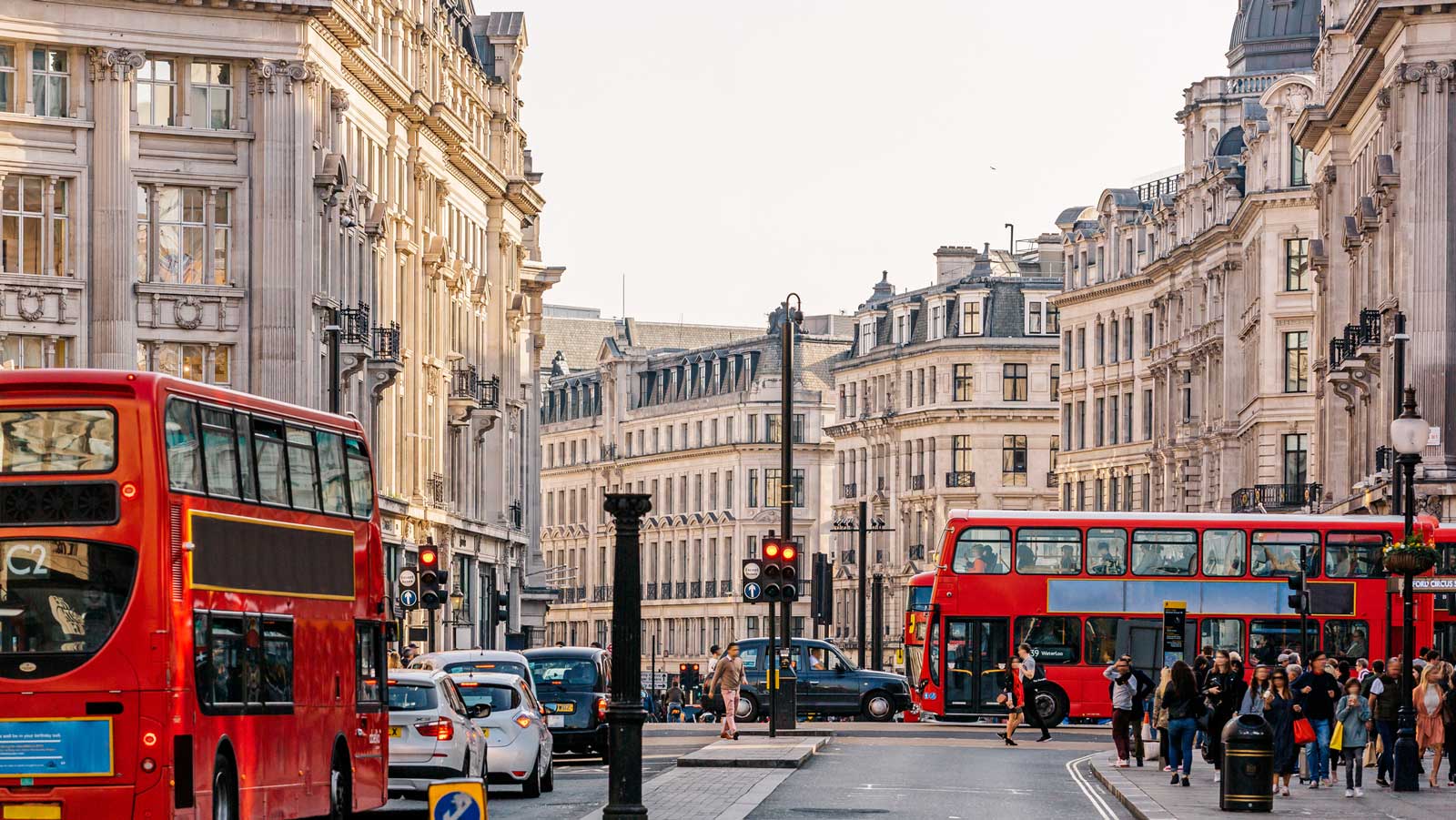
Compared to most American cities, London is a paradise for climate-friendly, car-free transportation. Around a quarter of all trips in the UK capital are made on foot, and cyclists are a frequent sight on many streets. Thousands of buses – many of them electric – and hundreds of train stations serve journeys across the city and destinations farther afield, including continental Europe.
“We see London as a beacon, really, when it comes to progressive and sustainable transport policy,” said Oliver Lord, the UK lead for transportation advocacy group Clean Cities. “London has a lot of influence on the rest of Europe as well, because a lot of people look to it as the only megacity in the continent.”
The local government wants to make it even easier to get around without a car. In 2018, Mayor Sadiq Khan, now serving a third term, set a goal for 80% of all trips to happen on foot, bicycle, or public transportation by 2041 – a significant increase from the then-current figure of 63%. His administration sees reducing driving as critical to meeting its climate goals, improving public health, and generally improving residents’ lives and livelihoods.
The government has taken major steps toward reaching the 80% goal, leading to, among other things, a 43% growth in cycling since 2019.
Despite this, the city is not on track to meet its overall target. As of 2024, the overall percentage of car trips was still roughly equivalent to 2018 figures.
Other indicators show that cars remain a problem. London’s traffic is the worst in Europe and the seventh-worst globally, according to transportation data company INRIX. And climate pollution from road transportation has declined relatively little in the past two decades.
“London has made a lot of progress compared to 10 or 20 years ago,” said Izzy Romilly, who leads sustainable transport campaigns at climate organization Possible. “But compared to what needs to be done, we’re still just not moving fast enough.”

Most concerningly, London’s government is not alone in failing to meet the moment, according to Robin Hickman, a professor of transportation and city planning at University College London. As he wrote in his 2025 book, which compares sustainable urban transportation initiatives around the world, “even in the so-called ‘progressive’ transport cities, transport CO2 emissions are decreasing only marginally.”
Making driving less attractive
Restricting car use is a critical step in reducing car dependency. But in London, as elsewhere in the world, it often provokes intense backlash.
“We know from research going back years that just providing cycle lanes or better pedestrian areas doesn’t necessarily lead to car reduction,” said Jamie Furlong, a transportation researcher at the University of Westminster. “We can achieve more significant reductions in car use by making traveling by car more difficult, and that’s really, really politically difficult.”
Compared to American cities, London has taken bold steps to deprioritize cars. From a global perspective, however, its efforts look relatively limited, Hickman said.
These efforts started in earnest around the turn of the century. In 2003, the city implemented a congestion pricing program that charged drivers £5 ($6.73 in today’s dollars) to enter the designated area on weekdays, using cameras to record license plates. The proceeds were funneled to public transportation.
Although the program affected only a small part of the city, its impact reverberated throughout the transportation network, Lord said.
“It was that policy that initially helped the mayor at the time to introduce bus lanes, because it started to free up some of the capacity on the road network, and it also created a budget to make that investment.” (It also later helped inspire New York City’s congestion pricing program.)
But Hickman said the city’s congestion pricing program had limited direct impact, in part because limited parking in the affected area had always kept some drivers away.
“Overall, it reduced traffic a little bit, but it’s only a very small intervention,” he said.
In 2019, the government introduced a second fee-based program, the Ultra Low Emission Zone, in the city center. It charged drivers of older, more polluting vehicles £12.50 ($16.80 in today’s dollars) to enter the affected area, with the proceeds going to public transportation. In 2023, the program was expanded citywide, despite significant controversy.
Another program that has reshaped parts of the city, low-traffic neighborhoods, has also been contentious. Designed to limit through traffic on residential streets using cameras or physical barriers like planters and curbs, low-traffic neighborhoods reduce climate and air pollution while making it safer to walk and cycle. More than 100 have been rolled out in London, although 27 were later removed due to resident complaints.

In general, however, low-traffic neighborhoods – known as LTNs – tend to be popular, or simply recede into the background once they’re in place, Furlong said.
“The evidence shows, in the UK, lots of people don’t even know that they live in an LTN after it’s been implemented,” he said.
Other efforts to restrict driving include 20-mile-per-hour speed limits covering half the city’s roads and a school streets program that prevents cars from entering streets near affected schools during specific hours. The government is also pedestrianizing much of Oxford Street, the city’s main shopping corridor.

Recent comments from Mayor Khan have led to speculation that the city may also start charging large cars like SUVs to drive in London. Hickman said this step, along with charging drivers based on the number of miles traveled (which Khan has pledged not to do) and eliminating diesel vehicles, would allow the city to make greater progress on reducing driving.
London on two wheels
Today, some parts of the city are notable for their bike-friendly infrastructure and the number of cyclists on the streets. There are 268 miles of protected bike lanes, with more planned. As bike infrastructure has improved, the number of cycling trips has risen dramatically, growing 43% between 2019 and 2026.
Despite this investment, cycling remains a small player in the overall transportation system, Hickman said. Roughly 5% of trips in the city are made by bike, he noted, compared to an average of 27% in the Netherlands.

Moreover, cycling infrastructure is highly uneven across the city.
“There are still huge gaps in the cycling network, particularly in outer London,” Furlong said.
This problem occurs partly because each of the city’s 33 local authorities manages its own roads. Local officials’ hesitation to upset the status quo is another important factor, Hickman said: “[London] is very slow in implementing good cycle projects because they tend to be controversial with the car-owning population.”
Public transportation
What has been undeniably successful in the UK capital is mass transit, which carried around 8.8 million rides per day in 2024.
“London is one of the classic public transport cities,” Hickman said. “It has very high public transport use for trips.”
Moreover, the city continues to deliver major new mass transit projects like the Elizabeth Line, a regional express train that opened in 2022 at a cost of £18.8 billion ($25.3 billion).

Projects like this one tend to be easier to push through in London than efforts to restrict car use or improve bike infrastructure, Hickman said. Unlike in most American cities, Londoners from all walks of life view public transportation positively and believe it’s vital for the economy. Moreover, major mass transit projects tend to align with the logic of UK transportation planning, which weighs projects’ economic impact above factors like public health and climate change.
Although these dynamics have helped mass transit grow, the downside is that major projects often disproportionately serve wealthy communities and business interests, Hickman said. They “tend to link the financial district of London, Canary Wharf; Heathrow Airport … that type of thing. But they don’t really give better public transport for people in the suburbs.”
Suburban car dependency
Outer London, the suburban ring that’s home to more than 5 of the city’s roughly 9 million inhabitants, is much more car-dependent than the central city. Although the region is large and diverse, featuring everything from densely populated high-rise neighborhoods to semirural districts, much of it was built around cars, making walking and cycling more challenging. In a 2022 survey, only 32% of outer London respondents said they could live car-free, compared to half inner Londoners.
In recent years, the government has taken steps to improve public transportation in the suburbs, introducing a new orbital express bus network, adding bus lines, and opening stops on the Elizabeth Line. Generally, however, outer Londoners still have far less access to transit than people in the city center.
This gap creates feedback loops that complicate efforts to reduce driving. Lacking other transportation options, many suburban residents “might spend a huge amount of money on car ownership and use,” Hickman said. “And then if you say that you would like to take away that provision and give them full public transport or expect them to cycle … that doesn’t go down too well.”
Politics also come into play. Many parts of outer London are governed by conservative politicians skeptical of efforts to change the transportation system.
“There’s some unease with the right-wing councils about anything that infringes an individual’s personal freedom to drive where they like,” said Sharon Erdman, a volunteer coordinator at Mums for Lungs, a nonprofit focused on air pollution. “Whereas we feel that it’s not about them driving where they like, it’s about the cost to public health.”
Jane Dutton, a digital communications manager with Mums for Lungs who lives in outer London, said her borough leaders fit the stereotype of suburban politicians actively fighting sustainable transportation initiatives.
“The leaders are very open about absolutely, vehemently opposing things like the ultralow emission zone. They don’t think it’s necessary … They really favor cars over walking and cycling.”
Moreover, outer London officials sympathetic to efforts to reduce car dominance are often afraid to take bold action, Erdman said. In one borough she has worked with, “the council leader is really honest that they are guided by public appetite,” she said.
Since local officials have control over the roads in their communities, these dynamics have huge real-world implications.
“Ultimately, if a borough doesn’t want to do certain things, they don’t have to,” Dutton said.
Political will and public imagination
Making progress on car dependency will require the government to lead more decisively, campaigner Izzy Romilly said.
“In the UK, there’s a real political nervousness around standing up against car dependency,” she said. “But when you actually have a conversation with people, time and again, they want less traffic, they want less congestion. Support for better public transport is absolutely through the roof. So I think it really is just a case of political leadership.”
But London residents also need to do more, Hickman said. Today, “there’s no great public debate” about what kind of transportation system people actually want, he said. “That is needed to dramatically remove road space from the car and give that back to cycling and walking and transport.”
This <a target=”_blank” href=”https://yaleclimateconnections.org/2026/06/what-americans-can-learn-from-londons-war-on-cars/”>article</a> first appeared on <a target=”_blank” href=”https://yaleclimateconnections.org”>Yale Climate Connections</a> and is republished here under a <a target=”_blank” href=”https://creativecommons.org/licenses/by-nc-nd/4.0/”>Creative Commons Attribution-NonCommercial-NoDerivatives 4.0 International License</a>.<img src=”https://i0.wp.com/yaleclimateconnections.org/wp-content/uploads/2020/10/ycc-favicon.png?resize=100%2C100&ssl=1″ style=”width:1em;height:1em;margin-left:10px;”>
<img id=”republication-tracker-tool-source” src=”https://yaleclimateconnections.org/?republication-pixel=true&post=139393&ga4=1401ERFF5Q” style=”width:1px;height:1px;”><script> PARSELY = { autotrack: false, onload: function() { PARSELY.beacon.trackPageView({ url: “https://yaleclimateconnections.org/2026/06/what-americans-can-learn-from-londons-war-on-cars/”, urlref: window.location.href }); } } </script> <script id=”parsely-cfg” src=”//cdn.parsely.com/keys/yaleclimateconnections.org/p.js”></script>