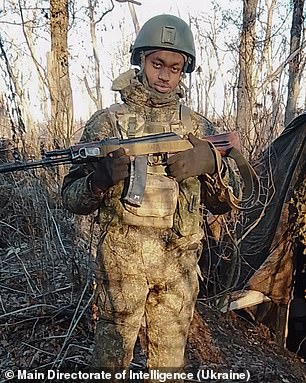
Africans are being lured into joining the Russian army with promises of work, only to end up being deployed to the front lines of the war in Ukraine where they are used as ‘meat for the meat grinder’.
A new report by Ukraine’s Centre for Strategic Communications accuses Moscow of using the facade of sport events, educational grants and employment agencies to trick African men into travelling to Russia.
Recruiters are also believed to have exploited established migration networks that have long been used to source and take advantage of low-paid workers.
Back in February, Kyiv said it had identified more than 1,700 fighters from 36 African countries serving in Putin’s army.
Now, Ukraine’s defence intelligence claimed it has identified 2,965 African citizens who have signed military contracts so far.
Ukraine’s Centre for Strategic Communications said Russia ‘exploits the socio-economic vulnerabilities of African countries and the personal motivations of foreigners, allowing the Kremlin to intercept migration flows and redirect them from the civilian sector directly to the front line’.
Michael, a Kenyan who is one of thousands of young men who served as mercenaries on the front line in Ukraine, told The Telegraph that he was duped into believing he was being given a security job.
‘When we were being recruited, they described it as more of a security job,’ he said.
‘They were saying: “You will be protecting the areas where the war has already passed. You will just be providing protection, like security.”‘


Ukraine’s defence intelligence claimed it has identified 2,965 African citizens who have signed military contracts


Africans are being lured into joining the Russian army with promises of work, only to end up being deployed to the front lines of the war
However, upon arrival, he signed a military contract and was given equipment and a gun, which he was never taught to use.
Michael recounted: ‘They gave us armour and everything and told us to go. They never trained me on anything. I came to know how to use the rifle after I watched other people using it.’
African men are told they will receive a £5,600 bonus and £1,700 a month to join, but many do not understand what they are signing up for.
‘I think a lot of Kenyans don’t know what they are getting themselves into. I can say a lot of Kenyans are tricked into getting those jobs,’ said Michael.
The young man was working in sales when he decided to move to Russia.
For years, the country has been a popular destination for African men looking to study, find work or use it as a gateway to Europe.
Russian propaganda has long portrayed it as a land of opportunity, free from the racism often associated with the West.
But racism is rife in Kremlin’s army, and the language barrier only made things worse, Michael said.
‘They would put you in positions where they don’t want to go. I can say that’s how I experienced racism. Not everyone was friendly. It was a common thing,’ he added.
He said at first he was put to work delivering food, but later he was sent to the frontline, constantly in danger from, Ukrainian drones.
He says: ‘They used a lot of drones. It was more a drone fight. We would fight mostly with drones, not with people. Most of the time, we were shooting at drones and if the drone sees you, then it attacks.’
Chilling videos have emerged on social media appearing to show Russian troops using racist language, joking about African deaths and even forcing one recruit to blow himself up to destroy a Ukrainian bunker.
Footage widely circulated on social media earlier this year appeared to show a black mercenary with a landmine strapped to his chest being forced to act as a ‘human bomb’ by a Russian soldier holding him at gunpoint.
The Russian uses a racist term and describes the recruit as a ‘bottle opener’, saying he is going to blow himself up to ‘open’ an enemy bunker.
‘He’s about to run – gonna be hopping through the woods,’ the soldier says, before adding: ‘What the f*** are you scared of? Don’t s*** yourself.’ Another video also found online supposedly shows a group of black mercenaries in a snowy forest singing in their own language.
One of the Russian troops who appears to be filming them says: ‘Look how many disposable ones there are here.’ He adds they will be ‘singing differently’ once deployed to the front.
Earlier this year, Duduzile Zuma-Sambudla, the daughter of former South Africa president Jacob Zuma, resigned as an MP over allegations that she tricked 17 men into fighting for Russia against Ukraine.
The men aged between 20 and 39 were lured into joining mercenary forces ‘under the pretext of lucrative employment contracts’ and had issued distress calls after becoming trapped in the Donbas area of Ukraine.
Top recruiting grounds for mercenaries have been Kenya, Egypt, Cameroon, Ghana, Nigeria, Uganda, Algeria, Mali, South Sudan and South Africa.
Kenya reported last year that some of its citizens had been detained in Russian military camps after being unwittingly caught up in the conflict.
Kenyan athlete Evans Kibet is one of a growing number of international recruits who – wittingly or not – signed up for the Russian army’s ‘meat grinder’ and ended up a PoW in Lviv.
He arrived in St Petersburg at the end of July on a two-week visa to host an event on behalf of his country, famous for its long-distance runners.

For years, Putin’s Russia has been a popular destination for African men looking to study, find work or use it as a gateway to Europe

Kenyan long distance runner Evans Kibet, who claimed he was lured to Russia to compete in an athletics meeting then forced to train and fight for the Russians in Ukraine
The 35-year-old says he came to attend a cultural festival and to teach Russian athletes how to train.
He claims a festival staffer persuaded him to stay, saying he could organise a one-year work visa.
The chance to provide a better life for his family, and in particular his teenage daughter, was too enticing, he says, so he signed a stack of documents presented to him by the man even though they were written in Russian and unintelligible.
The next morning, the man seized his passport before driving Kibet to a nearby military facility.
Then it finally dawned on him what was happening, he claims. ‘I was so scared that I would never see my daughter again. I started to get angry and asked the guy why he signed me up.
‘He told me, “You will manage and get out of this, it is only for one year”. That was the last time I saw him.’
After five days, he was sent to the frontline. As soon as he saw the chance, he says, he deserted: ‘I dropped everything and just ran for my life . . . There were so many dead soldiers. My mind kept on telling me I would be the next one.’
After more than a day trudging through the forest he began to lose all hope of making it out alive.
Then he heard gunfire and made the desperate decision to move towards it. ‘I didn’t even know if they were Russian or Ukrainian,’ he admits. ‘But I shouted to them for help. They were shocked because they didn’t expect me to be there. They pointed their guns at me.’
Kibet raised his hands in the air, fell to his knees and begged them for help. ‘I am a Kenyan, I’m not a fighter,’ he told the soldiers. ‘Please save my life.’
The soldiers, who were Ukrainian, took him in as a PoW and he was transferred to the prison camp in Lviv.
Michael ultimately escaped, and was helped home by the Kenyan embassy. He was never given any money when he was in Russia.
Of the seven others he travelled to Russia with, one is dead, one is missing and the rest have returned home.