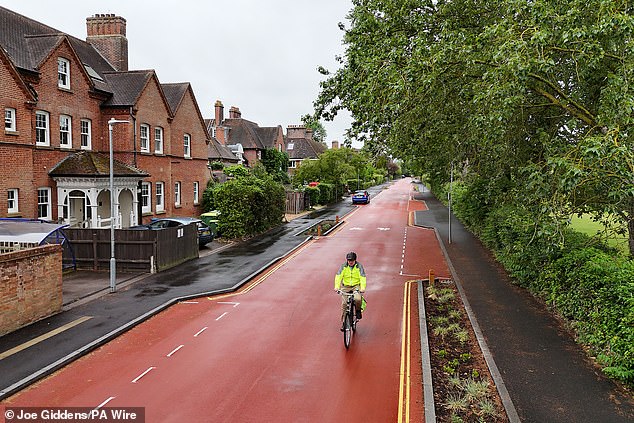
England’s controversial first ‘cycle street’ was used by only half the cyclists that the public were led to believe travelled along it every day, a Freedom of Information request has revealed.
Prior to developing the route, the Greater Cambridge Partnership, which is behind the scheme, said on its website it was ‘already used by more than 3,000 cyclists daily’.
But two manual counts of cycle use on Adams Road were carried out in 2022 and 2026 on behalf of the GCP – which has been accused of forcing anti-car schemes on Cambridge, where there is a powerful bike lobby – with both finding around 1,500 bikes went down it per day each time.
There have also been questions about the GCP handing over more than £150,000 of public money to persuade Clare Hall – the city’s poorest college by net assets – to stop lobbying against plans for a major bus route to go down a nearby road, which might have led to it being routed along the proposed cycle street instead.
The college dropped its opposition to the C2C bus route in October last year, having spent £537,000 on its objection campaign.
Local Frazer Merritt, 44, who obtained the FoIs and completed a Masters in Creative Writing at the university in 2017, told the Mail: ‘There’s a legitimate concern about Cambridge and its infrastructure as it’s expanding and there are problems with traffic jams and wanting to increase cycling.
‘But to my mind, the ends don’t justify the means. If you want to do these public projects, you have to justify the money.’
The cycle street was developed at a reported cost of £2.4 million amid claims it would improve safety for those on two wheels and pedestrians.

Greater Cambridge Partnership – which has been accused of forcing anti-car schemes on Cambridge, where there is a powerful bike lobby – said on its website the road proposed for the cycle street was ‘already used by more than 3,000 cyclists daily’
This would be done by narrowing the road, removing on-street parking, widening footpaths, raising crossings and reconfiguring junctions.
But figures unearthed previously by the Mail revealed there had been just two collisions involving bicycles in the past six years, with only one of them deemed serious.
Detractors also asked why the money couldn’t be spent on more pressing needs such as fixing potholes on roads and pointed out similar schemes wouldn’t work on narrower, more dangerous roads.
Documents have now revealed that the GCP’s engineering consultants manually counted cyclists for an Outline Business Case in November 2022 which concluded 1,543 bikes used the road every day.
A further count in 2026 for the Full Business Case registered slightly lower numbers, at 1,528.
Yet the GCP has repeatedly quoted the ‘3,000’ figure, which opponents suspect is based on a sensor placed on nearby Coton Path.
This showed nearly 3,000 cyclists crossed the sensor in the months of October and November but this dropped to as low as 1,687 in summer months, while the yearly average was 2,397.
However, the sensor was not actually on Adams Road and sat on a busy four-way intersection used by people coming from different parts of the city, many heading to or from Cambridge University’s popular Wilberforce Road Sports Ground.

Documents obtained under a Freedom of Information request show manual counts in 2022 and 2026 found around 1,500 cyclists used the road every day

The road – one of the most exclusive in Cambridge, with detached houses selling for more than £3.5 million – seen before the work was done
Documents also reveal the GCP – whose members include Cambridge City Council, the county council and the University of Cambridge – paid £158,863 to Clare Hall.
This consisted of a £100,000 contribution towards the college’s professional costs, £48,000 to the law firm that represents it and £10,863 to its property advisors.
In return, it agreed to withdraw its formal objection to the busway on Rifle Range Road, which is adjacent to their grounds, and not to make any public statement about its decision to withdraw without the GCP’s prior written approval.
Clare Hall reported net assets of £41,069,076 in June 2024. The richest college in Cambridge is Trinity College, which has more than £2.4 billion, followed by St John’s College with over £1 billion.
Delowar Hossain, a Conservative councillor in Labour-run Cambridge city, today said of the cycling statistics: ‘These figures are not accurate.
‘There should be a public inquiry. If they’re not true, people should be accountable for it.’
He had not seen details of the deal between Clare Hall and the GCP but added: ‘They are in the same alliance. All of them are against motorists.’
Mr Hossain also branded the cycle street an ‘extraordinary waste of money’, saying: ‘If they wanted less parking there, they could do double yellow lines.

Frazer Merritt, 44, seen with his mother, Chris, submitted the FoI requests and said: ‘If you want to do these public projects, you have to justify the money.’

GCP chairman Brian Milnes told the Mail he might ‘return it to how it was’ following a trial period
Members of the public have questioned the scheme, with driver Bob Heath, in his 60s, pointing out it had been installed in one of the city’s most exclusive roads where one detached house sold for more than £3.5 million.
‘What about all the terraced houses on narrow roads in Cambridge?’ he said.
‘This would never work there. It’s fine if you can afford one of these places though.’
A pedestrian, who gave his name as Ian, commented: ‘I’ve never seen anyone knocked off their bike down here.
‘It used to be a normal road, with cars parked on either side. Cars and bikes had to go pretty slowly because there wasn’t much space.’
GCP chairman Brian Milnes, who is also deputy leader of the Lib Dem group on South Cambridgeshire District Council, sparked incredulity recently when he told the Mail he might ‘return it to how it was’ following a trial period.
A spokeswoman later contradicted him, saying the ‘upgrades to Adams Road were installed as permanent changes’.
Many in Cambridge argue the cycling lobby is too powerful and claim schemes championed by the GCP are anti-car and detrimental to the area and its economy.
Recent controversies have included a ‘bus gate’ in Mill Road, which only allows buses, taxis, pedestrians and cyclists over a bridge.

Work is continuing along the third-of-a-mile-long road
Opponents claim the blockage on a major route towards the city centre forced motorists to drive much further on journeys and slashed trade for the shops and bars in the cosmopolitan area.
It has also raised up to £1 million in fines in its first year in operation, it emerged last month.
Two years ago, it was announced that a footpath running alongside a £24 million road upgrade would be altered after residents pointed out it was so narrow that pedestrians were at risk of being hit by cyclists.
The C2C route at the heart of negotiations between the GCP and Clare Hall also caused fury as the plans involved bulldozing a precious orchard filled with century-old fruit trees to make way for the ‘green’ off-road route.
Cambridge introduced the UK’s first Dutch-style roundabout in 2020 at a cost of £2.3 million but this saw more collisions in its first three years than the previous three years.
A GCP spokeswoman said: ‘Before becoming a cycle street, Adams Road was already being used by up to 3,000 cyclists a day.
‘Despite only being open for a few weeks, we are already seeing cyclist numbers climbing above 3,000 on some days as the street is easier and safer to use – not only for cyclists but for everyone.’
Repeated requests were made to Clare Hall for a comment.