Using the James Webb Space Telescope (JWST) and the Atacama Large Millimeter/submillimeter Array (ALMA), astronomers may have uncovered new clues about a longstanding mystery in galaxy evolution: why so many massive galaxies in the early universe appear to have died far sooner than expected.
Galaxies are often considered “alive” when they are actively forming stars and “dead” when star formation has largely ceased. In today’s universe, dead galaxies are common. But astronomers have been surprised to find large numbers of them in the early universe, when galaxies were expected to be rapidly growing and churning out stars.
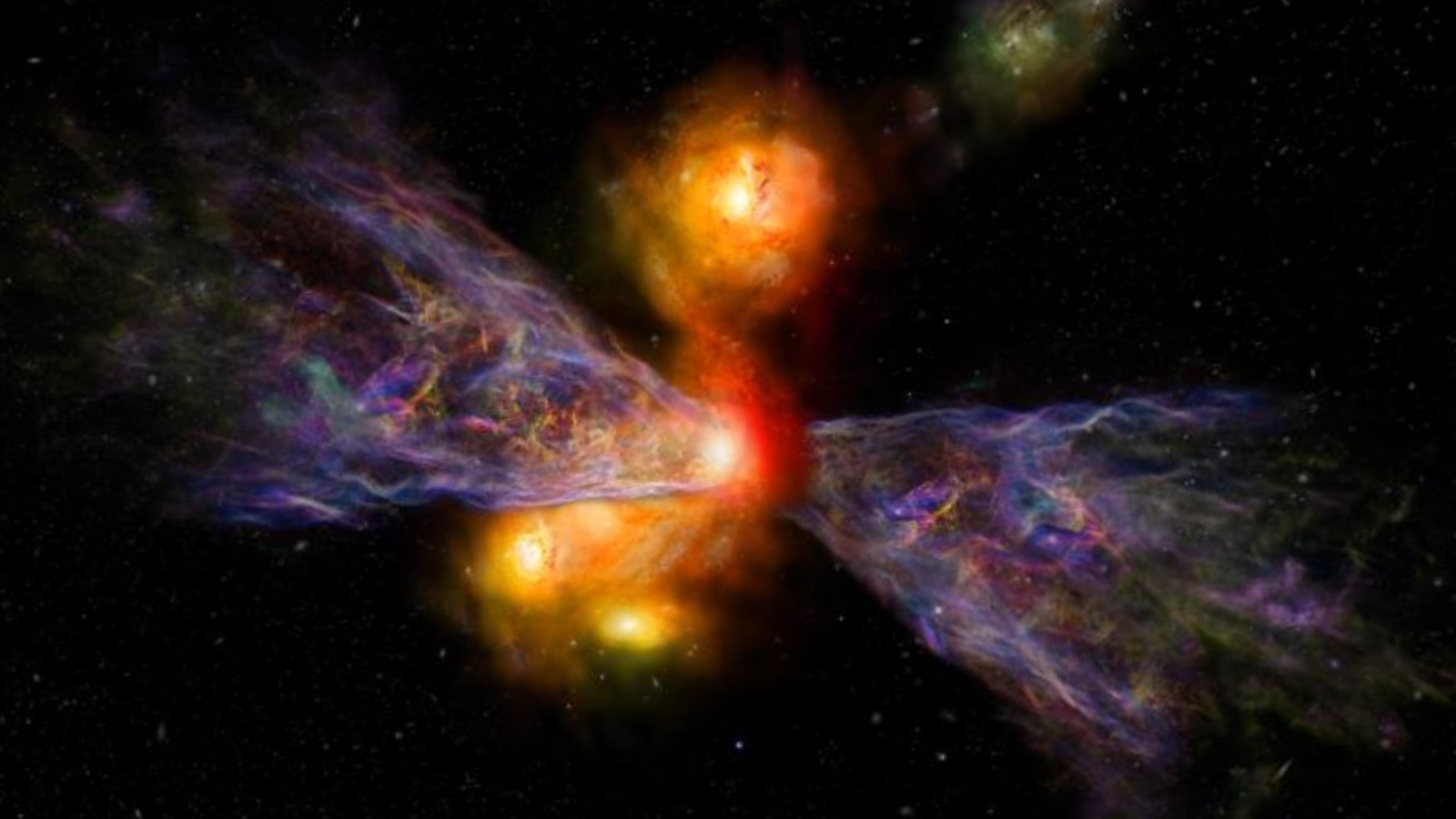
Using ALMA and JWST observations of a distant galaxy, researchers have detected a “galaxy-killing” wind — an enormous, high-speed outflow of gas — that is powerful enough to strip a galaxy of the raw material needed to make new stars. The discovery could help explain the puzzling population of massive “dead” galaxies found throughout the young cosmos, according to a statement from the Royal Astronomical Society.
“Dense regions of the universe are like very active cities,” Rebecca Davies, lead author of the study from Swinburne University of Technology in Melbourne, said in the statement. “Galaxies collide and undergo frenzied bursts of star formation. But when the biggest stars burn out, they explode as supernovas, launching powerful winds that blast away the very gas galaxies need to keep forming stars.”
Davies and colleagues observed a galaxy called CRISTAL-02 as it appeared just one billion years after the Big Bang, catching it in the midst of a rapid growth spurt.
The observations revealed that CRISTAL-02 is forming stars at roughly twice the rate of similar galaxies from the same era. At the same time, JWST and ALMA detected a vast plume of cold gas extending far from the galaxy — a telltale sign that material is being blown out into intergalactic space, according to the statement.
“The galaxy has a powerful wind that is ejecting material twice as fast as the galaxy forms stars,” Davies added. “If this rapid blowout continues, the galaxy could be dead in less than 50 million years, explaining the origin of the mysterious massive dead galaxies in the early universe.”

The discovery is particularly intriguing because CRISTAL-02 is not a single galaxy. Instead, it consists of multiple galaxies in the final stages of a merger. During these cosmic collisions, gas is funneled toward galactic centers, triggering intense bursts of star formation, later followed by supernova explosions that drive powerful winds that prevent any new stars from being born.
What’s more, observations suggest that nearly half of massive galaxies in the early universe were interacting with nearby companions, indicating that mergers and their galaxy-killing winds may have been widespread. In turn, many of the universe’s earliest giant galaxies may have effectively destroyed their own ability to form stars — helping explain why so many of these galaxies seem to have lived fast and died young.
“If many early galaxies collide and experience rapid growth, then it may not be surprising that we see so many dead galaxies in the early universe,” Davies said in the statement. “CRISTAL-02 offers a natural solution to the mystery of why these massive galaxies live fast and die young.”
The study was published June 10 in the journal Monthly Notices of the Royal Astronomical Society: Letters.