Over the weekend, China’s second deep-space mission, Tianwen-2, quietly performed a crucial engine burn to rendezvous with a mysterious tiny world in a quasi-Earth orbit. Although China’s space administration has yet to acknowledge the milestone, amateur radio observers using telescopes in Germany and the Netherlands tracked the maneuver, observing Tianwen-2 to now be in the vicinity of the near-Earth asteroid Kamoʻoalewa. Over the next four weeks, the spacecraft will approach the rapidly spinning asteroid to begin studying and mapping its surface, lining up future sampling attempts.
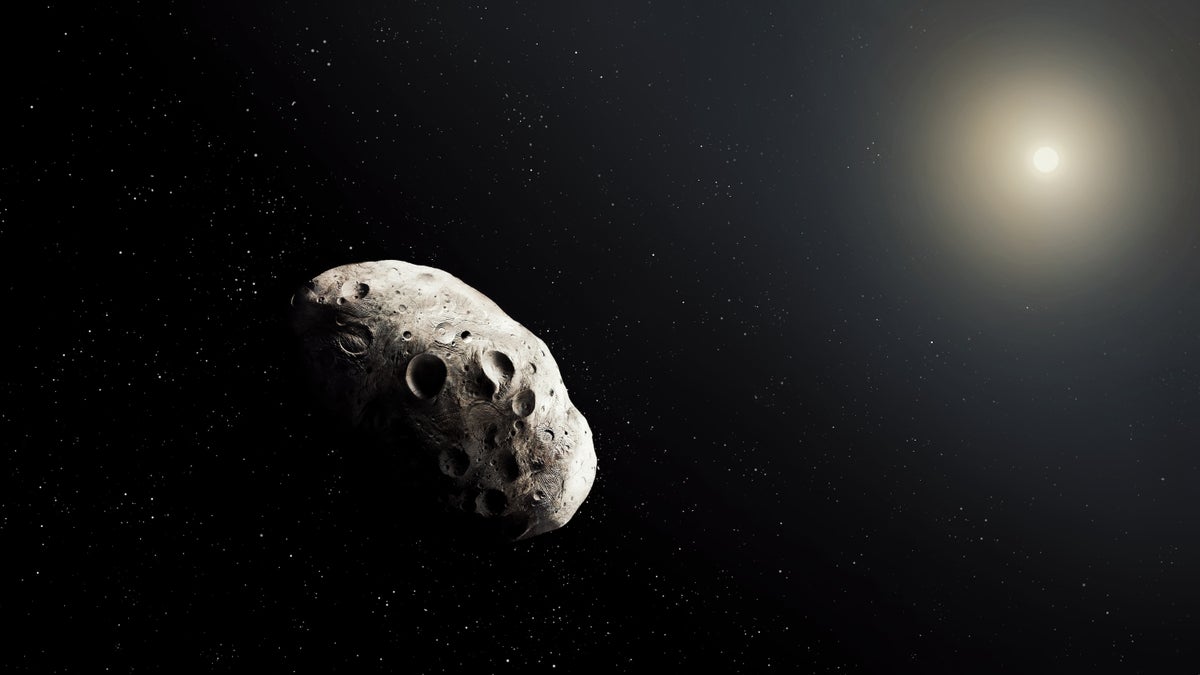
Kamoʻoalewa is a space rock between about 40 to 100 meters in size that rotates once every 28 minutes. It’s also one of seven known quasi-moons of Earth, bodies that orbit the sun in tune with our planet, making slow retrograde loops around us. But at least until Tianwen-2 gets close enough to see it in more detail, scientists can’t say much more about the enigmatic, smaller than soccer-pitch-size object.
“Every new image of an asteroid has been a surprise,” says Patrick Michel, director of research at the French National Center for Scientific Research and principal investigator of the European Space Agency’s Hera mission, who has studied Kamoʻoalewa extensively. “We have everything to learn.”
On supporting science journalism
If you’re enjoying this article, consider supporting our award-winning journalism by subscribing. By purchasing a subscription you are helping to ensure the future of impactful stories about the discoveries and ideas shaping our world today.
The asteroid’s rapid spin may give some clues as to its composition because, if it were a “gravel pile,” it should shed debris as it twirled. Instead it could be, in the words of planetary scientist Christine Hartzell of the University of Maryland, “a chunk of rock or a couple of chunks of rock held together.” A mission paper from the Tianwen-2 team acknowledges as much, noting that while Kamoʻoalewa’s surface is likely composed of millimeter- to centimeter-scale grains, deeper down, it could be essentially one giant boulder—or a coalesced rubble pile.
Another open question is how this apparent asteroid found its way into a weird orbit alongside Earth’s. One theory, espoused by Michel and others based on the asteroid’s reddish appearance, which resembles that of common moon rocks, is that Kamoʻoalewa began as a chunk of the lunar farside. It was then blasted into orbit sometime in the past 10 million years by the impactor that created the 22-kilometer-wide Giordano Bruno Crater.
Conversely, other researchers argue the object is more likely an émigré from the main asteroid belt between Mars and Jupiter that migrated inward to its current quasi-moon orbit around the sun. “If you just take the size of this body, it is very weird that it would be so large and have been ejected from the moon so recently,” says Mikael Granvik, a professor at the University of Helsinki and Luleå University of Technology in Sweden. Granvik’s statistical models of the near-Earth object population suggest an asteroid on Kamoʻoalewa’s orbit is 10 times more likely to have originated from the inner main asteroid belt than from the moon.
If all goes according to plan, Tianwen-2 will settle such debates by collecting samples from Kamoʻoalewa and delivering them to Earth for analysis. If this material matches the isotopic composition of lunar rocks, the “moon fragment” theory will triumph. That result, Granvik says, would place important new constraints on our understanding of impact physics. “If you want to track the solar system backward to see how it has evolved over time, then we need to understand how the collisional evolution has actually worked, and so this could provide key data for those models,” he says.
On the other hand, a main-belt origin for Kamoʻoalewa would suggest that its ruddy resemblance to moon rocks is a by-product of extreme space weathering, which would have implications for how other reddened asteroids are classified.
In some respects, however, Tianwen-2’s studies of Kamoʻoalewa are about more than just science. The mission is an important test of China’s burgeoning ability to perform autonomous, high-precision maneuvers in deep space, which will be essential for the nation’s subsequent forays to the moon and other worlds beyond Earth. And guided by cameras, radar and lidar readings, the spacecraft’s sampling attempt will be China’s most ambitious yet—a precursor of sorts for the nation’s even bolder plans to retrieve rocks from Mars.
Tianwen-2’s three available sampling methods—touch and go, hover, and anchor and attach—should allow it to adapt to Kamoʻoalewa’s rapid spin and unknown surface.
Touch and go is a method similar to those used previously by Japan’s Hayabusa2 and NASA’s OSIRIS-REx missions. In this approach, a disk-shaped, gas-driven head briefly contacts the surface. Spinning brushes and bursts of pressurized gas inside the head then sweep samples into a collection chamber before the spacecraft beats a hasty retreat.
The hover mode involves the spacecraft using a robotic arm to scoop a sample from the surface. Although seemingly simple, Hartzell describes this as akin to floating in a water tank and trying to gather material from the bottom with nothing to push against to steady yourself. “Of those three options, [hover] would be the most risky, because you have to worry about the reaction forces that your spacecraft needs to generate in order to actually scoop right,” he says.
The anchor-and-attach approach would use a claw-and-spike mechanism at the tip of the robotic arm to grapple and anchor to the asteroid—assuming, that is, that Kamo‘oalewa’s surface is sturdy and relatively obstacle-free. “You don’t expect any boulders on the surface, because you need cohesion to be able to survive at this spin rate,” Michel says. “But who knows? Maybe there are boulders glued with small dust. We don’t know.”
Michel sees the three-mode approach as revealing something about the mission’s priorities. “If science were driving the mission, you would try to maximize success and use the approach that has already been tested,” he says. And you’d probably select a larger, more slowly spinning target to simplify a sampling attempt. But, Michel adds, that calculus changes when you’re planning to ultimately extract resources from asteroids. “If you want to use these as gas stations to go further [into the solar system], you find more smaller objects than bigger ones, and they are all rotating fast. So it’s not a bad choice” he says.
According to an unverified timeline leaked on Chinese social media, which has so far aligned perfectly with already-executed mission milestones, Tianwen-2’s close encounter with Kamo‘oalewa is due to begin on July 4, when the spacecraft is expected to have approached within 20 kilometers of the asteroid. While the U.S. will be marking its independence, China will be beginning the latest phase of an increasingly ambitious exploration agenda and demonstrating its own autonomy in space, aiming to join both the U.S. and Japan in conducting successful asteroid sample returns. The asteroids Itokawa, Ryugu and Bennu—sampled by Japan’s Hayabusa and Hayabusa2 and NASA’s OSIRIS-REx, respectively—each held surprises and delivered precious material. Kamo‘oalewa is smaller, spinning faster and more uncertain in terms of origin than all of these. “Even if they’re unsuccessful in capturing samples, if they can go and take high-resolution images of a body this size, that would be super interesting,” Hartzell says, because no one has ever seen such a small asteroid up close.
If successful, however, Tianwen-2 will complete its sampling and depart from Kamo‘oalewa next April, after which it will be bound for a brief reunion with Earth in November 2027. Swooping by our planet, the spacecraft will send its sample-filled reentry on a one-way trip to terra firma for touchdown and collection at a target site in Inner Mongolia. To get there, the capsule will have to endure a fiery atmospheric reentry at a velocity of 12 km per second—a faster, more energetic plunge than those experienced by China’s previous lunar sample-return missions. After dropping off its samples, Tianwen-2 will then use Earth’s gravity to slingshot itself on course to visit Comet 311P, arriving in 2035.