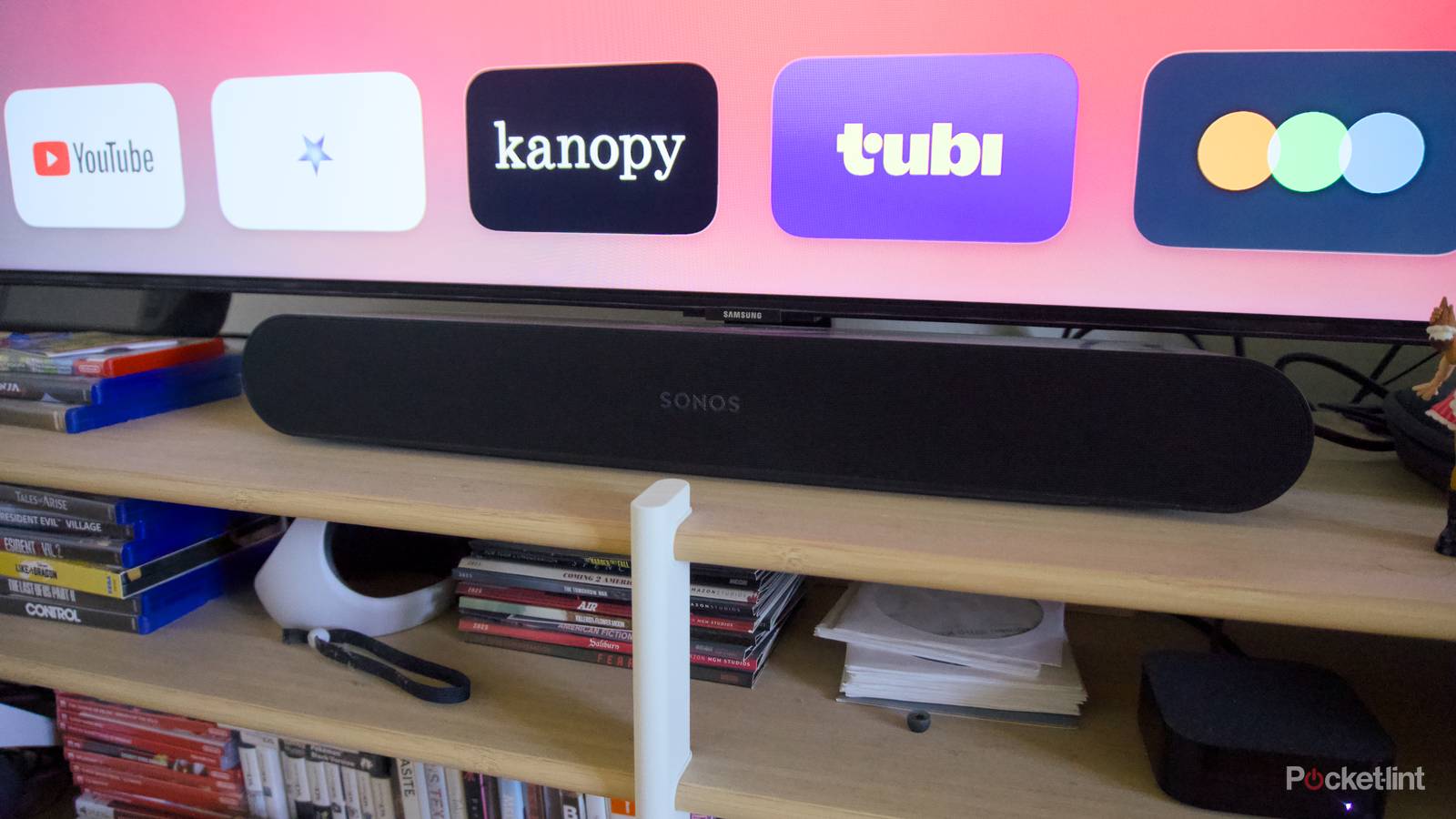
It’s very easy to spend a lot of money building out your home entertainment system. Not only are TVs naturally one of the more expensive electronics you can buy, they’re also usually worth splurging on. When you add in things like audio equipment — speakers, a soundbar, or a subwoofer for your setup — it’s easy for price to get out of control. I bought my Samsung Q80T on sale and chose my soundbar with a budget in mind. Rather than spend a lot on a high-end model with support for the latest premium audio features, my limited space and price led me to a humble Sonos Ray.
Sonos’ entry-level soundbar is a cheaper way into the company’s speaker ecosystem, but it still sounds good for its usual $279 price. It’s not as capable as something like the Sonos Arc Ultra, but it reaps the benefits of plenty of the same software features, and it’s a great team player when paired with Sonos’ other products. The Ray also has another, nearly as important, benefit. Because the entry-level soundbar doesn’t support high-end audio features like Dolby Atmos, it connects to your TV over optical audio rather than HDMI eARC. That frees up an HDMI port on your TV and you don’t even lose out on a solid sound experience in the process.

TV speakers and soundbars
Trivia challenge
From built-in tweeters to Dolby Atmos monsters — how much do you really know about TV audio?
SoundbarsTechnologyBrandsFormatsHistory
What does the term ‘Dolby Atmos’ refer to in home audio?
Correct! Dolby Atmos is an object-based audio format that places sounds in a three-dimensional space, including overhead height channels. It was originally developed for cinema in 2012 before making its way into home theatres and soundbars.
Not quite. Dolby Atmos is an object-based surround sound format that adds height channels to create a three-dimensional listening experience. It debuted in cinemas in 2012 and later arrived in home audio products including soundbars.
What does a soundbar’s ‘2.1’ configuration refer to?
Correct! In speaker configurations, the first number represents full-range or satellite speakers, and the ‘.1’ refers to a dedicated subwoofer channel. A 2.1 soundbar therefore has two speakers plus a subwoofer for bass reproduction.
Not quite. Speaker configuration numbers follow a simple convention: the first digit is the number of full-range speakers and the ‘.1’ denotes a dedicated subwoofer. So a 2.1 soundbar has two speakers and one subwoofer.
Which company developed the Acoustic Research bookshelf speaker and is widely credited with popularising the hi-fi speaker market in the 1950s?
Correct! Acoustic Research, founded by Edgar Villchur in 1952, revolutionised speaker design with the acoustic suspension (sealed box) woofer. This innovation dramatically improved bass response from compact enclosures and helped launch the modern hi-fi industry.
Not quite. The answer is Acoustic Research, founded by Edgar Villchur in 1952. His acoustic suspension speaker design transformed the industry by delivering deep bass from a compact sealed cabinet, setting the stage for the hi-fi revolution.
What is the primary purpose of an HDMI eARC connection on a TV?
Correct! HDMI eARC (Enhanced Audio Return Channel) allows a TV to send high-quality audio — including lossless formats like Dolby TrueHD and DTS-HD Master Audio — downstream to a soundbar or AV receiver. It improved on the original ARC standard, which was limited to compressed audio.
Not quite. HDMI eARC stands for Enhanced Audio Return Channel, and its job is to send audio from the TV to an external speaker system such as a soundbar. Unlike original ARC, eARC supports lossless audio formats including Dolby TrueHD.
In what decade did the first commercially available soundbar products begin to appear on the consumer market?
Correct! Soundbars began appearing as commercial consumer products in the early 2000s, driven by the rise of flat-panel TVs whose slim profiles left little room for decent built-in speakers. Brands like Yamaha were among the early pioneers of the format.
Not quite. Soundbars emerged as a consumer product category in the early 2000s. The shift to thin flat-panel televisions created a need for a compact audio solution, and companies like Yamaha helped popularise the soundbar as an accessible alternative to full surround sound systems.
What technology do upward-firing drivers in a soundbar primarily aim to simulate?
Correct! Upward-firing drivers are designed to bounce sound off the ceiling and back to the listener, simulating the overhead height channels used in object-based formats like Dolby Atmos and DTS:X. They allow a soundbar to approximate a full overhead speaker setup without ceiling-mounted speakers.
Not quite. Upward-firing drivers bounce audio off the ceiling to simulate overhead height channels, which are a key part of object-based formats like Dolby Atmos. It’s a clever workaround that avoids the need to physically mount speakers in the ceiling.
Sonos launched its first wireless home speaker system in which year?
Correct! Sonos launched its first product, the Sonos Digital Music System, in 2004. It was a groundbreaking multi-room audio system that allowed users to stream music wirelessly throughout the home, well before smart speakers became mainstream.
Not quite. Sonos actually launched its first wireless multi-room audio system in 2004, making it a very early pioneer in the wireless speaker space. The company helped define the category years before smart speakers like Amazon Echo became common household names.
What does ‘passive radiator’ mean in the context of a TV speaker or soundbar design?
Correct! A passive radiator is a diaphragm with no voice coil or magnet — it moves purely in response to changes in air pressure inside the cabinet caused by an active woofer. This allows manufacturers to extend bass response without using a bass reflex port, which is useful in slim soundbar designs.
Not quite. A passive radiator is an unpowered driver — essentially a cone or diaphragm with no voice coil — that vibrates sympathetically with the air pressure generated by an active woofer. It’s a common technique in compact soundbars to boost bass without adding a port or increasing size.
Your Score
/ 8
Thanks for playing!
The Sonos Ray packs a lot in a small package
The soundbar still supports some iconic Sonos features

Sonos launched the Ray in 2022, during a pretty consistent period of expansion that included the introduction of new products at a variety of different price points (Sonos’ first portable Bluetooth speaker, for example) and an ongoing legal battle with Google over smart speaker technology. The Ray is designed to be a gateway to the larger Sonos ecosystem, though Sonos also pitches it as being for televisions of a certain size: up to 55-inch televisions, specifically. Some of that might have to do with the size of the soundbar and the volume it can reach, but having used a Ray with a larger TV, you don’t have to worry.
The Sonos Ray comes equipped with four drivers and two tweeters. That setup makes it less capable of the deep bass of the company’s more premium soundbars, but still great at getting loud and producing crisp mids and highs. More importantly, the Ray supports plenty of classic Sonos features like Trueplay, which lets you tune your speaker to your room using the microphones on your smartphone and the company’s speaker grouping system. The Ray can also seamlessly hand off audio to Sonos Ace headphones, if you want to listen or watch something without bothering other people in your home.
The big feature missing from the Ray is any of the more immersive audio features offered in the more expensive Sonos Beam or Arc Ultra. The Sonos Ray doesn’t support Dolby Atmos, an audio standard that takes into account height (and in general, three-dimensional space) to create more immersive sound experiences. Plenty of modern TVs, streaming boxes and streaming services support Dolby Atmos or some kind of spatial audio. By not including an HDMI ARC or HDMI eARC port, the Ray isn’t capable of delivering spatial audio, even if it can be incorporated into a more traditional surround sound setup.
While discerning ears might notice the lack of Dolby Atmos, just because so many streaming services support the format by default, you don’t really lose that much quality with the Ray’s simple stereo playback.
HDMI ARC or HDMI Audio Return Channel, was added to the HDMI specification in 2009 as a way to play compressed audio codecs like Dolby Digital, Dolby Digital Plus, DTS and Dolby Atmos, while reducing the number of cables connected to your TV. The specification was updated again in 2017, adding HDMI eARC or Enhanced Audio Return Channel, which was capable of playing the same codecs, but completely uncompressed. Most new soundbars use HDMI eARC by default, with an optical audio connection available as a backup, unless they’re specifically designed to be cheaper, like the Sonos Ray.
While discerning ears might notice the lack of Dolby Atmos, just because so many streaming services support the format by default, you don’t really lose that much quality with the Ray’s simple stereo playback. And what you gain is more important. With multiple consoles, a living room PC ( my trusty Steam Deck), and an Apple TV fighting for an HDMI port, having a little more free space is always welcome.
Space comes at a premium under a TV
The Sonos Ray is compact and saves port space, too

With my current arrangement, I’d rather have a free port than extra audio features, especially when experiencing an approximation of Dolby Atmos is still possible by connecting a pair of AirPods to my Apple TV. Having access to more experiences and more types of games, movies, and shows is ultimately better to me than having access to less, but at a higher quality.
Not everyone might feel the same, but that shouldn’t take away from the quality of the Sonos Ray, either. Pocket-lint’s review of the Sonos Ray found that the compact soundbar performed well for its sound and price, and looked good doing it. I found that to still be true years later. The only thing I didn’t expect was that I’d like its limitations as much as its features.