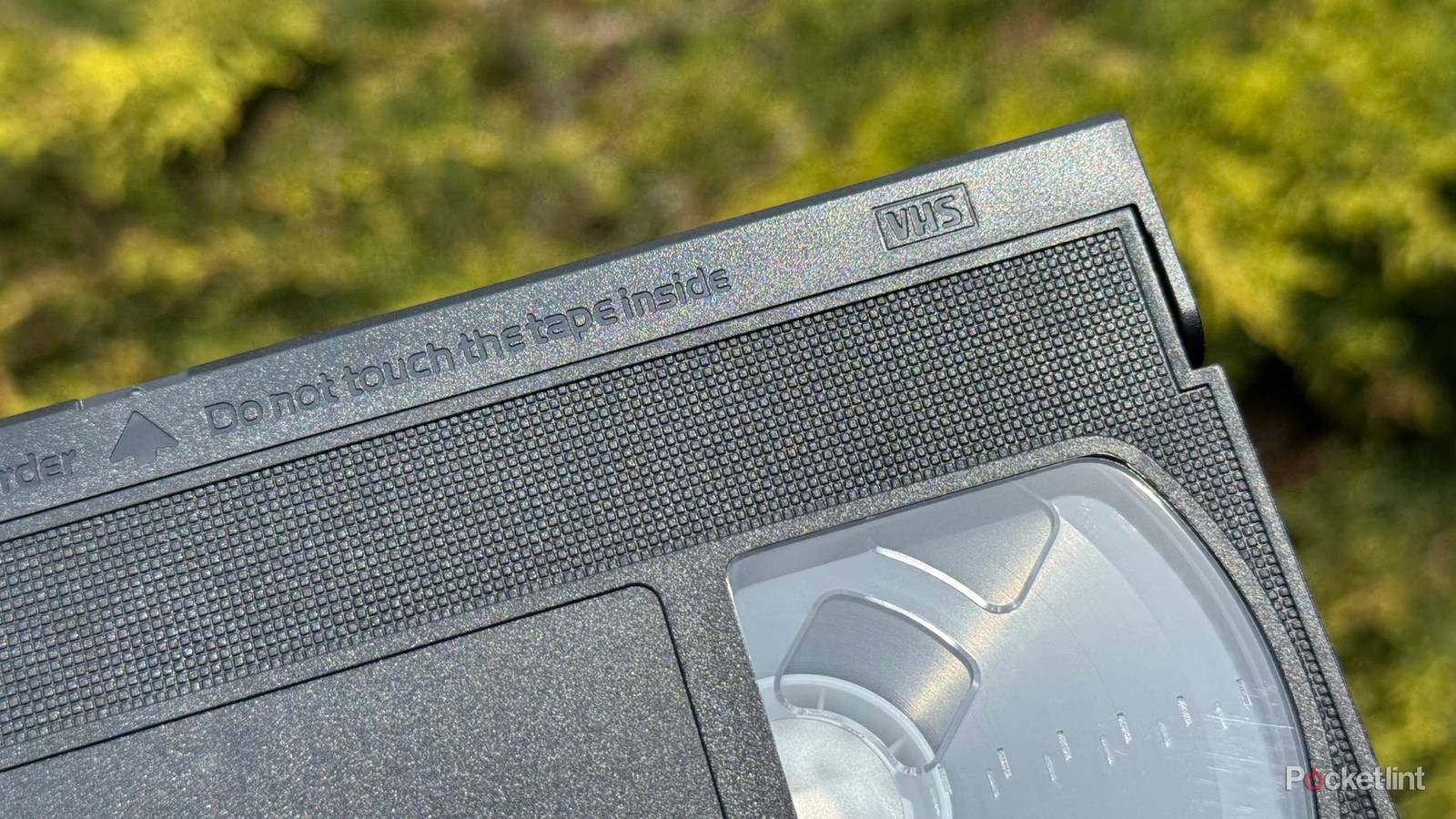
Something that warms my heart just a little is that there’s been a resurgence of interest in physical media. For some people it’s about going retro, reliving an imagined golden age. Others just like collecting obscure releases. One thing everyone can agree on is that it’s nice accumulating media that’s truly yours, and won’t disappear the second you can’t afford a subscription, or the service you’re using loses the streaming rights.
When it comes to movies and TV shows, this typically involves picking up Blu-rays or DVDs, which are readily available and better suited to watching on a 4K TV. VHS tapes have their appeal though, and are often the only way of reliving family memories. No matter what’s in your collection, you should strongly consider digitizing it, or at least transferring it to fresh tapes. You’re already living on borrowed time, especially for anything recorded in the ’80s or ’90s.

VHS technology
Trivia challenge
From rewind fees to rental nights — how much do you really know about the golden age of VHS?
HistoryHardwareFormat WarsCultureTechnology
In what year did JVC officially release the VHS format to the consumer market?
Correct! JVC launched VHS in Japan in 1976, and it quickly began its march toward global dominance. The format was the result of years of internal development at JVC, with engineer Yuma Shiraishi playing a key role in its creation.
Not quite — VHS was released by JVC in 1976. Although video recording technology had been around since the early 1970s, it took JVC’s consumer-friendly approach to bring VHS to living rooms around the world.
Which rival home video format, developed by Sony, competed most directly against VHS in the late 1970s and 1980s?
Correct! Sony’s Betamax launched in 1975 and was considered technically superior by many, but VHS won the format war largely due to longer recording times and aggressive licensing deals. Betamax was discontinued for consumer use in 2002.
The correct answer is Betamax, Sony’s competing format launched in 1975. Despite being widely regarded as higher quality, Betamax lost the format war to VHS, which offered longer tape runtimes and broader manufacturer support.
What does the acronym VHS stand for?
Correct! VHS stands for Video Home System, a name chosen by JVC to emphasize its suitability for everyday household use. The branding was a deliberate contrast to the more professional-sounding formats of the era.
Not quite — VHS stands for Video Home System. The name was chosen by JVC to appeal directly to consumers, signalling that this was a recording format designed for the home rather than professional broadcast environments.
What tape width does a standard VHS cassette use?
Correct! VHS tapes use half-inch (12.7mm) magnetic tape, housed inside the distinctive black plastic shell. This was a deliberate choice by JVC to balance recording quality with the ability to fit longer play times on a compact cassette.
The correct answer is 12.7mm, or half an inch. VHS cassettes use half-inch magnetic tape, a specification that JVC carefully chose to allow for extended recording times while keeping the cassette housing to a manageable size.
Which major Hollywood studio was the first to widely embrace VHS distribution for its films in the early home video era?
Correct! Warner Bros. was among the earliest major studios to commit to VHS distribution, helping legitimise the format as a serious home entertainment medium. Their early involvement gave VHS a crucial boost in the battle for consumer and retailer confidence.
The answer is Warner Bros., which was one of the earliest major studios to embrace VHS distribution. Their commitment helped establish VHS as the go-to format for home video at a time when the industry was still figuring out how to handle the home market.
What was the maximum recording time offered by a standard T-160 VHS tape at the slowest EP/SLP speed?
Correct! A T-160 tape at EP (Extended Play) or SLP (Super Long Play) speed could record up to 8 hours of footage. The trade-off was significantly reduced picture and sound quality compared to the standard SP speed.
Not quite — a T-160 VHS tape running at EP/SLP speed could record up to 8 hours. While this was impressive for the time, the slowest speed came with a noticeable drop in picture quality, making it best suited for recording rather than watching back critically.
In which year did the last major manufacturer stop producing VHS VCRs, effectively ending the format’s production run?
Correct! Funai Electric, the last known manufacturer of VHS VCRs, ceased production in 2016, officially closing the chapter on the format. At its peak in the late 1990s, billions of VHS tapes had been sold worldwide.
The correct answer is 2016, when Funai Electric — the last manufacturer still making VHS VCRs — finally ended production. It marked a symbolic end to a format that had dominated home entertainment for nearly four decades.
Which compact version of VHS was introduced in 1982, commonly used in camcorders?
Correct! VHS-C (VHS Compact) was introduced in 1982 and became a popular format for portable camcorders throughout the 1980s and 1990s. Tapes could be played in standard VHS machines using an adapter cassette, which was a clever and practical solution.
The correct answer is VHS-C, which stands for VHS Compact. Launched in 1982, it used a smaller cassette shell that made it ideal for camcorders, and an adapter allowed the tapes to be played back in any standard full-size VHS player.
Your Score
/ 8
Thanks for playing!
How long do VHS tapes last?
What you can expect, and what causes failure

Anecdotal evidence suggests that VHS tapes can last a surprisingly long time. There are tapes from the ’80s that are still playable, and naturally, tapes from subsequent decades may be in even better shape with quality manufacturing. There wouldn’t be much interest if you couldn’t pick up a used copy of Aladdin, Batman, or Buckaroo Banzai and reasonably assume it would work. The last big Hollywood VHS release, incidentally, was David Cronenberg’s A History of Violence in 2006 — the same year Blu-ray got off the ground.
All VHS tapes inevitably become unwatchable at some point. The long-term threat is something called remanence decay, which involves a tape’s magnetic particles gradually losing their charge. You’ll see the signs of this long before outright failure, such as noise, discoloration, or brief blackouts. This decay can’t be reversed, so if you want to preserve fidelity, it’s best to digitize or otherwise duplicate a video as soon as possible. Kodak estimates that signal quality tends to degrade about 10 to 20% over a period of about 10 to 25 years, which is why that original copy of Aladdin might not look the best, but will still play on your scavenged VCR.
While some tapes from the ’80s and ’90s are already dead or on the verge of obsolescence, you may have some time to spare if a tape has been treated well.
The most immediate threats are repeated playback and copying. Every time you play or rewind a tape, you’re inflicting a tiny amount of damage, whether it’s to the magnetic surface, the rest of the tape, or the winding mechanisms. As a consequence, a movie you’ve only watched three or four times in your life might still look like new, but that recording you watched over and over as a kid might be hard to make out, or even on its last legs.
If one tape is a copy of another, it can be in good shape physically but still have terrible image quality. A first-generation copy may be near-indistinguishable from the original. Any subsequent copies, though, will look progressively worse, introducing more and more artifacts. Admittedly, this was more of a concern in the format’s heyday, when people would make copies for friends and family on a regular basis. These days, people tend to prioritize owning the originals or else go straight to digitization.
As if all this weren’t bad enough, there are the environmental threats. Moisture can encourage mold growth, or affect the binding material holding the magnetic layer to the rest of the tape. There’s also oxide shedding, and if a tape becomes too dry and brittle, there’s a higher chance of the tape snapping or becoming jammed. Nearby magnetic fields can erase a tape if they’re strong enough.
If you’re looking for the major takeaway here, it’s that while some tapes from the ’80s and ’90s are already dead or on the verge of obsolescence, you may have some time to spare if a tape has been treated well. Companies selling video transfer services will try to scare you into thinking the end is nigh for everything you own — realistically, you just need a proper storage and migration plan.
What’s the best way to preserve VHS tapes?
Think short-term, not long-term

According to the US National Archives, it’s best to store tapes in a room between 55 and 70F (roughly 13 to 21C), free of air pollutants and sunlight. Humidity should be relatively low, but not zero, specifically in the 30 to 55% zone. Pay attention to whether a space experiences wild swings during the day — it’s no use if your storage area is 70F at night, but rises to 80F during the day. Tapes should also be stored vertically in their boxes or cases if possible, rather than stacked on top of each other.
Avoiding magnetic fields shouldn’t be too hard as long as you keep your collection away from high-powered electrical wiring and appliances, as well as anything with an electric motor. Something as simple as a surge protector might pose a threat. A handy rule of thumb is that if you’re not popping a tape into your VCR, you’ll be safer keeping it a few feet away from anything plugged into the wall.
These are all stopgap measures, however. Once you’ve eliminated the environmental risks, there’s still wear and remanence decay to contend with. All proper storage does is buy you time. If you care about the contents of your tapes, it’s time to start transferring them.
I’d recommend against making more VHS copies. Although you can still buy blank tapes in 2026, the copied content is going have degraded audio and video, and you’re just kicking the can down the road. Indeed, there’s no guarantee anyone will still be supporting VHS in 2036, much less 2056.
Hardware-wise, the main things you need for transfer are your VCR, a USB capture card you can connect to a computer, and some sort of HDMI adapter for bridging your VCR’s output.
DVD and Blu-ray are better options in some ways, being digital, but still sub-optimal. The Canadian Conservation Institute notes that some recordable Blu-rays can last up to 50 years, and gold-based DVD-Rs can last a full century. Yet they’re still vulnerable to outside hazards, not to mention flukes I haven’t even touched on so far, like floods, fire, theft, or simply getting lost.
Your best bet is to store videos on portable SSDs and/or cloud services. While SSDs may die well before a well-tended BD-RE disc does, the advantage is far easier transfer going forward. You might even be able to watch videos on your phone or tablet, whereas a Blu-ray won’t do you much good beyond your living room.
Hardware-wise, the main things you need for transfer are your VCR, a USB capture card you can connect to a computer, and some sort of HDMI adapter for bridging your VCR’s composite or component output (component is better). That capture card doesn’t need to be expensive — even if it’s limited to 1080p resolution, that’s well beyond VHS quality. Some hardware products may theoretically be able to help with upscaling, but you probably don’t need that.
As for the software, you can ignore the paid options out there, because a free multi-platform option is OBS Studio. It’s mostly intended for livestreaming, but you can digitize a VHS tape pretty easily using the following steps:
- Click on Sources -> + -> Video Capture Device. When prompted, give the source a name — remembering that OBS can only see your capture card, not the VCR.
- Under Device, choose USB 3.0 capture. Any card worth owning will support USB 3.0 or later.
- Set Resolution/FPS Type to Custom, then scale resolution to 640×480.
- To avoid recording any audio from your computer, find Audio Mixer, then completely disable Mic/Aux and Desktop Audio.
- Hit Play on your VCR, then Start Recording in OBS. When the tape is done, click Stop Recording.
The result of all this should be an MKV video file saved to a default folder. If you don’t know what that folder is, it shouldn’t be too hard to find your file using the search tools in File Explorer (for Windows 11) or Finder (for macOS), since MKV is a relatively uncommon format. Thankfully, it’s now well-supported by TVs, as well as playback apps like VLC.
Once you’ve found the file, make sure it’s well-named for later retrieval, and consider making backups right away. Some people will even pop their recordings into offline media server platforms like Plex and Jellyfin, making it as easy to watch their first steps as it is Dr. Strangelove.