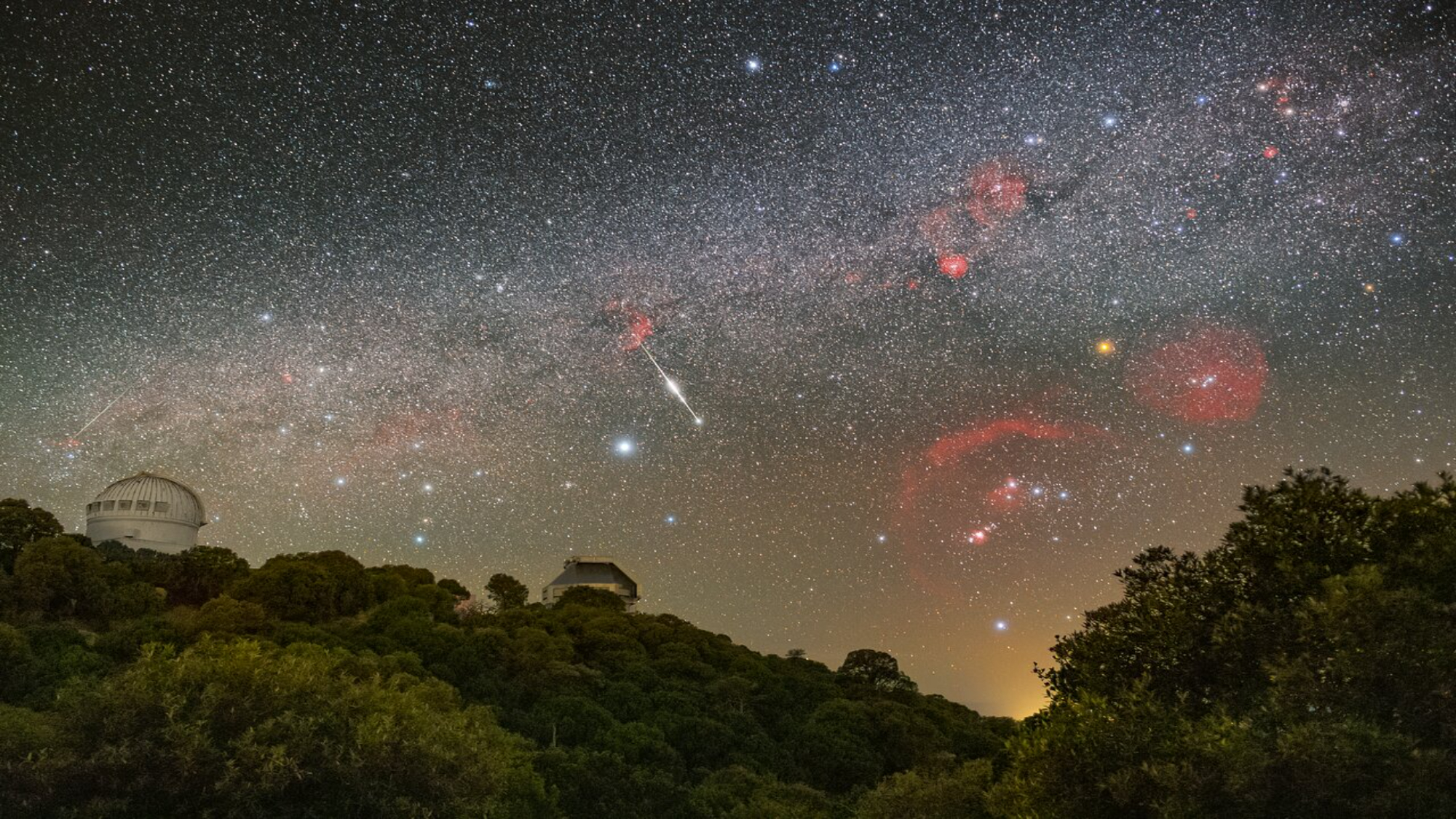

Searing across the night sky, a meteor puts on a spectacular show above a powerful observatory.
The meteor’s blaze was captured above the U.S. National Science Foundation’s (NSF) Kitt Peak National Observatory (KPNO).
What is it?
Petr Horálek, a NOIRLab Audiovisual Ambassador, captured this photograph of a meteor soaring above the KPNO, which is located on Kitt Peak in the Quinlan Mountains in the Sonoran Desert. The observatory is in southern Arizona, on the land of the Tohono O’odham Nation. KPNO is also part of the NSF’s NOIRLab (National Optical-Infrared Astronomy Research Laboratory).

In the image, you can see an observatory dome to the left of the bright meteor’s blaze. This is the dome of the WIYN 0.9-meter telescope, and to its right is the WIYN 3.5-meter telescope.
Above these scopes, the meteor is surrounded by quite an impressive view. The night sky in this image contains the constellations Orion and Canis Major, and you can even see some interesting bright red structures in the sky. These are emission nebulae, or clouds of ionized gas that emit light.
Why is it incredible?
It is no easy feat capturing an image of a meteor in motion. The brilliant streak is often visible for just a moment or two. Even if you are outside sitting and waiting and staring at the sky, the second you turn your head elsewhere you might miss it.
The most active meteor showers generate enough action to give you a decent shot of catching one in a photograph. But even in the best of circumstances, capturing a meteor in a photo this spectacular takes both serious skill and luck.
But Horálek didn’t just manage to capture a mid-streak meteor. The astrophotographer also framed the meteor with the tree line, the telescopes, and a fantastical backdrop of the night sky. That takes skill, luck and an artistic eye.