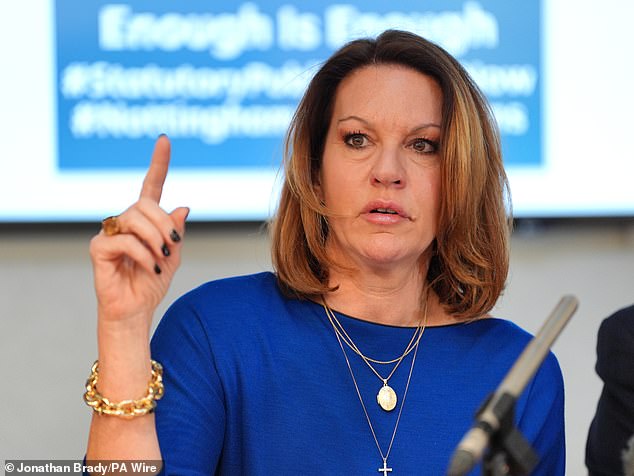
The mother of Nottingham stabbing victim Barnaby Webber has warned ‘difficult discussions’ need to be had over how authorities are influenced by racism, as she drew comparisons between her teenage son’s killing and the tragic murder of Henry Nowak.
For more than three months, Emma Webber has sat daily through a public inquiry into the circumstances leading up to the deaths of University of Nottingham students Barnaby, 19, and his friend Gracey O’Malley Kumar, also 19.
In the early hours of June 13, 2023, paranoid schizophrenic Valdo Calocane fatally stabbed the three innocent victims on Ilkeston Road in Radford.
Calocane, who was 31 at the time, then tried to break into a hostel before flagging down 65-year-old school caretaker Ian Coates, stabbing him to death and stealing his van.
The dual Guinea-Bissau and Portuguese national then drove the stolen van into three people waiting at a bus stop in the city centre, injuring them all and leaving one in critical condition.
Around an hour and a half into his unprovoked rampage, Calocane was found, Tasered, and arrested on suspicion of murder.
In January 2024, he was sentenced to indefinite detention at a high-security hospital after denying three counts of murder and instead pleading guilty to three counts of manslaughter on the basis of diminished responsibility and three further counts of attempted murder.
But nearly three years on, Barnaby’s grieving mother still finds herself asking how this incident came to be, with the inquest – which is due to end tomorrow – helping to shed light on the possible mishandling of Calocane by the police and mental health services.

Emma Webber, whose son Barnaby was stabbed to death by a paranoid schizophrenic in 2023, has called on authorities to take a new look at their anti-racism policies

Ian Coates, Barnaby Webber and Grace O’Malley Kumar was killed by a paranoid schizophrenic man with a history of violence

Valdo Calocane had been sectioned four times, but was free to carry out his bloody rampage in June 2023. A public inquiry is examining whether there were failings by the police and mental health services
The timing of the inquest coincides with this week’s sentencing of Henry Nowak’s murderer.
Southampton University student Henry was 18 when he was stabbed to death by knife-obsessed Vickrum Digwa, 23, with an eight-inch ceremonial dagger, last December.
Digwa, who is a Sikh, did not know his teenage victim, but lied to officers at the scene by claiming Henry shouted racist abuse, punched him and knocked off his turban.
Henry was then arrested as he lay covered in his own blood, before dying ‘alone, humiliated and handcuffed’ in police custody.
On Monday, Digwa was jailed for life with a minimum term of 21 years, after a jury found him guilty of ‘aggressively pursuing’ the student and stabbing him six times – including an 8cm deep chest wound.
While the motivations may have differed, Barnaby’s mother believes there is a common bond between the two cases – namely that police were so pre-occupied with racial bias that it stopped officers from properly assessing each situation.
She has called on authorities to take a new look at their anti-racism policies.
Speaking to The Telegraph, she said: ‘What we do need to do is be brave and have those really difficult discussions in this country.
‘[Calocane] was a black man who killed three white people and tried to kill another three white people, and that was never part of the conversation.
‘If it had been the other way round, it would have been.’
The inquiry previously heard the devastating killings in Nottingham were the result of ‘entirely predictable structural, systemic and individual failure’.
Mrs Webber said in an interview at the start of the inquest in March she ‘firmly believes Grace, Barnaby and Ian would still be here had those different officers over both forces done their jobs properly over all of those instances.’
Calocane had been sectioned four times in the three years before the stabbing but he was repeatedly released back into the community despite concerns about his deteriorating behaviour.
Examples of that included visiting MI5 headquarters demanding to speak with officials, and bringing a hammer to a hospital ward – as well as concerns he was not taking medication properly after being sectioned multiple times.
His behaviour was so troubling that a doctor warned in July 2020 that Calocane ‘will end up killing someone’, yet he was discharged two weeks later.
There were multiple occasions where police were involved after Calocane became violent – this included leaving a woman with a major back injury after she leapt from a first floor window to escape him.
Five students also moved out of their house share after becoming so concerned about Calocane’s violent unpredictability, the inquiry heard. But he never faced conviction until he struck in 2023.
Calocane’s mother repeatedly flagged her own concerns about her son’s behaviour, and he was sectioned four times.

Southampton University student Mr Nowak (pictured) was stabbed to death by Vickrum Digwa last December with an eight-inch ceremonial dagger
The Nowak case meanwhile has prompted claims of two-tier policing, with both the Conservatives and Reform UK suggesting Henry’s treatment was influenced by police guidance around racial bias.
Earlier this week, violence broke out in Southampton amid an outcry over the treatment of the 18-year-old.
Speaking at Prime Minister’s Questions on Wednesday, Leader of the Opposition Kemi Badenoch said Henry’s death must be a ‘wake up call’ as forces were urged to scrap ‘two-tier’ policing rules.
Meanwhile Reform UK’s Nigel Farage said ‘two-tier’ policing could not continue, and warned that Southampton riots were ‘in danger of getting worse’ unless the Government acts.
But Sir Keir Starmer said there was ‘no justification’ for the ‘disgraceful’ violence shown in the wake of Mr Nowak’s death and denied there was a ‘two-tier’ policing system.
Henry’s mother, Lucy Ross, father Mark Nowak and stepmother Katie Woodcock, met with the Prime Minister and Tory leader Kemi Badenoch during separate meetings on Thursday.
Ms Badenoch praised their ‘extraordinary courage’ and insisted the family want ‘common sense’ policing.
She said: ‘They have endured the most appalling loss, it is a life sentence for them.
‘They have also faced the agonising decision to release the harrowing body-worn camera footage, knowing how painful it would be and how strongly people would react.
‘They did so because they want truth, accountability and change. They have asked that we work across political parties and religions to rebuild trust in the police.
‘That trust has been broken because of what happened, and I agree with them on that.’
Mrs Badenoch added: ‘We must also be prepared to examine, carefully and seriously, religious practices or exemptions that permit the carrying of dangerous weapons in public, and other activities that are not conducive to the public good.
‘We also need to examine where the law needs to change. Henry’s family do not want anger to tear communities apart.
‘They are a family who have friends across faith and race, and so did Henry.
‘His family want his memory to help bring our society together. Everyone knows I have strong views about how we should deal with equality under the law.
‘What the family agreed with me on is that we need to bring common sense back, and that is what we should all be fighting for.’