



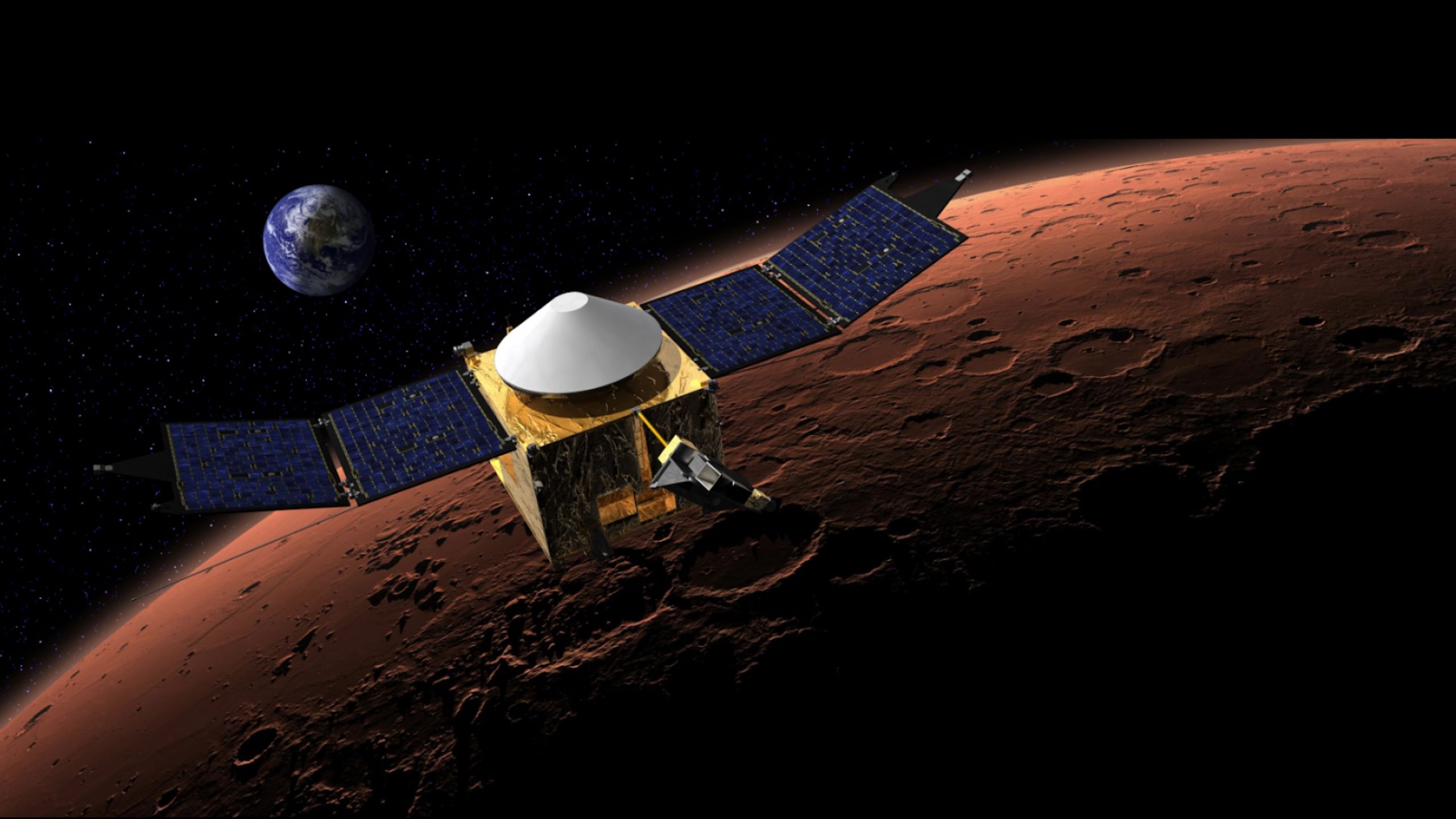
The Mars graveyard just welcomed another corpse.
On Wednesday (June 3), NASA officially declared its MAVEN orbiter dead, closing the book on a highly successful mission that studied the Red Planet’s atmosphere for nearly a dozen years.
The MAVEN team didn’t script this ending; the orbiter went dark without warning this past December, and it remained silent despite repeated attempts to hail it. But MAVEN’s ultimate fate would have been roughly the same even if its handlers had been able to shut it down in a controlled fashion.
“The nominal plan for disposing of the spacecraft at the end of its mission was just to leave it in that nominal orbit, where it would remain for a period of 50 to 100 years before entering the Martian atmosphere,” MAVEN Project Manager Mike Moreau, of NASA’s Goddard Space Flight Center in Greenbelt, Maryland, said during a press conference on Wednesday.
“So, the spacecraft’s basically in a configuration, in an orbit, that’s very similar to what it would have been if the mission had ended nominally,” he added.
And that’s what happens to dead Mars orbiters: They generally keep circling for a half-century or more, until the planet’s thin atmosphere drags them down and burns them up. Or the end could come considerably sooner, if they’re unlucky enough to slam into one of their brethren or into Phobos or Deimos, the two moons of Mars. (Indeed, MAVEN had to perform a maneuver in February 2017 to avoid a potential collision with Phobos.)
Some of these probes may already have been pulled down, considering the long timeline of Mars exploration. Here’s a brief rundown of the orbiter missions that have successfully arrived at the Red Planet to date:
- Mariner 9 (NASA; arrived November 1971)
- Mars 2 (USSR; November 1971)
- Mars 3 (USSR; December 1971)
- Mars 5 (USSR; February 1976)
- Viking 1 (NASA; June 1976)
- Viking 2 (NASA; August 1976)
- Phobos 2 (USSR; January 1989)
- Mars Global Surveyor (NASA; September 1997)
- Mars Odyssey (NASA; October 2001)
- Mars Express (European Space Agency; December 2003);
- Mars Reconnaissance Orbiter, or MRO (NASA; March 2006)
- Mars Orbiter Mission (India; September 2014)
- MAVEN (NASA; September 2014)
- ExoMars Trace Gas Orbiter, or TGO (ESA; October 2016)
- Emirates Mars Mission, or Hope (UAE; February 2021)
- Tianwen 1 (China; February 2021)
Only Mars Odyssey, Mars Express, MRO, TGO, Hope and Tianwen 1 remain operational today, meaning the orbital graveyard has up to a dozen bodies in it. (It’s tough to track unresponsive spacecraft in Mars orbit, so we generally don’t know which dead ones are still aloft.)
There’s a Mars graveyard on the surface, too. Among the many robots being buried by the wind-blown red dirt are NASA’s Spirit and Opportunity rovers, Ingenuity helicopter and Pathfinder lander (which Mark Watney finds and uses in the book and movie “The Martian“), and Zhurong, a rover that was part of China’s Tianwen 1 mission.
Just two Mars surface craft remain operational today: NASA’s Curiosity and Perseverance rovers, which landed in August 2012 and February 2021, respectively.
But let’s end with an appreciation of MAVEN (whose name is short for “Mars Atmosphere and Volatile Evolution”). The probe’s data has helped scientists better understand Mars’ dramatic transition from a relatively warm and wet world to the frigid desert we know today.
That change occurred because Mars lost most of its once-thick atmosphere. (The planet’s air is now just 1% as dense as that of Earth at sea level.) Thanks to MAVEN, we know that loss was driven by the solar wind and occurred between 4.2 billion and 3.7 billion years ago — around the time that life was getting started here on Earth.