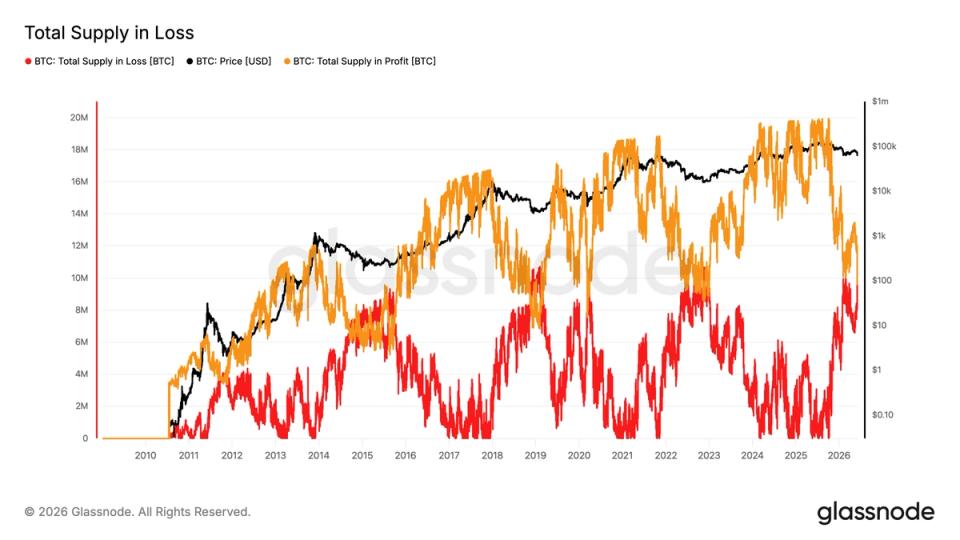
The amount of bitcoin supply in loss reached a key bear-market threshold, surpassing 10 million BTC, more than half of the total in circulation.
According to Glassnode data, at a one-hour resolution, the number peaked at about 10.5 million BTC as the price fell to as low as $61,300 on Thursday. Total circulating supply is roughly 20 million BTC, so more than half of all coins are currently held at an unrealized loss.
At the same time, supply in profit has declined to around 9.8 million BTC. This is the first time during the current market cycle that the amount of bitcoin held at a loss has exceeded the amount held in profit.
Historically, this transition has occurred only during deep bear-market conditions, and it has often coincided with major market bottoms.
Previous cycles provide some context.
During the 2015 bear market, supply in loss and supply in profit remained near equilibrium for almost a year before the market recovered. In 2019, the period lasted roughly six months. The Covid-driven capitulation in March 2020 was shorter, lasting around one month, and the 2022 bear market saw this condition persist for about six months.
The takeaway is that while this signal has historically aligned with bear-market lows, the duration of these periods has varied significantly, making it difficult to estimate how long bitcoin could remain at depressed levels.
Adding to the significance of the recent decline, bitcoin touched its 200-week moving average of around $61,300. The measure is a long-term trend indicator that calculates bitcoin’s average price over the previous 200 weeks. It has historically acted as a major support level during every bear market cycle.
Should bitcoin drop below the psychologically important $60,000 level, the next major support zone is around $54,000, which corresponds to the realized price. The realized price represents the average acquisition cost of all bitcoin in circulation based on the price at which each coin last moved onchain. Bitcoin has traded below its Realized Price during every major bear market.