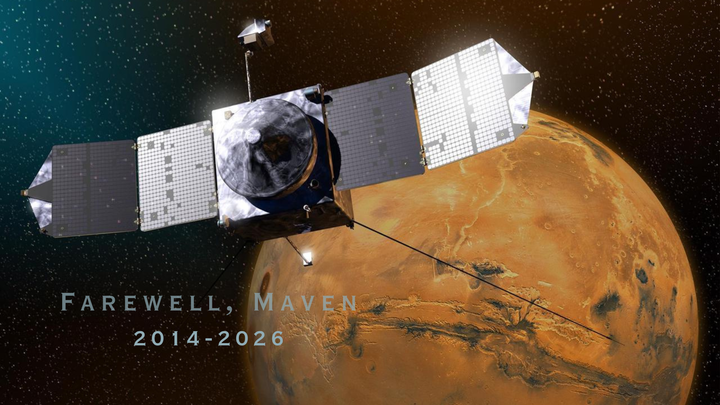
NASA is saying goodbye to one of its most accomplished Mars orbiters.
After months of repeated attempts to reestablish contact with the Mars Atmosphere and Volatile EvolutioN (MAVEN) satellite, NASA has declared the Red Planet probe dead. MAVEN’s last transmission was received on Dec. 6, by NASA’s Deep Space Network (DSN), before the solar-powered spacecraft’s orbit took it behind Mars. When it emerged on the other side, telemetry data showed the satellite had switched to safe mode and was tumbling in an uncontrollable spin that led to a loss of power, according to a NASA review board in February.
Efforts to communicate with MAVEN since then have been unsuccessful, according to an agency release, and NASA officials held a press briefing at today (June 3) to discuss the end of MAVEN’s mission. The cause of the satellite’s incident on the far side of Mars is still under investigation.
The announcement of MAVEN’s end brings a close to more than a decade of science and research. MAVEN launched on a United Launch Alliance Atlas V rocket in November 2013 and arrived in orbit around Mars 10 months later.
Shannon Curry, MAVEN’s principal investigator, described the probe as the “Best. Mars. Mission. Ever.” during Wednesday’s call. Mike Moreau, the MAVEN project manager, praised the team and said they, “really experienced the loss of a loved one with the end of the mission here.”
Curry agreed, but highlighted MAVEN’s many accomplishments. “The team was certainly broken up about this, but at the same time, we’re incredibly proud of the science we’ve accomplished over the last decade,” she said, and called MAVEN, “the best observer of atmospheric escape anywhere in the solar system.”
MAVEN’s anomaly review board concluded that the probe likely lost power within hours of its incident in December, “causing the communication system to eventually lose power and rendering the spacecraft in an unrecoverable state,” Moreau said, and added, “the anomaly review board is continuing to perform their work to determine the root cause for the failure.”
Its original mission was planned to last just one Earth year, but was extended for another 10 as it continued nominal operations. MAVEN’s loss leaves only two NASA probes in operation in Mars orbit — the Mars Odyssey spacecraft, which launched in 2001, and the Mars Reconnaissance Orbiter (MRO), which lifted off in 2005. Both of those probes are also operating well beyond their original mission lifetimes.
MAVEN was also one of five spacecraft that NASA used as a communications relay for rovers on the Martian surface. The other four, which remain active, are Odyssey, MRO and Europe’s Mars Express and Trace Gas Orbiter spacecraft.
MAVEN was the first probe equipped with instrumentation to study the evolution of Mars’ atmosphere and its interaction with the solar wind. The mission supplied data that led scientists to new discoveries, even after the orbiter fell silent.
“The data collected from MAVEN will continue to provide valuable insight into Mars for decades to come,” said Louise Prockter, director of NASA’s Planetary Science Division, in the agency’s announcement.
“We have so much to learn from the data set that we’re about to get ready to archive,” Curry said.

Watch On
Editor’s note: This story was update at 3:50 p.m. EDT (1950 GMT), on Wednesday, June 3, to reflect statements from NASA and MAVEN officials during the press briefing to announce the mission’s end.