



There is a reason treasurers love high immigration, even when they pretend otherwise: it makes the economy look better than it really is.
Immigration masks the economic failures of the political class. It is the great Australian illusion.
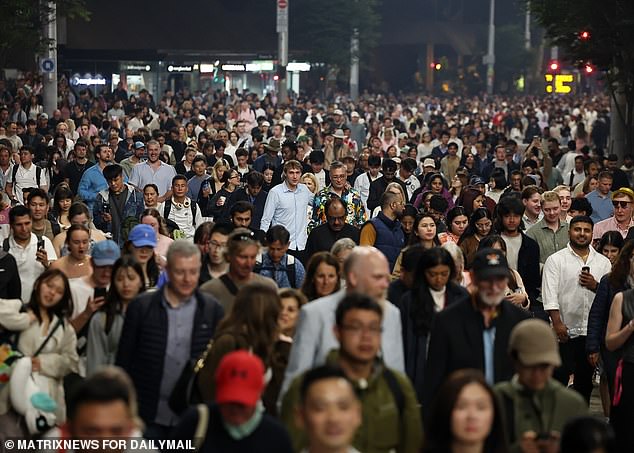
Australia’s population has just hit 28million, driven by years of record high immigration rates.
This milestone highlights the basic trick at the heart of our economic debate. High immigration lifts aggregate GDP because more people means more workers, consumers, and taxpayers.
But a bigger economy does not necessarily mean the average Australian is better off.
In fact, Australia recently endured a per capita recession, which means the economy grew in total, but shrank when measured person by person.
It’s the reason you can feel poorer when the economy is still growing. It’s growing because of immigration.
Which is why it has become a highly useful political instrument.

Australia’s population has just hit 28million, driven by years of record high immigration rates

New data has revealed Australia will have a total net overseas migration of 1.2million people between 2025 and 2030. Pictured are travellers at Sydney International Airport
It allows governments to boast about growth while avoiding hard conversations about stagnating living standards requiring serious reforms.
Worse, immigration has become a substitute for genuine reform and a cover-up for systemic failures.
Instead of doing the hard work of reform (and I’m not talking about election lies that give way to more tax grabs like we are seeing right now in the CGT and negative gearing spaces), governments use migration to mask weak productivity by simply adding more workers rather than improving output per worker.
It also hides domestic skills shortages by importing labour instead of fixing education, vocational training, and workforce planning.
And it delays genuine budget repair by relying on a steady stream of new taxpayers rather than restructuring spending or the wider tax system.
No wonder Treasurer Jim Chalmers won’t address his addiction to bracket creep. With all the new tax-paying migrants arriving each year, why would he?
For treasurers, the temptation is obvious.
Migrants tend to arrive younger, work, pay income taxes, consume goods and services, rent homes, and in the short term draw less heavily on age-related spending than older Australians, thereby softening the blow of an ageing population.

Success should not be judged by headline GDP figures, but by whether immigration improves per capita prosperity, housing affordability, and workforce capability

We need an honest migration policy, not a fiscal anaesthetic, Daily Mail political editor Peter van Onselen (pictured) writes
More new citizens also makes debt, deficits and spending look more manageable against a larger GDP base.
Which is why immigration is so attractive to governments. It boosts revenue, flatters economic growth results, and softens the fiscal pressure of an ageing population without requiring the harder work of tax reform, spending restraint or productivity growth.
Australia has tried to run a high-migration model without doing the hard governing required to make it sustainable for many years now.
A country with abundant housing, efficient training institutions, and rising productivity can absorb rapid population growth easily enough.
It can even become more prosperous because of it, including on a per capita basis.
But a country with housing shortages, infrastructure bottlenecks, and anaemic productivity can’t, and that’s us.
Turning up the migration tap is simple and easy for lazy politicians, or at least it was.
The politics is becoming harder as more Australians wake up to the fiscal trick, realising that the underlying pressures high immigration rates can add to are accumulating.
We invite large numbers of people into a housing market that is already under-supplied and over-regulated, then act surprised when rents soar and vacancy rates plummet.
The government reaps the budget benefits early when it comes to higher immigration, while the public pays the social cost later on.
This is not an argument for shutting the door on new citizens.
Australia needs skilled workers, population renewal, and a well-designed migration system. There is no doubt about that. However, we need an honest migration policy, not a fiscal anaesthetic.
Success should not be judged by headline GDP figures, but by whether immigration improves per capita prosperity, housing affordability, and workforce capability.
Voters live per capita lives, paying rent per household and experiencing congested infrastructure personally.
Until governments align migration with housing supply (something the Coalition has recommended doing) and genuine skills needs, the public will rightly continue to reject the illusion that a bigger Australia is automatically a better one.