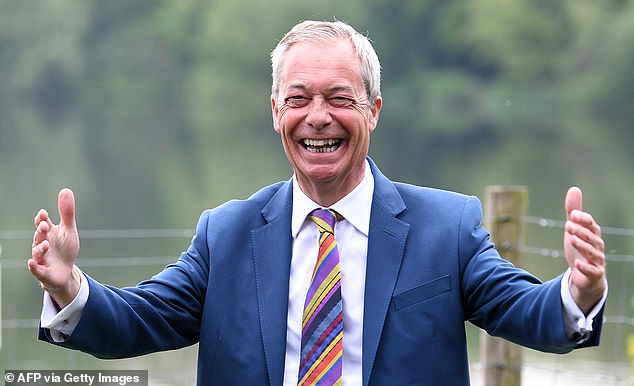
Reform winning the next election is growing more likely because the party’s backers are driven by ideology rather than protest, the UK’s leading pollster said yesterday.
Professor Sir John Curtice said his latest analysis was that the insurgent party’s supporters are a ‘coalition’ of people with ‘distinct socially Conservative views’.
It means turning around the state of the sluggish economy or improving the NHS ‘might help’ Labour but is ‘unlikely to be sufficient’ to stop Reform’s momentum.
While he predicted the party’s popularity is unlikely to surge much above 30 percentage points, he said this could be ‘a potentially winning number’ at the next election because UK politics is so fragmented and would still represent as much as a nine or ten point lead over Labour or the Tories.
He also said Reform has been eating the Tories for ‘breakfast, lunch and dinner’ in terms of peeling off Right-leaning voters.
Reform is hovering around 26 to 27 percentage points, Labour 17 to 19 and the Tories 18 to 19 in current polls.
It came as the veteran pollster launched the latest British Social Attitudes (BSA) survey, which has studied whether support for Nigel Farage’s insurgent party is just a ‘protest vote’ or whether its growth is based on firmer foundations which could last.
It comes after Reform won 1,450 council seats at last month’s local elections, including hundreds in Labour’s traditional heartlands in the Midlands and North.

Nigel Farage becoming the next Prime Minister is growing more likely because Reform voters have a ‘distinct’ set of beliefs and aren’t just ‘protest’ voters, pollster Professor Sir John Curtice has said
Sir John said: ‘There’s an element of support for Reform that seems to be a question of protest.
‘But it’s not simply a protest. Rather, it’s a group of people who are ideologically very, very distinct with very socially Conservative views.’
He said one of these was support for Brexit in the 2016 referendum to leave the European Union, which was ‘motivated by cultural questions of national identity, immigration, and pride in British history’. Around half of Reform backers would vote to remain outside of the EU, the research found.
But he said perceived zealotry or ‘wokery’ around issues such as trans rights and Net Zero had also driven more people towards Mr Farage’s party, adding: ‘This is the coalition of people who voted Conservative in 2019 for Boris Johnson to get Brexit done.
‘But they’ve now switched to Nigel Farage and Reform.
‘All of this suggests that, while turning around the economy and the NHS might help the current government to try to reduce the level of support for Reform, it’s unlikely to be sufficient at the end of the day.
‘The future of Reform, and whether it continues its current levels of support, even becomes more popular or not, depends very much on the ability of other political parties to appeal by one means or another to this relatively socially Conservative section of British society, which at the moment, at least, is very, very distinct.’

Pollster Professor Sir John Curtice said Reform voters’ ‘distinct’ set of beliefs were rooted in ‘socially Conservative’ ideas about migration, Net Zero and transgender rights

Sir John also said a huge proportion of Reform voters supported Brexit in the historic 2016 vote to leave the EU and would vote to stay outside the bloc
The BSA survey found Reform supporters were more dissatisfied with the state of the country and their personal circumstances than other voters.
Some 60 per cent of Reform voters were ‘very dissatisfied’ with the NHS, compared to 51 per cent of the general public, while 27 per cent said they were ‘struggling’ on their current household income – five points more than the figure for the general public.
But they stood out far more on cultural issues, with 75 per cent saying migrants undermined Britain’s culture. Just 35 per cent of the general public said the same.
Some 88 per cent said equal opportunities for transgender people had gone too far and 78 per cent said benefits for the unemployed were too high.
The figures for the general public were 48 per cent and 60 per cent respectively.
The research found Reform backers were more likely to be older, male and less likely to have gone to university.
Sir John added that the best way for the Tories to try and win back Right-leaning voters would be on the economy, as Reform are ‘not necessarily regarded for their perceived ability to handle the country’s economy’.
He added: ‘It is not obvious that the Labour Party is particularly well placed itself to meet the challenge from Reform in terms of votes.
‘If these folk are going to leave Reform, given their history, they are more likely to go back to the Conservatives than they are to Labour.’
The BSA survey, carried out annually since 1983 by the National Centre for Social Research, surveyed 4,656 people across the UK. The most recent version took place between August and October 2025.